C Section Recovery Timeline: A Realistic Week-by-Week Guide
You've made it home with a newborn, a healing incision, and a body that feels unfamiliar. Getting out of bed may require planning. Walking to the bathroom can feel like a major event, while lochia, abdominal soreness, fatigue, and the need for pain relief compete for your attention. If you're wondering whether your recovery is “on track,” you're not alone.
A c section recovery timeline isn't a countdown to one perfect day of healing. It's a progression through changing milestones: safer movement, manageable bleeding, improving scar mobility, better abdominal load tolerance, and a pelvic floor that can respond without pain, leaking, or heaviness. Most guidance describes the core physical recovery window as about 6 weeks, but follow-up contact within 3 weeks and a postpartum visit by 12 weeks show that recovery is treated as a staged process, not a single endpoint. (NHS cesarean recovery guidance)
The First Hours After a Cesarean Birth
Your first trip to the bathroom may involve a nurse, an IV pole, and a cautious shuffle. As the anesthesia wears off, your legs may feel unfamiliar. Sitting up can pull at the incision, and the heaviness of lochia may make you pause before standing. These sensations reflect the combined effects of surgery, birth, medication, and reduced movement. They do not indicate personal weakness.
During the first 24 to 72 hours, care focuses on pain control, circulation, bleeding, hydration, food as tolerated, and gradually restoring normal body functions. Early mobility commonly starts within 24 hours, with ankle movements, sitting, standing, and short assisted walks rather than exercise. (NHS cesarean recovery guidance) A hospital stay typically lasts about 2 to 3 days, although your health, your baby's needs, and the facility can change that timing.
What matters on day one
- Breathing: Use slow, comfortable breaths into your ribs and abdomen. Stop short of forcing a breath that increases pain.
- Circulation: Ankle pumps and brief walks help your body adjust after time in bed.
- Bowel function: Passing gas suggests that digestion is beginning to recover after surgery.
- Incision awareness: Watch for increasing redness, drainage, separation, or pain. Repeated touching is unnecessary.
- Lochia: Bleeding is expected after birth. Sudden heavy bleeding or a concerning odor requires medical advice.
Support your incision with a pillow or folded blanket when coughing, laughing, or changing position. Your abdominal muscles do not need a workout yet. Each supported movement gives your nervous system information that changing position and walking can be safe.
The first milestone is not distance or speed. It is tolerating small tasks without a clear increase in pain, bleeding, dizziness, or incision pulling afterward. Rest between efforts, accept help, and follow your obstetric team's instructions.
Gentle personal care may also help you feel more connected to yourself during this unfamiliar period. Guidance on postpartum self-care with SEYANTE can complement, but never replace, medical advice.
Why Cesarean Recovery Happens in Stages
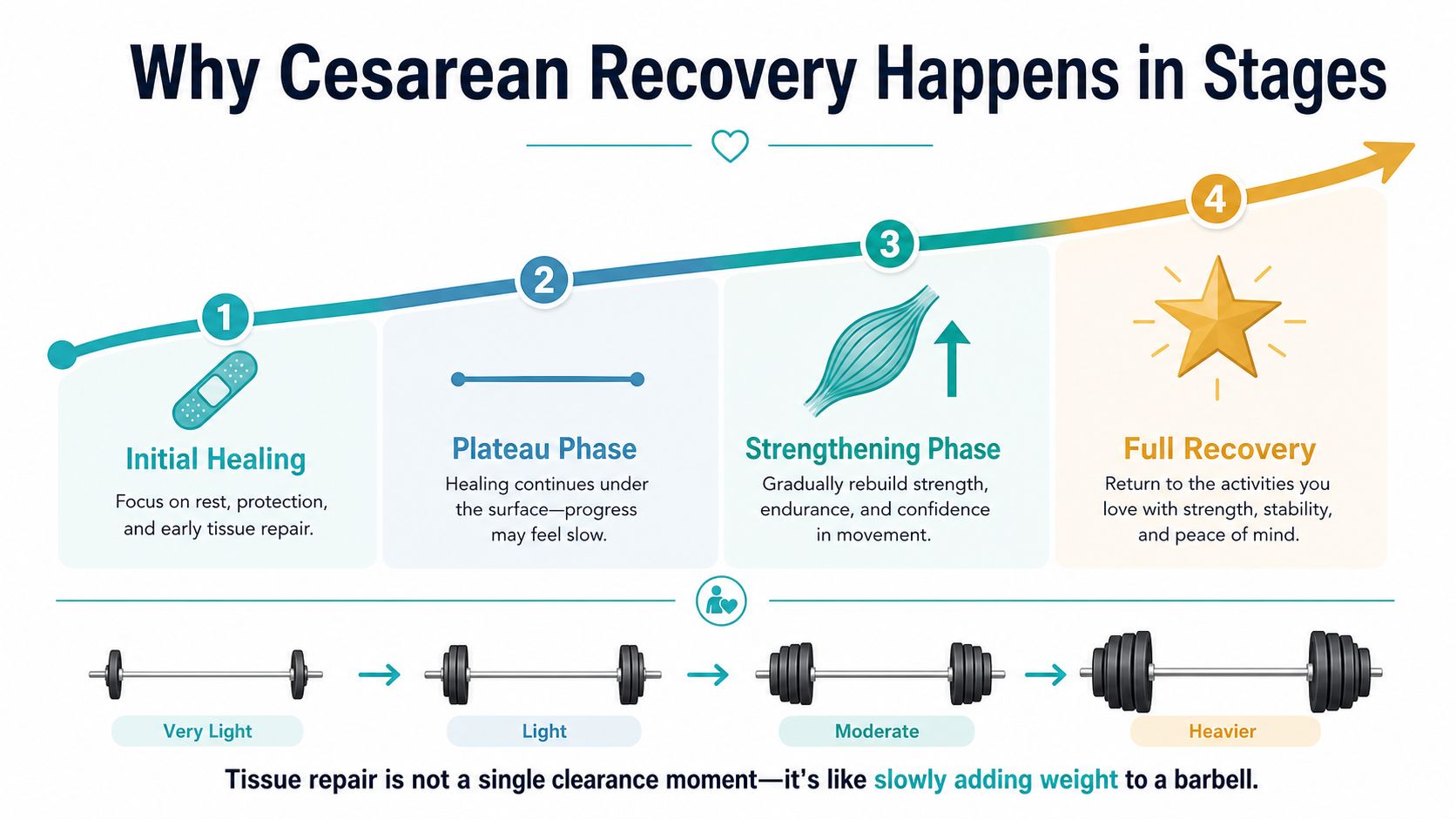
A closed skin incision is like the surface of a repaired road. It may look finished before the deeper layers can tolerate traffic. After a cesarean, the skin, abdominal wall, connective tissue, uterus, pelvic floor, and nervous system don't recover at the same speed.
That's why a clearance appointment shouldn't be treated like a starting gun. It's better understood as permission to test the next level of load, then observe how your body responds. If walking causes more bleeding, pain, pelvic pressure, or abdominal pulling later that day, the activity was too much for that stage, even if the movement itself felt manageable.
The milestones that shape recovery
Think of the timeline as overlapping phases:
- Immediate postoperative recovery: Pain control, breathing, circulation, bowel function, and supported transfers come first.
- Days 1 to 14: The foundation is short walking, incision protection, prescribed medication use, rest, and basic reconnection with the abdominal and pelvic floor muscles.
- Weeks 2 to 6: Daily function improves, but the week-three plateau can expose how much healing remains beneath the surface.
- The six-week check and weeks 6 to 12: Medical assessment guides a gradual return to exercise, intimacy, lifting, and more demanding household tasks.
- Months 3 to 6: Strength, impact tolerance, scar mobility, and pelvic floor coordination become the focus.
- Long-term recovery: Residual numbness, sensitivity, pulling, or movement limitations deserve attention if they continue affecting your life.
Clinical guidance supports this distinction between surface healing and deeper recovery. One NHS hospital advises daily walking early on, avoiding prolonged standing and lifting beyond the baby, and delaying more physically active exercise until at least 3 months after surgery. (Plymouth Hospitals post-cesarean guidance)
Practical rule: Advance by response, not by the calendar. A milestone is useful only when your symptoms remain stable during and after the activity.
Days 1 to 14 After Surgery
The first two weeks are a foundation layer. Your job is to calm irritation and rebuild basic movement, not to regain fitness. Each small task should leave the incision and your energy level reasonably settled afterward.
Take pain medicine exactly as prescribed instead of waiting until discomfort is difficult to control. Guidance notes that many patients need medication for 1 to 2 weeks, while regular activities may take 4 to 8 weeks to feel manageable. (MedlinePlus cesarean recovery instructions) If you're breastfeeding, ask your clinician which medications are appropriate for you.
Log-roll technique and short walking intervals
To get out of bed, roll onto your side, lower your legs, and push up with your arms. This log-roll keeps your trunk moving as one unit, rather than asking the abdominal wall to perform a straight sit-up. For sit-to-stand, bring your feet underneath you, exhale gently, and use your hands on the bed or chair when needed.
Walk in short, frequent bouts around your home. Stop before the incision begins to throb, your breathing becomes strained, or your posture collapses. Daily walking is encouraged in hospital guidance, while prolonged standing and lifting beyond the baby should be avoided. (Plymouth Hospitals post-cesarean guidance)
Keep the incision clean and dry according to your discharge instructions. Do not apply creams, oils, or scar products to an open or draining wound. Once it is fully closed and your provider approves touch, a clinician can guide you through C-section scar massage. Early scar work should feel gentle, not like pressing through resistance.
Signs that need prompt medical advice
Contact your provider for fever, increasing or severe pain, heavy bleeding, foul-smelling discharge, calf tenderness or swelling, breathing difficulty, wound drainage, or incision separation. These symptoms need medical guidance rather than casual observation.
For background on infection-prevention principles, see how to lower SSI rates with evidence, while following your surgical team's instructions first. Rest is active treatment during this stage. Accept help with meals, laundry, bathing, and infant care so your body can direct more energy toward repair.
Weeks 2 to 6 and the Week 3 Plateau
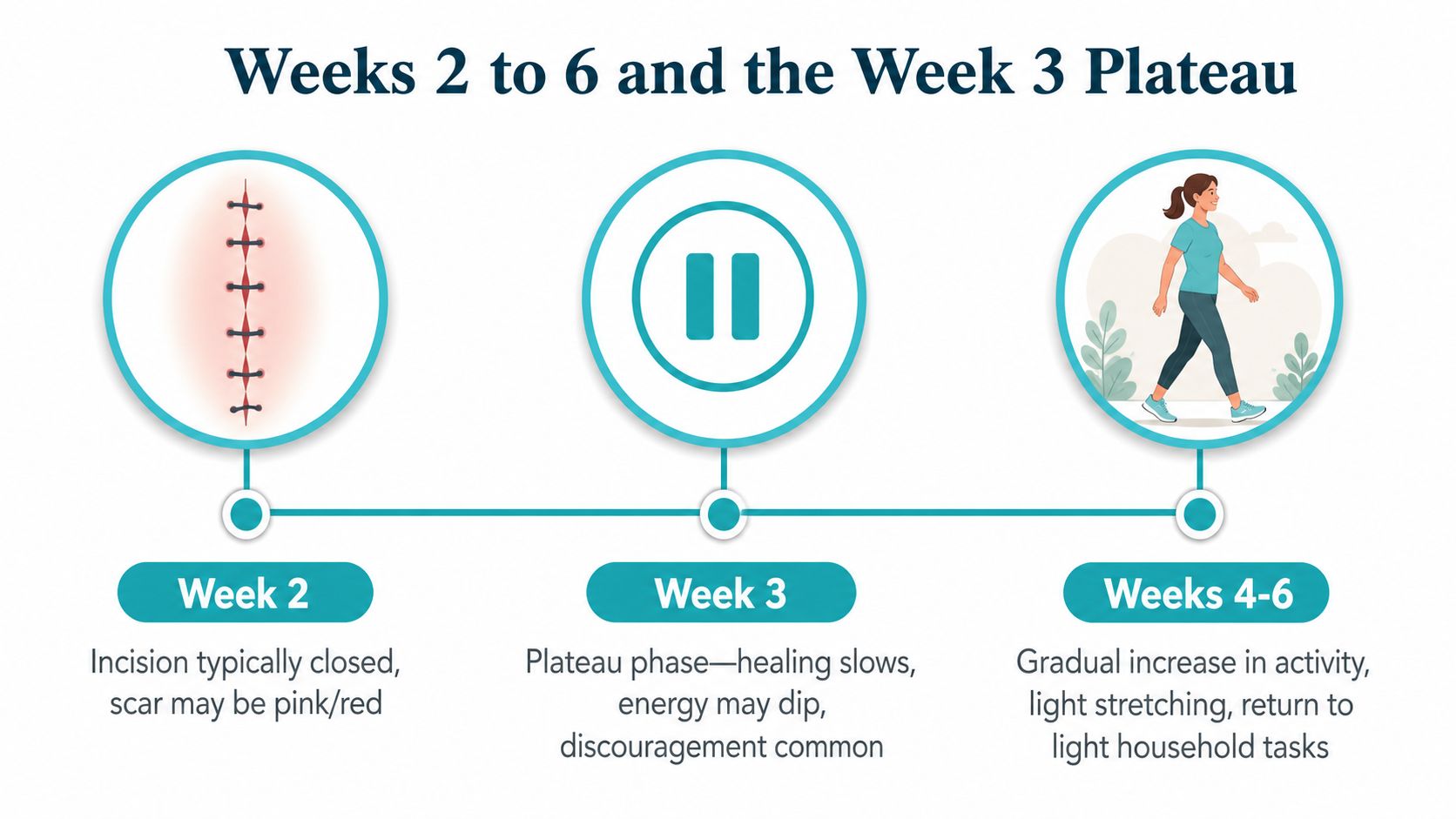
Week two can bring an unexpected shift. The incision may be closed, adhesive strips may have dissolved or been removed, and you may suddenly feel more capable. That improvement is encouraging, yet it can tempt you to catch up on chores, stand too long, or carry more than healing tissues can tolerate.
The recovery timeline consists of overlapping phases. Bleeding patterns, walking tolerance, scar comfort, and pelvic floor control may improve at different speeds. A stronger day does not mean every layer is ready for a heavier workload.
Week three may feel emotionally discouraging. A 2025 PubMed study found that patient-reported general health and vitality after scheduled cesarean delivery plateaued around week three, meaning the largest perceived improvement occurred early while later gains became slower and more incremental. (2025 PubMed study on recovery after scheduled cesarean delivery)
How to read the signals
Lochia often changes from red toward pink and then brown as bleeding gradually decreases. Activity can make it vary. A temporary increase after doing more suggests reducing your pace, while a sudden substantial increase, foul odor, or worsening pain should prompt a call to your provider.
Your scar may become flatter and less raised while remaining numb, itchy, tender, or tight. Walking can lengthen gradually, sometimes reaching 15 to 20 minutes when symptoms stay calm. This is an example of expanding capacity, not a required target.
Pelvic floor symptoms also belong in this check-in. Pressure, leaking, difficulty emptying your bladder or bowels, or pain with movement may indicate that pelvic health physical therapy would help assess breathing, abdominal pressure, scar mobility, and load tolerance.
Avoid lifting more than your baby plus a car seat until your provider clears greater loads. Brace the incision with your hand or a pillow when coughing or laughing. If the wound opens, drains, becomes increasingly red, or develops worsening pain, seek prompt medical advice.
The plateau does not mean recovery has stopped. It often means the fast early changes are over, while deeper tissue remodeling and load tolerance continue at a steadier pace.
The 6 Week Visit and Weeks 6 to 12
At six weeks, you arrive still carrying laundry, feeding a baby, and testing whether your body tolerates a longer day. The visit is a checkpoint, not a finish line. Your clinician may assess uterine recovery, incision integrity, bleeding, mood, contraception, pain, and readiness for more activity.
Follow-up can happen earlier and continue through the first 12 weeks, so care does not need to depend on one appointment. Use the visit to discuss function: how long you can walk, whether lifting increases symptoms, and whether your scar or pelvic floor limits daily tasks.
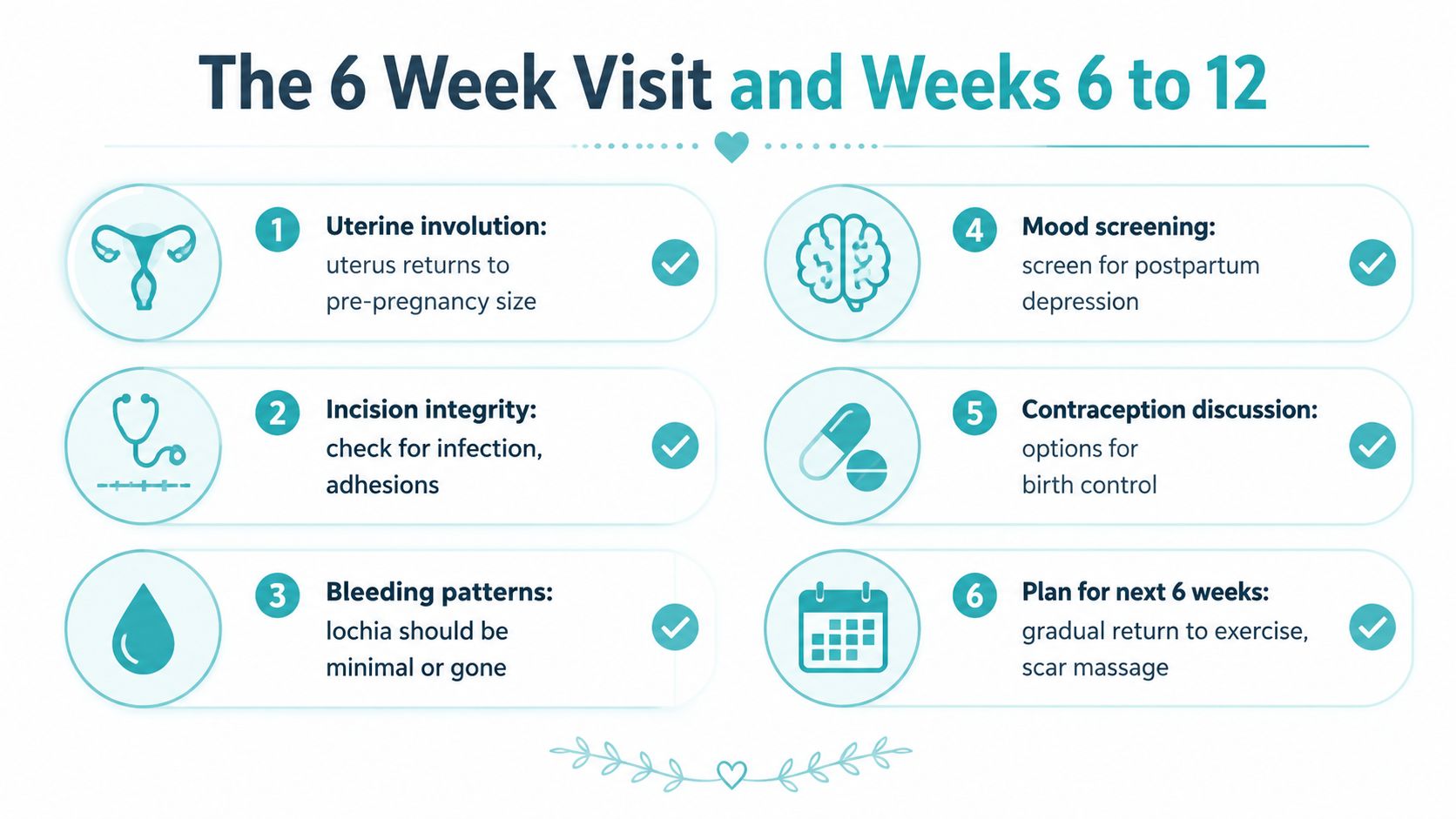
Medical clearance means progression may be reasonable when your symptoms and examination support it. It does not require an immediate return to previous workouts, heavier lifting, or sexual activity.
Build capacity by symptoms
Begin with diaphragmatic breathing, pelvic tilts, gentle walking, and low-effort abdominal connection. Your abdomen should engage without breath-holding, doming, or increased scar pain. Add supported squats, modified lunges, and controlled upper-body work only after walking feels steady.
Change one variable at a time, such as duration, repetitions, resistance, or speed. If bleeding increases, pelvic pressure appears, or pain lasts after exercise, reduce the workload. Capacity grows like a dimmer switch, not an on-off switch.
Pelvic health PT can assess persistent leakage, pelvic heaviness, painful intercourse, abdominal pain, or difficulty rebuilding strength. An abdominal separation that remains functionally limiting beyond 12 weeks also merits evaluation. The calendar offers a frame, while bleeding, load tolerance, scar comfort, and pelvic floor symptoms determine the next step.
Scar Mobility and the Pelvic Floor Connection
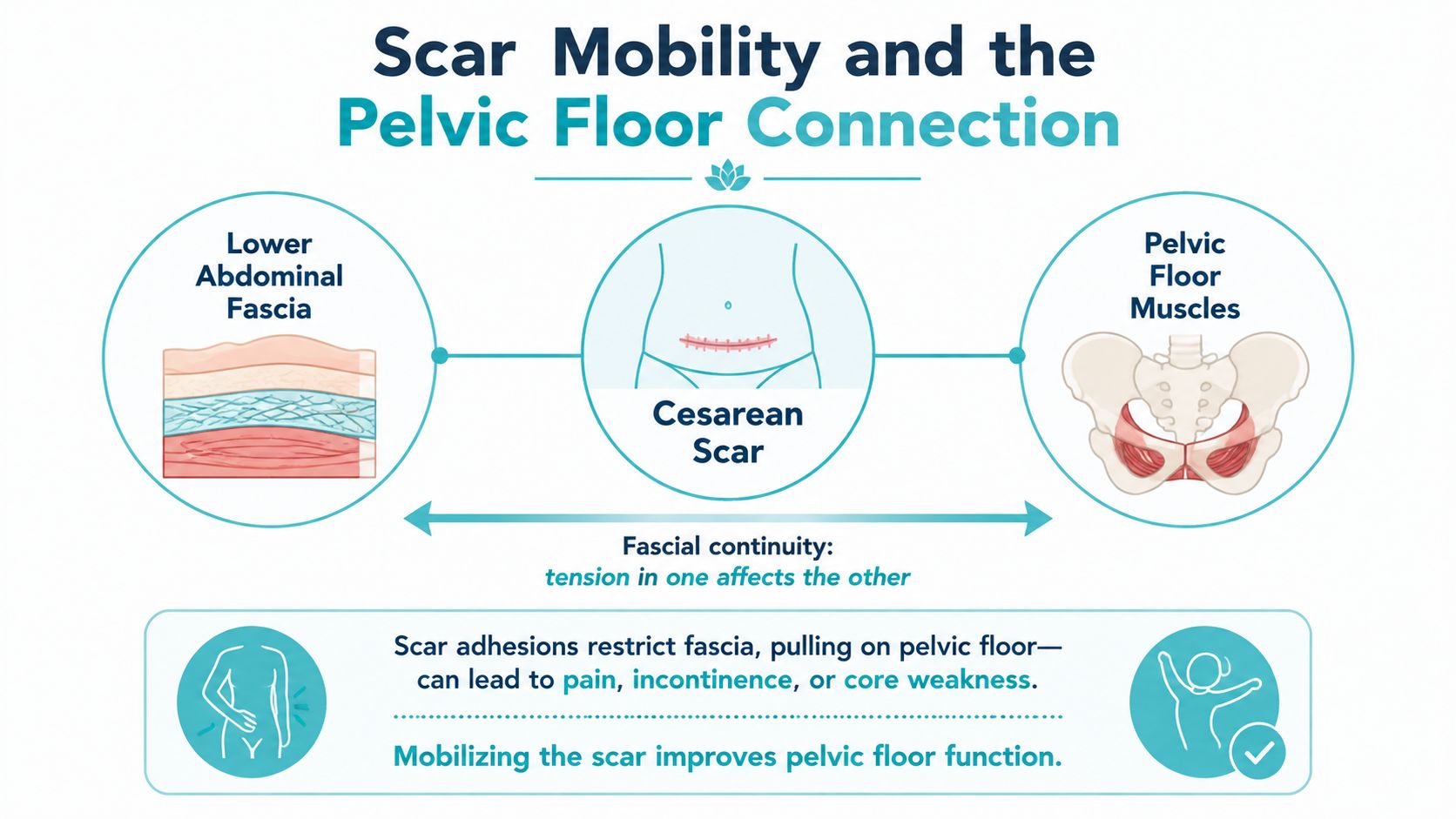
The scar isn't only a line on the skin. It sits within layers of skin, connective tissue, abdominal wall, and deeper structures that must glide as you breathe, roll, stand, walk, and lift. When scar tissue feels tethered, you may notice pulling across the lower abdomen, restricted trunk rotation, low back discomfort, or a sensation that movement is being held from below.
The abdominal wall and pelvic floor also coordinate pressure. When you cough, lift, or rise from a chair, the diaphragm, abdominal muscles, and pelvic floor respond together. A sensitive or restricted scar can change how you brace, while pelvic floor overactivity can make abdominal movement feel guarded. This relationship doesn't mean every bladder or sexual symptom comes from the scar, but it explains why a pelvic health clinician assesses both regions rather than treating the incision in isolation.
Gentle mobility after closure
Don't massage an open, draining, or infected wound. Once the incision is fully closed and your medical team has cleared touch, begin around the scar with light circular contact. Later, a clinician may teach direct mobility using two fingers to move the tissue gently upward, downward, and side to side.
The goal is not to break tissue forcefully. It's to improve comfort, sensory tolerance, and glide while observing how your body responds. Stop if you develop sharp pain, increased bleeding, wound irritation, or symptoms that persist after the session.
For general information about how to reduce scars naturally, remember that topical products shouldn't replace wound assessment or individualized rehabilitation. If the scar limits movement or contributes to pelvic symptoms, cesarean scar treatment can address the abdominal wall and pelvic floor together.
Months 3 to 6 and Long Term Recovery
By the third month, many people can begin shifting from basic mobility to structured strengthening, provided bleeding has stopped, the incision is fully healed, and abdominal or pelvic symptoms remain controlled. The difference from the early weeks is not just that you can do more. You're now testing load, impact, speed, and coordination in a planned order.
| Phase | Typical activities | Key criteria to advance | Watch for |
|---|---|---|---|
| Month 3 | Bodyweight squats, modified lunges, coordinated hip hinging | No increase in pain, bleeding, heaviness, or abdominal doming | Scar pulling, breath-holding, pelvic pressure |
| Months 4 to 5 | Cycling, swimming, elliptical intervals, progressive strength | Comfortable repeated sessions with stable symptoms afterward | Leakage, deep pelvic pain, worsening fatigue |
| Months 5 to 6 | Run-walk preparation, sport-specific drills, heavier resistance as tolerated | Pelvic floor control, abdominal bracing, and impact tolerance remain steady | Urine leakage, bulging, incision sensitivity, pain |
| Long term | Running, lifting, and full recreational activity when appropriate | Gradual progression guided by function and recovery response | Persistent numbness, twinges, tethering, or fear of movement |
Walking is primarily a duration and recovery challenge. Running adds repeated impact. Lifting adds load and intra-abdominal pressure. Sport adds speed, reaction, and unpredictable positions, so passing one stage doesn't automatically qualify you for the next.
Numbness, sensitivity, and occasional twinges can continue for many months, sometimes up to a year, while scar and nerve sensations evolve. (NHS cesarean recovery guidance) Persistent or worsening symptoms deserve assessment rather than forced acceptance.
When Pelvic Health Physical Therapy Makes the Difference
Pelvic health PT isn't a last resort. It's a precision assessment for symptoms that a routine postpartum check may not fully explain. You don't need to wait until the end of the first six months if your body is giving you clear signs that a movement system isn't coordinating well.
Consider referral when you have:
- Persistent pelvic pain: Pain with walking, lifting, sitting, or intercourse deserves attention, especially when it continues beyond the early healing period.
- Leakage: Urine or stool leakage that hasn't resolved by around week eight is a reason to ask for help, not a normal condition to tolerate indefinitely.
- Heaviness or bulging: Pressure in the vagina, a dragging sensation, or a bulge can indicate pelvic floor dysfunction and should be evaluated.
- Abdominal separation with coning: Doming or coning during ordinary tasks may show that pressure management and abdominal coordination need retraining.
- Scar restriction: Pulling, itching, pain, reduced trunk rotation, or a tethered sensation can respond to scar and movement treatment.
A pelvic floor assessment can include breathing mechanics, abdominal wall function, hip strength, posture, movement patterns, scar mobility, and pelvic floor coordination. An internal assessment may be considered once the incision is closed and your medical provider has cleared you, but you can begin discussing symptoms before that point.
For individualized postpartum rehabilitation, pelvic floor physical therapy postpartum can help connect symptoms to a practical plan instead of relying on a standard clearance date.
Lake City Physical Therapy provides women's health and postpartum rehabilitation focused on pelvic floor function, abdominal recovery, scar mobility, and a safe return to activity. Visit Lake City Physical Therapy to explore care options, schedule an evaluation, or find support for the specific symptoms affecting your recovery.

