Physical Therapy for Urinary Incontinence Guide
For women with stress urinary incontinence, pelvic floor muscle training made participants eight times more likely to report a cure than no treatment or an inactive control, according to a 2018 Cochrane review. That result points to an important distinction: physical therapy for urinary incontinence isn't just a set of Kegels. The right plan depends on what triggers the leak and whether your pelvic floor needs more strength, better timing, more ability to relax, or a combination.
Leak Types and What Therapy Can Change
Three patterns help make sense of leakage. Stress incontinence means urine escapes with a cough, sneeze, laugh, lift, run, or jump. Urgency incontinence means a sudden, strong need to urinate followed by a leak before you reach the toilet. Mixed incontinence combines both.
A 2018 Cochrane review of 31 trials involving 1,817 women found that, for stress incontinence, women assigned to pelvic floor muscle training were eight times more likely to report being cured than women receiving no treatment or an inactive control. When cure and meaningful improvement were combined, they were about six times more likely to report benefit. Across women with stress or any type of urinary incontinence, training reduced leakage by about one episode per day; for stress incontinence, the average reduction was 1.23 episodes per day in seven trials involving 432 women. Symptoms and quality of life also improved, though outcomes differed with adherence, program design, and symptom type and severity.
| Pattern | Usual trigger | First therapy focus | What evidence shows |
|---|---|---|---|
| Stress | Cough, sneeze, laugh, lift, run, or jump | Supervised pelvic floor training and a pre-squeeze, called the knack, before pressure | About eight times more likely to report cure; 1.23 fewer episodes a day in the Cochrane review |
| Urgency | Sudden strong urge and leakage on the way to the toilet | Bladder training and urge-suppression skills, with pelvic floor work | Training habits and muscle control together targets urgency and accidents |
| Mixed | Both pressure leaks and urgency | Supervised training alongside bladder training | Addresses support and urgency; the leading symptom helps shape the plan |
| With stage 1 or 2 prolapse | Heaviness plus leaks | Supervised training for at least 16 weeks as a first option | A non-surgical start before other treatments are considered |
The findings aren't a promise that every person will be cured. They show why a structured, supervised program can be a meaningful first treatment, especially for stress leaks. A separate 2024 Cochrane review compared pelvic floor training approaches across 63 trials involving 4,920 women, while a 2025 systematic review in Supportive Care in Cancer found that 13 of 20 randomized trials reported significant improvements in continence recovery or symptom severity with structured, supervised training. These reviews look at different questions and groups, but both reinforce that how training is delivered matters.
If your symptoms began after pregnancy, bladder leakage may coexist with back or pelvic discomfort. Restore Osteopathic Medicine's postpartum pain guide offers related information about postpartum recovery. For more on possible contributors to bladder leaks, see Lake City Physical Therapy's overview of what causes urinary incontinence.
A useful first step is to identify the leak that most affects you. Does it happen during a jump, on the way to the bathroom, or in both situations? That clue can guide a conversation with a clinician, but it can't replace an assessment, particularly when pain or trouble emptying is also present.
Weakness Is Not the Only Muscle Problem
A leak doesn't automatically mean your pelvic floor is weak, and more squeezing isn't always the answer. The 2025 Cochrane review of pelvic floor muscle training and biofeedback notes that weakness can contribute to incontinence and prolapse, while pelvic floor overactivity is associated with problems such as dysfunctional voiding and pain with sex. When leakage comes with pelvic pain, constipation, urgency, painful sex, or difficulty relaxing, a therapist may need to assess coordination and release as well as strength.
Think of the pelvic floor as a door closer. If it can't close firmly enough, pressure from a cough may push the door open. But if it's stuck halfway closed, squeezing harder won't make it work smoothly. A tense muscle can also struggle to lengthen and relax, so extra tightening may aggravate urgency, constipation, or painful sex.
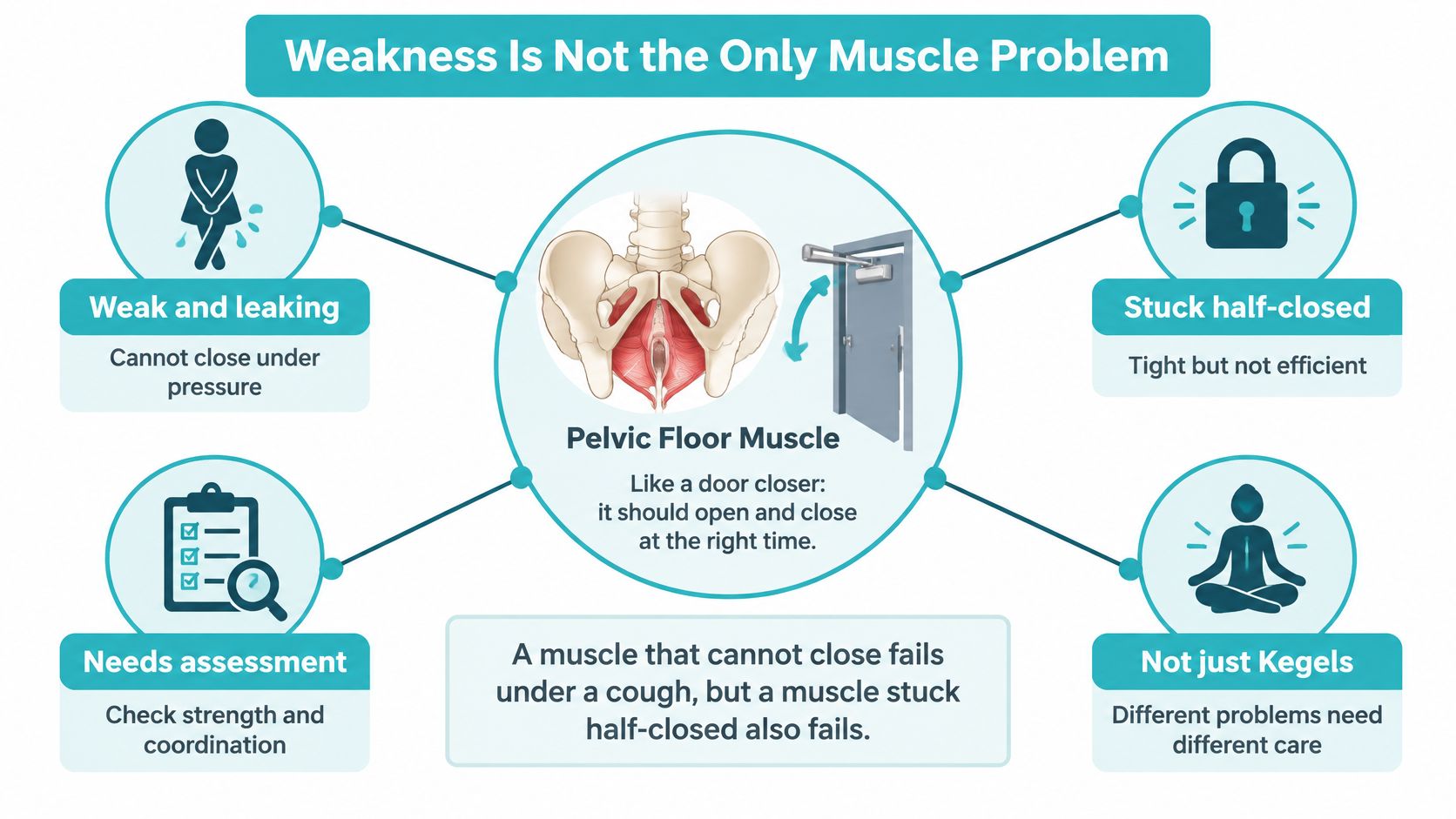
Three clues can help you decide what to raise at an appointment:
- Leakage only with coughing or sport: If you can start and stop your urine stream normally and don't have pain, strength and the timing of the muscle response may need attention.
- Leakage plus pain or difficulty relaxing: A constant clenched feeling, painful sex, or trouble emptying points toward assessing relaxation, breathing, and pelvic floor activity before adding more load.
- Pushing down when trying to lift: Breath-holding or gripping your buttocks and inner thighs can signal a coordination problem. More repetitions won't necessarily teach the muscles to work in the right direction.
Postpartum changes, athletic impact, endometriosis-related pain, and constipation can all complicate the picture. A general exercise sheet can't show whether you're lifting, bearing down, or fully releasing the pelvic floor. A clinician can assess contraction and relaxation, with your consent, and help decide whether strengthening, down-training, coordination work, or medical evaluation makes sense. Learn more about a hypertonic, or overactive, pelvic floor.
Practical rule: If pain, urgency, or incomplete emptying is part of your symptoms, don't add tightening exercises without an assessment.
How a Supervised Training Program Is Built
A useful pelvic floor program is a prescription, not a slogan. NICE guidance recommends supervised pelvic floor muscle training as first-line care for stress or mixed urinary incontinence for at least three months, with a minimum of eight contractions, three times daily, under the guidance of a physiotherapist or another appropriately trained clinician. The NICE urinary incontinence guidance also emphasizes the quality of the contraction, not just the count.
The training builds muscle strength, endurance, and the ability to activate before pressure rises. Short contractions help practise a quick response before a cough; longer holds build endurance for activities such as walking or lifting. The knack is a gentle pre-contraction timed just before a cough or exertion.
The progression
-
Check the movement. First, learn to lift the pelvic floor without holding your breath or clenching your belly, buttocks, or inner thighs. A contraction that comes with a push downward needs correction before you add repetitions.
-
Practise short contractions. Start with brief squeezes you can release fully. Being able to let go matters as much as being able to contract.
-
Build sustained holds. Increase the hold only while your technique stays controlled and your breathing remains easy. The goal is a clean contraction, not the strongest possible squeeze.
-
Use the knack before pressure. Practise a gentle pre-squeeze immediately before a cough, lift, run, or jump, then release afterward.
-
Track what changes in daily life. A bladder diary, activity-specific notes, and a symptom questionnaire can show whether you're having fewer accidents during the tasks that matter. A harder-feeling squeeze isn't the outcome you're aiming for; better functional control is.
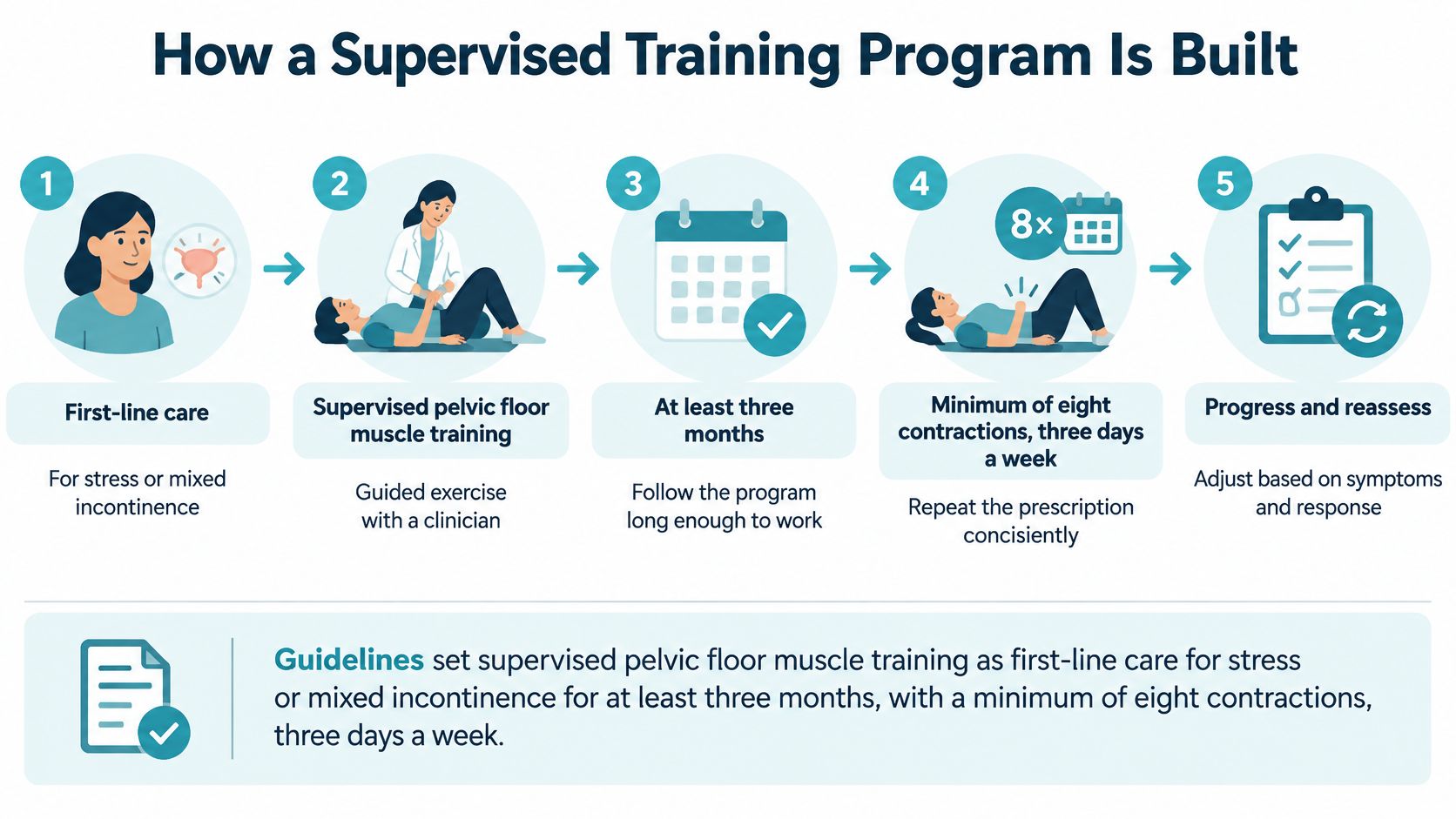
Generic, unsupervised Kegels can skip the quality check, the progression, and the opportunity to adjust for pain or urgency. For mixed incontinence, bladder training runs alongside pelvic floor work rather than being replaced by it.
Over the three-month course, good adherence means doing the prescribed practice regularly, keeping the movement comfortable and controlled, and noting how symptoms respond. If the exercise causes pain or you're unsure whether you're contracting or relaxing, tell your clinician rather than trying to work through it.
When to Add Biofeedback or Bladder Training
Not every patient needs a device, and not every leak needs the same add-on. The decision should follow the symptom pattern and what you can do with the pelvic floor during an assessment.
| Tool | Use it when | What it changes | Skip it when |
|---|---|---|---|
| Biofeedback | You can't find, time, or relax the muscle | Awareness of the movement and whether effort is going in the right direction | You already contract well; adding biofeedback cut only 0.29 leakage episodes per day across 12 studies involving 932 women |
| Bladder training | Urgency or mixed urgency is part of the problem | Gradually lengthens bathroom intervals and builds urge-control skills | The only problem is a cough-related leak with no urgency |
| Manual therapy | Overactivity, a scar, or painful tissues need attention | Can support relaxation and tolerance for movement | An assessment shows an isolated strength deficit |
| Habit changes | Irritants, constipation, or fluid timing contribute to symptoms | Reduces triggers alongside the exercise plan | It's being used instead of supervised training |
| Electrical stimulation or cones | You can't produce an effective contraction | May help you find a contraction to practise | You already lift the pelvic floor cleanly |
Biofeedback uses visual or sound cues, sometimes from surface sensors or ultrasound, to help you recognize what your muscles are doing. It can be useful if you're pushing down instead of lifting, struggling to locate the muscle, or unable to tell whether you've relaxed. But it isn't an automatic upgrade: NICE guidance on pelvic floor treatment reports that adding biofeedback to training produced just 0.29 fewer leakage episodes per day than training alone in 12 studies involving 932 women, a difference that may be too small to matter for everyone.
For urgency, bladder training usually takes the lead. You practise planned bathroom visits, gradually extend the interval when appropriate, and use a pause-and-wait strategy when urgency rises. If you have mixed symptoms, a clinician can combine those skills with pelvic floor work. The bladder-control guidance from Lake City Physical Therapy offers further information about practical strategies.
Manual therapy may be considered when an assessment finds overactivity, scar tissue, or painful tissues, while fluid timing, caffeine or other bladder irritants, and constipation management can reduce contributing triggers. Electrical stimulation or vaginal cones are options for some people who can't yet make an effective contraction. These tools should have a clear reason for being in your plan, not be added just because they're available.
Biofeedback earns a place when it solves a problem you can identify, not simply because it sounds more advanced.
Contact a healthcare professional for blood in the urine, repeated infection symptoms, significant difficulty emptying, unexplained pain, or neurologic symptoms. Medical evaluation is also appropriate if symptoms don't improve after an adequately supervised course.
What the First Visit Looks Like
A first pelvic health visit begins with your history, not an exercise test. The clinician will ask when leakage happens, how it affects work, sleep, sport, or daily routines, and what you've tried. They may also ask about fluids, constipation, medicines, childbirth, pain, and what you want to get back to, such as a symptom-free run.

If you're comfortable with an exam, the therapist may check whether you can contract, hold, and fully relax the pelvic floor, and whether your belly, buttocks, or thighs take over. An internal assessment can help answer those questions, but it isn't required to begin care. The clinician should explain what an exam involves and obtain your consent before proceeding.
Two different visits, two different plans
A postpartum woman who leaks during the school run might leave with a short-hold practice plan and a cough knack, once the therapist has checked how she contracts and releases. The immediate aim is to connect the movement with the activity that triggers the leak.
A CrossFit athlete who leaks during impact and also has painful sex needs a different starting point. If the assessment finds difficulty relaxing or pain, her initial plan may focus on breathing and release rather than more Kegels. Pain alongside leakage changes the questions the therapist needs to ask.
You don't need to prepare perfectly. Bringing a three-day bladder diary, a list of medicines, and one activity you want to return to gives the clinician practical information to shape the visit. Prenatal and postpartum patients, people with prolapse symptoms, athletes who leak during impact, and women with pain alongside bladder symptoms can all ask whether pelvic health therapy fits their situation.
Keeping Results After the Visits End
Completing a training course is only part of the work. The practical challenge is keeping helpful routines going when travel, cost, mobility, caregiving, embarrassment, or a lack of follow-up makes regular appointments hard to manage. A clinical overview of pelvic floor dysfunction and nonsurgical care describes access, adherence, stigma, and follow-up as persistent barriers. It also reports that fewer than half of patients maintain recommended behavioral practices at 12 months when treatment lacks reinforcement or follow-up.
The plan after therapy should fit your life. Your clinician can agree on a shorter maintenance routine, connect it to activities that used to trigger leaks, and use the same diary to notice whether symptoms stay controlled. If a routine is too complicated to manage alongside work or caregiving, ask for a version that fits your day rather than abandoning it altogether.
A missed visit or a difficult week isn't proof that therapy has failed. The plan may need a more workable form of follow-up.
Hybrid care can help when a weekly drive isn't realistic. In-person visits can support an initial assessment and technique checks; telehealth may be useful for reviewing your diary, adjusting your routine, or practising urge-control strategies. Older women may need individualized plans, too: current evidence in this group is too limited and uncertain to identify a single best approach.
If leakage returns, consider a supervised review before deciding the exercises no longer work. If you develop pain, blood in your urine, difficulty emptying, or other concerning symptoms, seek medical review rather than trying another device. A clear maintenance plan includes both what to practise and when to ask for reassessment.
Book Pelvic Floor Care Near You
Lake City Physical Therapy, led by Sheree Dibiase, PT, provides women's health care for urinary incontinence, prolapse, endometriosis-related pain, painful sex, and prenatal and postpartum rehabilitation. Its clinics serve Coeur d'Alene, Hayden, Post Falls, Rathdrum, Liberty Lake, Spokane South Hill, Eagle, and Boise.
If travel, caregiving, cost, or mobility makes regular in-person care difficult, telehealth can support form checks, bladder-diary review, and urge strategies. Online scheduling and bill pay are available, and free pelvic health and postpartum classes can help you prepare. OB/GYN, primary care, and oncology clinicians can refer patients for supervised pelvic floor therapy, including people seeking support after cancer treatment.
For your first step, choose a pelvic health visit or telehealth start this week. Bring a three-day bladder diary, a medicine list, and the activity you want back; your care team can use them to begin shaping a personal plan.
Lake City Physical Therapy offers pelvic floor assessment and individualized care for bladder leaks, including in-person and telehealth options across North Idaho and Eastern Washington. To discuss a plan that fits your symptoms and daily life, visit Lake City Physical Therapy.

