Pelvic Floor Therapy for Vulvodynia: What Works and When
If pelvic floor exercises are supposed to help pelvic pain, why can doing more Kegels make vulvar pain worse? The missing piece is whether your muscles need strengthening, better relaxation, or both. A pelvic floor that's already holding tension needs a different plan from one that can't generate a coordinated contraction.
Pelvic floor therapy for vulvodynia starts with that distinction. Treatment should match your pain pattern, respect your comfort with examination, and help you do meaningful activities with less pain, rather than give you more exercises to complete.
Pelvic Floor Therapy Options at a Glance
Pelvic floor therapy is one component of multimodal vulvodynia care, not a stand-alone cure. Its support is strongest for pain triggered by touch or penetration, including dyspareunia, the medical term for painful intercourse. Clinicians often combine physical treatment with education, medical care, and psychological or sexual-health support.
The approaches below address different problems. Their inclusion in a successful combined program doesn't establish that each technique works equally well on its own.
Pelvic floor therapy approaches compared
| Approach | What It Targets | Evidence Strength |
|---|---|---|
| Down-training and relaxation | Resting muscle tone and guarding | Supported within care for provoked pain and dyspareunia |
| Manual myofascial treatment | Tender tissue and trigger points | Used within multimodal care; limited stand-alone evidence |
| EMG or ultrasound biofeedback | Pelvic muscle activity the patient can see and adjust | A pilot randomized trial of 57 women found that a physiotherapy-related intervention improved pain and muscle measures versus medication-only care; it doesn't isolate biofeedback's contribution |
| Electrical stimulation, such as TENS | Pain signalling; some stimulation approaches also address muscle activity | Improvements reported in included studies, but methods and results differ |
| Graded exposure with dilators | Sensitivity and fear around penetration | Reported in multimodal programs; independent benefit is less certain |
| Home exercises with education | Daily relaxation, breathing, and pacing | Included in combined protocols; the contribution of home work alone is uncertain |
| Psychosocial therapy with physiotherapy | Fear, catastrophizing, coping, and relationship concerns | Recommended alongside physiotherapy in clinical guidance |
EMG, or electromyography, measures electrical activity associated with muscle activation. Ultrasound shows movement. Neither is a treatment you must receive, and neither replaces a conversation about your symptoms and goals.
TENS uses surface electrodes to deliver electrical stimulation for pain modulation. It isn't interchangeable with every other form of pelvic electrical stimulation, so ask what a proposed device is intended to accomplish.
How to use these options
Choose by the problem being treated, not by which technique sounds most advanced. For example, a person who braces during attempted penetration may need relaxation and gradual exposure, while someone with a distinctly tender muscle may benefit from carefully paced manual treatment.
For additional patient education and terminology, the pelvic floor resources from MedAmerica Rehab Center can complement the explanations you receive at an appointment.
These are options clinicians combine and individualize, not a checklist every patient must complete. Small studies and mixed protocols also make it difficult to rank individual techniques confidently.
How Pelvic Floor Overactivity Links to Vulvodynia
A hand that stays clenched can't hold something gently. Similarly, a pelvic floor that remains tense between tasks may struggle to accommodate touch, a tampon, or penetration comfortably. This comparison helps explain how muscle tension may contribute to pain, but it doesn't explain every case of vulvar pain.
Vulvodynia means persistent vulvar pain without a clearly identifiable cause. People may describe burning, stinging, rawness, or aching. Provoked pain occurs with contact or pressure; unprovoked pain occurs without contact. Both patterns can occur in the same person.
How guarding can maintain pain
When contact hurts, pelvic muscles may tighten protectively. If that guarding persists, increased muscle pressure and pain-related nerve input during later contact can make it harder to release the muscles. Anticipating pain can reinforce this response; it doesn't make the pain imaginary or voluntary.
This illustration shows how resting tension may relate to everyday symptoms.
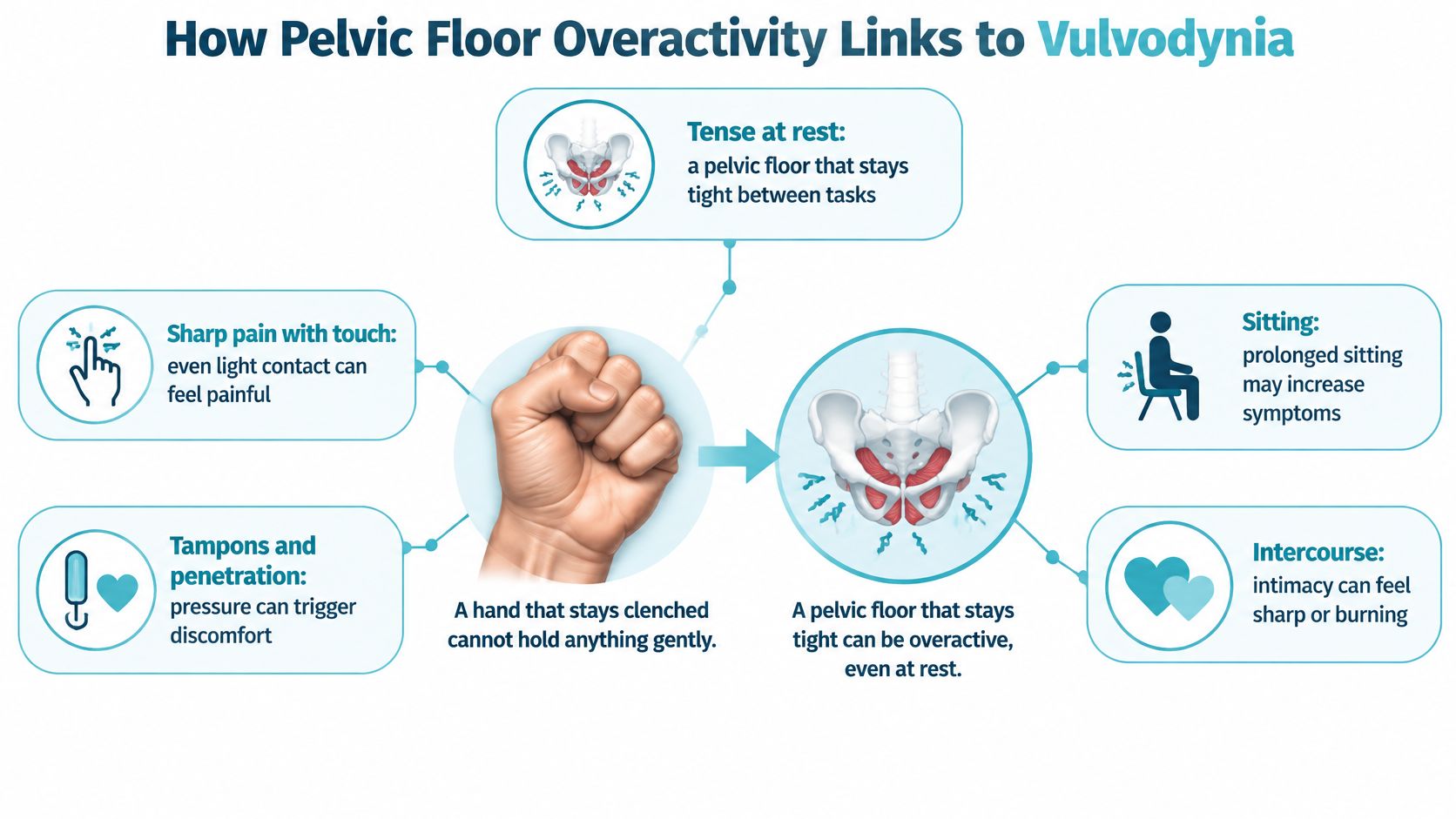
Clinical guidance published in 2010 identified pelvic floor dysfunction as common among patients with vulvodynia and sex-related pain. Clinical guidance generally includes physiotherapy as one part of multimodal care alongside psychosocial support. Evidence is strongest for provoked pain and more limited for generalized or unprovoked pain.
Muscle tension may contribute to symptoms, develop in response to pain from another source, or do both. Learning about a hypertonic pelvic floor can help explain what a therapist may assess.
Signs worth discussing
- Penetration sensitivity: Tampons, intercourse, or pelvic examinations provoke familiar pain.
- Sitting intolerance: Symptoms increase during sustained sitting.
- Clothing sensitivity: Pressure from fitted clothing aggravates discomfort.
- Response to relaxation: Symptoms ease when you consciously soften your lower body.
These clues can guide an assessment, but they don't establish a diagnosis. Normal-looking tissue doesn't rule out pain, and a muscular contribution doesn't rule out another condition that needs medical care.
What Your First Pelvic Floor Visit Covers
Your first visit is an assessment, not a test of how much discomfort you can tolerate. You can decline any part of the examination, request an external-only starting point, or withdraw permission after an examination has begun.
Patient interviews described in a study of vulvodynia care experiences identified difficulty finding knowledgeable clinicians, barriers to continuing therapy, and a preference for coordinated services. Clear explanations and practical planning matter because fear, embarrassment, cost, transportation, and privacy can all affect participation.
What the assessment may include
The order can be adapted to your needs. Agree on a stop signal before any touch-based assessment, even if the detailed pacing discussion comes later.
-
Your symptom history. Describe where the pain sits, whether it follows contact or occurs spontaneously, when it began, and what changes it. Bladder, bowel, sexual-health, and previous treatment information may help the clinician understand the pattern.
-
Pain mapping, when appropriate. A clinician may gently touch areas around the vestibule, the tissue surrounding the vaginal opening, with a cotton swab. Recording location and intensity provides a baseline without assuming that every tender spot has the same cause.
-
External assessment. With permission, the therapist checks accessible tissues for tenderness and signs of guarding. Some deeper muscle findings can't be fully assessed externally.
-
Breathing and coordination. You may be asked to breathe normally, contract and release, or gently bear down. The therapist observes whether you can change muscle activity without excessive bracing or straining.
-
An optional internal examination. If clinically useful and acceptable to you, a gloved, lubricated finger may assess deeper muscle tone, tenderness, contraction, and relaxation. You don't have to agree to this to begin discussing treatment.
-
Functional goals. Choose activities that matter to you, such as completing a car journey, exercising, wearing preferred clothing, or tolerating intimacy.
-
Pacing and a clear stopping plan. Decide how you'll signal discomfort, which techniques are acceptable, and how the plan will change if symptoms increase.
Your permission remains active throughout treatment. Agreeing to an examination isn't agreeing to endure pain or continue when you want to stop.
Making care workable
If you want support, ask whether a partner or trusted person can attend. Some education, movement coaching, and home-program reviews may be suitable for telehealth, although remote visits can't reproduce hands-on assessment.
You can also request trauma-sensitive adjustments without describing experiences you'd rather keep private. These might include remaining clothed initially, receiving explanations before every movement, or postponing touch-based assessment.
Reviewing what to expect at pelvic floor therapy can help you prepare. Bring a symptom-and-trigger list, medications, past treatments, and any questions about fitting a manageable home program into your day.
Why Strengthening Can Backfire
Can Kegel exercises make vulvar pain worse? Yes, they can when an overactive pelvic floor is repeatedly loaded without adequate relaxation. More squeezing isn't automatically better treatment.
An already guarded muscle may respond to repeated contractions with greater discomfort or difficulty releasing. The goal isn't to avoid all contraction forever. It's to establish whether strengthening addresses the problem you have.
A systematic review of rehabilitative approaches found overall pain reduction, but statistically significant subgroup effects were concentrated in shock-wave therapy and acupuncture, with substantial differences across studies. That finding doesn't justify treating every rehabilitation technique, or every exercise prescription, as equally proven.
Overactivity and weakness aren't opposites
A tight muscle can also produce a weak contraction. Resting tone, strength, and coordination are separate findings, so symptoms alone can't reliably sort them out.
| Finding during assessment | What it may suggest |
|---|---|
| Tenderness, elevated resting tension, or difficulty releasing after a squeeze | Overactivity or impaired relaxation |
| Familiar pain increases after repeated contractions | The current exercise dose or choice needs review |
| Weak squeeze, little lift, or poor control | Weakness or coordination difficulty |
| Leakage | A reason to assess function, not proof that Kegels are the answer |
Symptoms that build toward the end of the day can add useful context, but they don't establish a muscle diagnosis. A therapist should check how you contract and how completely you let go before prescribing repeated strengthening.
What to do after a flare
A flare may feel like burning or stinging that outlasts your usual pattern, or new tenderness after a session. Don't interpret escalating symptoms as proof that treatment is working.
- Reduce the dose. Pause or scale back the exercise that appears to provoke symptoms.
- Return to comfortable relaxation work. Use the breathing or release strategy your therapist has taught you rather than adding forceful stretching.
- Record the pattern. Note the activity, symptom change, and recovery.
- Contact your clinician. Persistent or increasing flares warrant reassessment; new concerning symptoms need medical evaluation.
Guidance on pelvic floor release can support a conversation about gentler options.
Progress isn't the number of squeezes you complete. It's whether your body handles daily activities with less guarding and discomfort.
How Therapy Sessions Are Sequenced and Dosed
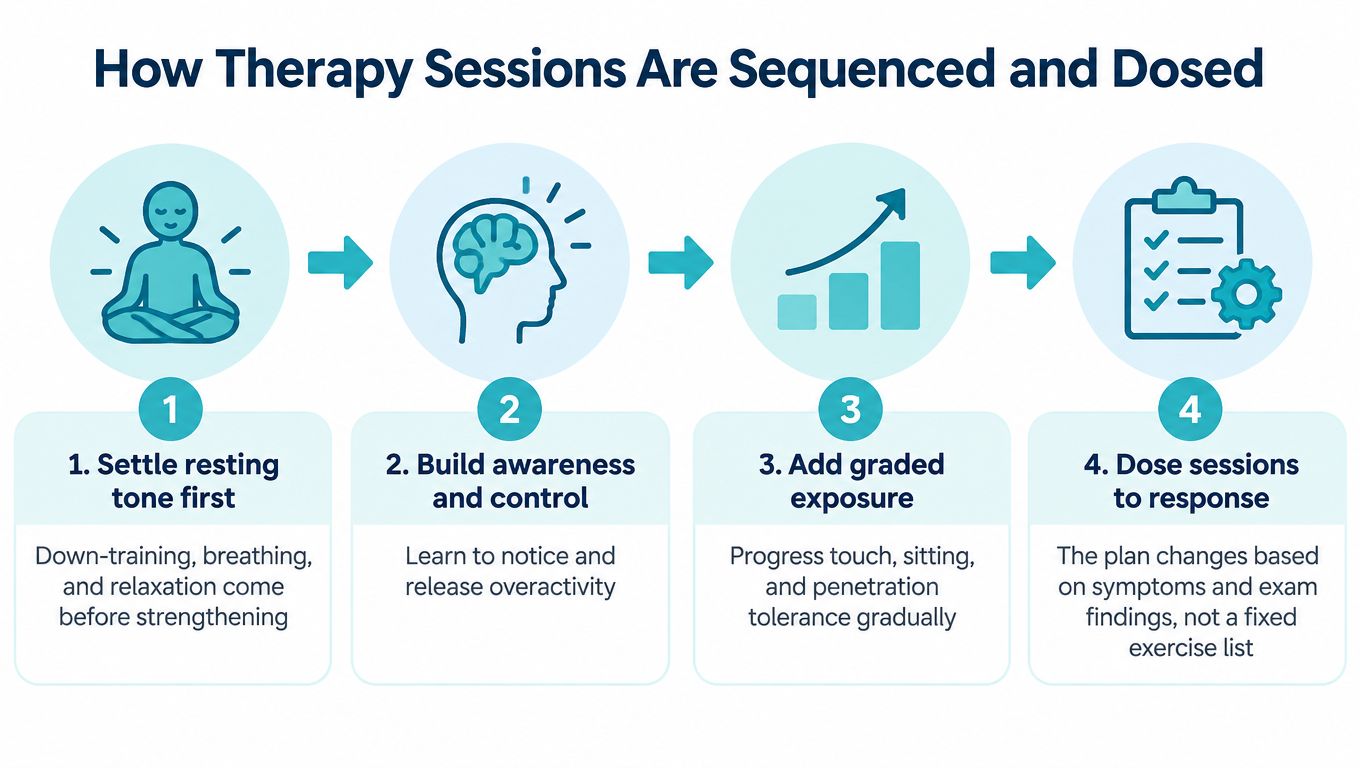
Therapy follows assessment findings rather than a fixed exercise list. Your starting point should reflect the main barrier, whether that's resting tension, local tenderness, poor coordination, or difficulty approaching painful activities.
Starting emphasis by symptom pattern
| Pattern | First Emphasis | Evidence Strength |
|---|---|---|
| Provoked pain with pelvic floor overactivity | Down-training, manual treatment, and biofeedback first | Strongest support is for provoked pain and dyspareunia |
| Provoked pain with weakness and poor control | Strengthening only after assessment confirms weakness | Assessment-led rationale; isolated strengthening benefit is uncertain |
| Generalized or unprovoked pain | Physiotherapy as an adjunct alongside education and medical care | Insufficient evidence for unprovoked pain |
| Coexisting skin disease | Dermatology alongside pelvic floor therapy | Coordinated care is appropriate; physiotherapy doesn't treat the skin disease itself |
| Fear-avoidance or relationship strain | Graded exposure with psychosocial therapy | Recommended within multidisciplinary care |
| Suspected neuropathic pain | Medical review before therapy is escalated | No established physiotherapy-only protocol for this pattern |
A systematic review of seven studies involving 477 patients found that physiotherapy approaches generally improved pain, sexual function, or quality of life. Differences between studies prevented pooled meta-analysis, and several studies had substantial risk of bias, so the findings don't establish a universally effective sequence.
An adaptable treatment sequence
-
Settle resting tone first. Down-training means learning to reduce unnecessary muscle activity using breathing, comfortable positions, and release practice. This provides a starting point when the main finding is persistent guarding rather than insufficient strength.
-
Address tender areas. Manual myofascial treatment uses carefully graded contact on sensitive muscles and surrounding tissue. Pressure should remain collaborative and tolerable, not become a challenge to push through.
-
Introduce graded desensitization. Start with an acceptable form of touch or activity and progress gradually. Vaginal dilators may be an option, but progressing to a larger size isn't more important than maintaining control and comfort.
-
Add biofeedback when useful. Visual information can help when you can't tell whether the pelvic floor has released. It's a learning aid, not a requirement or a judgment of how well you're trying.
-
Introduce strengthening when indicated. A weak or poorly coordinated contraction may warrant targeted exercise once the resting pattern is addressed. The prescription should include a complete release, not just a stronger squeeze.
The diagram summarizes the broader progression from settling symptoms to adjusting activity.
Dose according to response
Supervised sessions and home practice should reinforce the same goal. A small, repeatable program is more useful than a long routine that repeatedly provokes symptoms or doesn't fit your life.
A review of vulvodynia rehabilitation described a small study in which several muscle-tone and function measures normalized after treatment. That supports checking function during reassessment, not assuming that attendance alone confirms benefit.
The calendar doesn't determine progression. Your therapist should adjust contact pressure, exercise effort, exposure, and visit spacing according to symptoms and examination findings.
Realistic Results and What Progress Looks Like
In a reported cohort of 145 patients, 110, or 75.8%, experienced pain improvement after 10 weekly sessions combining physical therapy, electrical stimulation, biofeedback, and home pelvic-floor stretching, according to Vulvodynia: Assessment and Treatment. This was a combined-treatment cohort, not a guaranteed success rate for every patient or protocol.
The schedule gives a concrete example of weekly supervised care reinforced by home work, not a deadline for recovery. Broader findings support improvements in sexual pain and function, but small samples, differing treatments, and limited controlled comparisons reduce certainty about who benefits most.
Track changes you can use
Pain intensity matters, but it shouldn't be the only outcome. Agree on baseline measures that reflect both symptoms and your priorities.
- Pain distribution: Is the tender area smaller or less reactive during pain mapping?
- Muscle findings: Is there less tenderness or more complete relaxation during reassessment?
- Activity tolerance: Can you sit, exercise, wear preferred clothing, or undergo examination more comfortably?
- Sexual pain: Is chosen intimate contact less painful, without pressure to resume penetration?
- Instrument-based measures: Where available, cotton-swab scores, EMG, or ultrasound may supplement your account of progress.
A clinical comparison summarized by the International Continence Society reported that multimodal physiotherapy improved pain and sexual function more than topical lidocaine both after treatment and at six-month follow-up. That's encouraging for the population studied, but it doesn't establish the same outcome for generalized or unprovoked pain.
When progress stalls
Keep a brief weekly diary noting activities, symptom intensity, flares, and recovery. Look for a pattern across time rather than judging treatment by an unusually good or difficult day.
Reassessment matters: No measurable change after the agreed treatment course should prompt a review of the working explanation and treatment plan, not automatic repetition of the same exercises.
A plateau may call for a different physical approach, medical reassessment, or coordinated dermatologic, psychological, or sexual-health care. For unprovoked pain, expectations for physiotherapy should remain more cautious because its benefit is less firmly established.
Decide Whether to Book Therapy or Refer First
Use a yes-or-no starting question: Is your familiar pain triggered by contact, penetration, or sitting, without a new unexplained symptom that needs medical assessment? If yes, a pelvic floor assessment may be a reasonable next step, particularly when medical evaluation has already considered other causes.
A consultation should leave room for questions before any examination.

If the answer is no, or you're unsure, arrange medical review first or alongside therapy. New bleeding, unexplained discharge, skin changes, fever, a sudden change in pain, or constant unexplained pain shouldn't be labelled muscle tension. Fever or sudden severe symptoms warrant prompt assessment.
Choose the right combination of care
- Possible skin disease: Seek gynecologic or dermatologic assessment rather than relying on exercise alone.
- Prominent fear or relationship strain: Include a psychologist or sex therapist if that support fits your goals. This doesn't imply that the pain is psychological.
- Access barriers: Discuss visit spacing, remote follow-up suitability, transportation, and privacy before committing to a plan.
- Clinician fit: Look for vulvodynia experience, clear explanations, consent-based pacing, and willingness to coordinate with medical providers.
At Lake City Physical Therapy, we offer pelvic floor physical therapy for painful sex, as well as prolapse, endometriosis, and incontinence. The useful starting point is an assessment of which contributors can be addressed through physical therapy and which need additional care.
If you'd like additional video material, you can view it below.
Before booking, write down these questions: What findings would make relaxation more appropriate than strengthening? Can we start without an internal examination? What changes will we track to decide whether treatment is helping? Bring them with your symptom history so the appointment begins with your priorities.
We offer pelvic floor physical therapy, including care for painful sex, with assessment and education to help identify an appropriate starting approach. Visit Lake City Physical Therapy to arrange an assessment and discuss how your pain pattern, comfort, and daily goals can guide your care.

