8 Best Exercises for Diastasis Recti in 2026
Healing Your Core: A Guide to Diastasis Recti Recovery
After pregnancy, you might notice a lingering belly pouch that doesn't respond to walks, “ab workouts,” or sheer determination. You may also see a ridge or bulge down the center of your abdomen when you sit up, lift the baby, or get out of bed. That pattern often points to diastasis recti, a separation of the abdominal muscles that changes how your core handles pressure.
Many women often receive bad advice. Crunch harder. Plank longer. Push through. In practice, that often backfires because diastasis recti recovery usually responds better to low-load, well-controlled work that restores pressure management first, not aggressive abdominal training. If you're also dealing with leaking, pelvic heaviness, back discomfort, or a core that feels disconnected, the problem is rarely just the abs.
A more useful plan starts with breathing, deep abdominal activation, and pelvic floor coordination, then builds toward real-life strength. That's the difference between exercising your core and rehabilitating it. And because tissue repair also depends on the basics, your workouts pair best with recovery habits like sleep, hydration, and a solid muscle recovery nutrition guide.
Below are the best exercises for diastasis recti, but more importantly, how to use them as a progression system. That means knowing what to start with, what to avoid, when to advance, and when a specialist needs to step in.
1. Transverse Abdominis Activation and Progressive Loading
The first exercise I teach most postpartum clients isn't flashy. It's a controlled transverse abdominis brace with breath. That deep abdominal layer acts like a built-in support system, and it responds best to precision, not force.
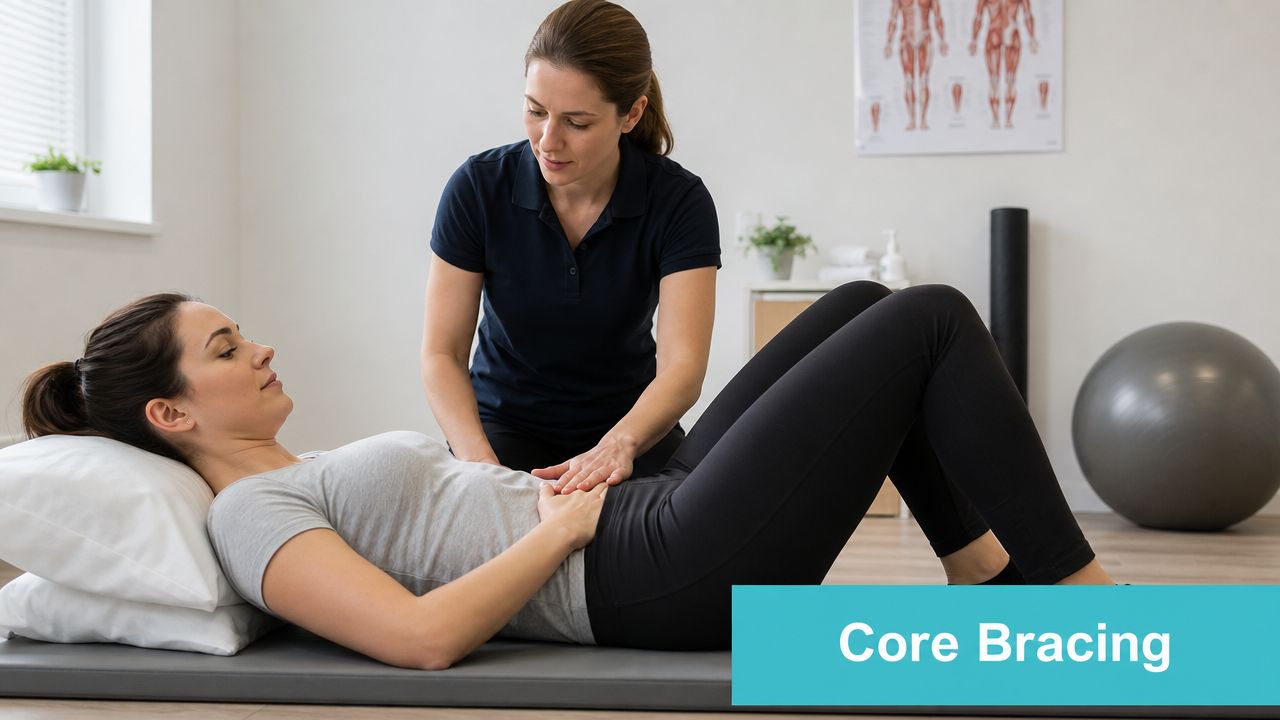
A practical starting dose comes from postpartum exercise guidance summarized in a 2021 online exercise intervention study on diastasis recti. One recommended format is holding core contractions for 3 to 5 seconds, doing 3 sets of 10, 3 to 4 times per week. That same body of guidance also supports deep core work over aggressive crunch-style training.
How to do it well
Lie on your back with knees bent and feet flat. Inhale to relax, then exhale and gently draw the lower abdominal wall inward without flattening your ribs or pushing your belly outward. You should feel a mild corset-like tension, not a hard brace.
Place your fingers just inside the front hip bones if you need feedback. If the abdomen domes, the low back arches, or you have to hold your breath, the effort is too high.
Practical rule: If you can't keep the abdominal wall flat and quiet, the exercise isn't too easy. It's still too hard.
Build from static to useful
Once you can manage the brace consistently, add movement. Good next steps include:
- Heel slides with control: Slide one heel away as you exhale, then return without abdominal bulging.
- Standing march holds: Brace gently, then lift one foot a few inches while keeping the ribcage stacked over the pelvis.
- Quadruped holds: Start on hands and knees, hold neutral, then progress to small arm or leg lifts.
This is also where many women start exploring the Dead Bug form and technique in a modified way. The full version may be too demanding early on, but the setup teaches excellent ribcage and pelvic control.
After you can hold that deep activation and move without coning, visual instruction can help refine it:
Traditional sit-ups and crunches usually aren't the best exercises for diastasis recti in the early phase. They ask the abdominal wall to manage more pressure before it has the coordination to do that well.
2. Tupler Technique
Some people do better with a structured, branded program instead of piecing exercises together from social media. The Tupler Technique is one of the better-known diastasis-specific approaches because it emphasizes posture, pressure management, daily movement habits, and targeted abdominal retraining.
The appeal is simple. It gives you rules, repetition, and a framework. That helps if you're overwhelmed and want a plan you can follow without guessing every day.
Where it fits
This method can work well for women who need clear guardrails around getting out of bed, lifting, standing posture, and exercise progression. A typical early session might include heel slides, supported head lifts, and controlled transitions from lying to sitting, all done with breath coordination and close attention to whether the abdomen tents or bulges.
It's most helpful when the person using it understands that “working the abs” is not the same as restoring abdominal function. If you race through reps or force a stronger contraction than you can control, you miss the point.
For a clinically grounded explanation of assessment and rehab options, Lake City Physical Therapy has a useful page on belly after baby diastasis recti repair.
The trade-offs
The upside of a named system is consistency. The downside is that no program fits every body equally well. If you have pelvic pain, persistent leaking, prolapse symptoms, C-section scar restrictions, or trouble sensing your deep core at all, a standard program may need modification.
A good rule is to watch tissue behavior, not just chase closure. If the midline stays supported, your breathing stays easy, and everyday tasks feel better, you're on the right track. If symptoms increase, the plan needs adjustment.
- Good fit: You want a repeatable home program and respond well to structure.
- Needs supervision: You have pain, pressure, hernia concerns, or mixed pelvic floor symptoms.
- Poor fit: You tend to push intensity too quickly and ignore body feedback.
The best exercises for diastasis recti aren't always the ones with the best branding. They're the ones you can perform with control, regularly, and without worsening symptoms.
3. Pelvic Floor Coordinated Core Rehabilitation
If you leak when you sneeze, feel heaviness in the pelvis, or notice your abdomen bulges during effort, don't separate your abs from your pelvic floor in your thinking. They work together as one pressure system.
That's why I rarely treat diastasis recti as an abdomen-only problem. The deep abdominals, diaphragm, and pelvic floor need to coordinate. If one part lags behind, pressure gets redirected somewhere else.
Coordination beats isolated squeezing
A clinical resource on core and pelvic floor exercise strategies is useful here because it reflects how rehab works in practice. You exhale as you exert, feel a gentle lower abdominal tension, and pair that with an appropriate pelvic floor response. For some women that means contraction. For others, especially those who are over-gripping and painful, it means learning to relax first.
That's an important distinction. More squeezing isn't always better. A tense pelvic floor can be just as dysfunctional as a weak one.
A good beginner pattern looks like this: inhale and soften, exhale during effort, gently engage the lower abdomen, and avoid bearing down. Then use that same pattern while rolling in bed, lifting the infant car seat, standing from the floor, or climbing stairs.
Recovery works better when the pelvic floor and abdominal wall share the load instead of competing with each other.
Exercises that pull double duty
These often work well when symptoms overlap:
- Exhale-to-lift drills: Practice before picking up your baby, laundry basket, or stroller.
- Bent-knee fallout with pelvic control: Let one knee open slightly without the pelvis rocking.
- Supported bridge with breath: Lift only as high as you can keep the abdomen quiet.
If bladder symptoms are part of the picture, it also helps to learn about bladder leakage solutions from a pelvic-health perspective, not just a pad-and-manage-it approach.
When a woman tells me, “I've been doing core work but it still feels wrong,” the missing piece is often pelvic floor coordination, not effort.
4. Functional Movement Pattern Retraining
The best exercises for diastasis recti have to survive real life. If your core can stay organized on a mat but loses control every time you lift the baby, carry groceries, or stand from the couch, rehab isn't finished.
That's why functional retraining matters. You're teaching the abdominal wall to tolerate normal load during normal tasks.

One postpartum review-oriented source notes that 39% of women may still have some degree of diastasis recti after childbirth, which helps explain why this remains such a common rehab target. That same source also emphasizes low-intensity foundational work, including brief holds of deep abdominal activation and starter rep ranges, rather than jumping straight to intense “ab workouts” in guidance on exercises for diastasis recti after childbirth.
Where people usually lose form
The weak spots are predictable. Getting out of bed by jackknifing forward. Picking up a toddler with the ribs flared. Carrying everything on one hip while the trunk collapses to one side. Returning to exercise classes before basic transfers feel solid.
In clinic, I'd rather see someone master three daily movements than add ten new floor exercises they won't use.
- Sit to stand: Exhale, lean forward from the hips, and stand without thrusting the ribs up.
- Floor to stand: Roll to the side first instead of trying to crunch straight up.
- Lift and carry: Keep the load close, exhale on effort, and avoid twisting under strain.
Make rehab practical
Use one daily task as your training drill. Practice picking up the baby from the crib with a stacked ribcage and pelvis. Practice loading groceries into the trunk without breath-holding. Practice pushing the stroller uphill while keeping the trunk from collapsing.
That's how abdominal control turns into functional strength. It also reduces the common frustration of “I'm doing the exercises, but life still feels hard.”
5. Eccentric Loading and Progressive Resistance Training
Early rehab should be gentle. It shouldn't stay gentle forever.
Once you can breathe well, brace well, and move without visible doming, controlled resistance training becomes important. Many women get stuck at this point. They stay in the “safe exercise” phase too long and never rebuild real-world capacity.
What progression actually looks like
You don't need to jump from heel slides to full planks. A better bridge is slow eccentric control, meaning you manage the lowering phase of a movement carefully. Lowering from a bridge, controlling the descent in a wall push-up, or stepping down from a low platform can all teach the trunk to handle load without collapsing.
A clinician-oriented research summary supports this kind of progression because practical diastasis rehab is built around deep core stabilization, abdominal bracing, heel slides, bent-knee fallouts, and modified side plank or wall-based progressions, with attention to neutral ribcage-pelvis alignment and no visible abdominal bulging in deep core stability exercise guidance for diastasis recti.
Good resistance choices
Start with exercises that challenge the trunk without forcing pressure spikes.
- Wall push-ups: Great for learning exhale-on-effort and trunk stiffness.
- Supported split squats: Train core control during leg loading and everyday lifting patterns.
- Farmer carries with light weight: Excellent for posture and anti-lean control.
- Modified side plank from knees: Useful when you can keep the waist lifted without coning.
Clinical cue: Add load only after you can keep the ribs, pelvis, and abdominal wall organized through the full movement.
What doesn't work well is chasing fatigue for its own sake. If the last reps turn into breath-holding, rib flare, or a visible ridge at the midline, the exercise stopped being therapeutic and became too expensive for the tissue.
The goal isn't to stay fragile. It's to become stronger without losing pressure control.
6. Breathing and Intra-abdominal Pressure Management
Breathing isn't the warm-up. It's part of the exercise dose.
Several expert resources emphasize the same pattern: exhale during exertion, keep the abdominal wall gently drawn inward, and stop or regress if the abdomen bulges, domes, or the low back arches. They also present modified wall planks, knee-based side planks, and supported quadruped work as safer options than full planks, sit-ups, or double-leg-lift style movements in practical guidance on diastasis recti exercise progressions.
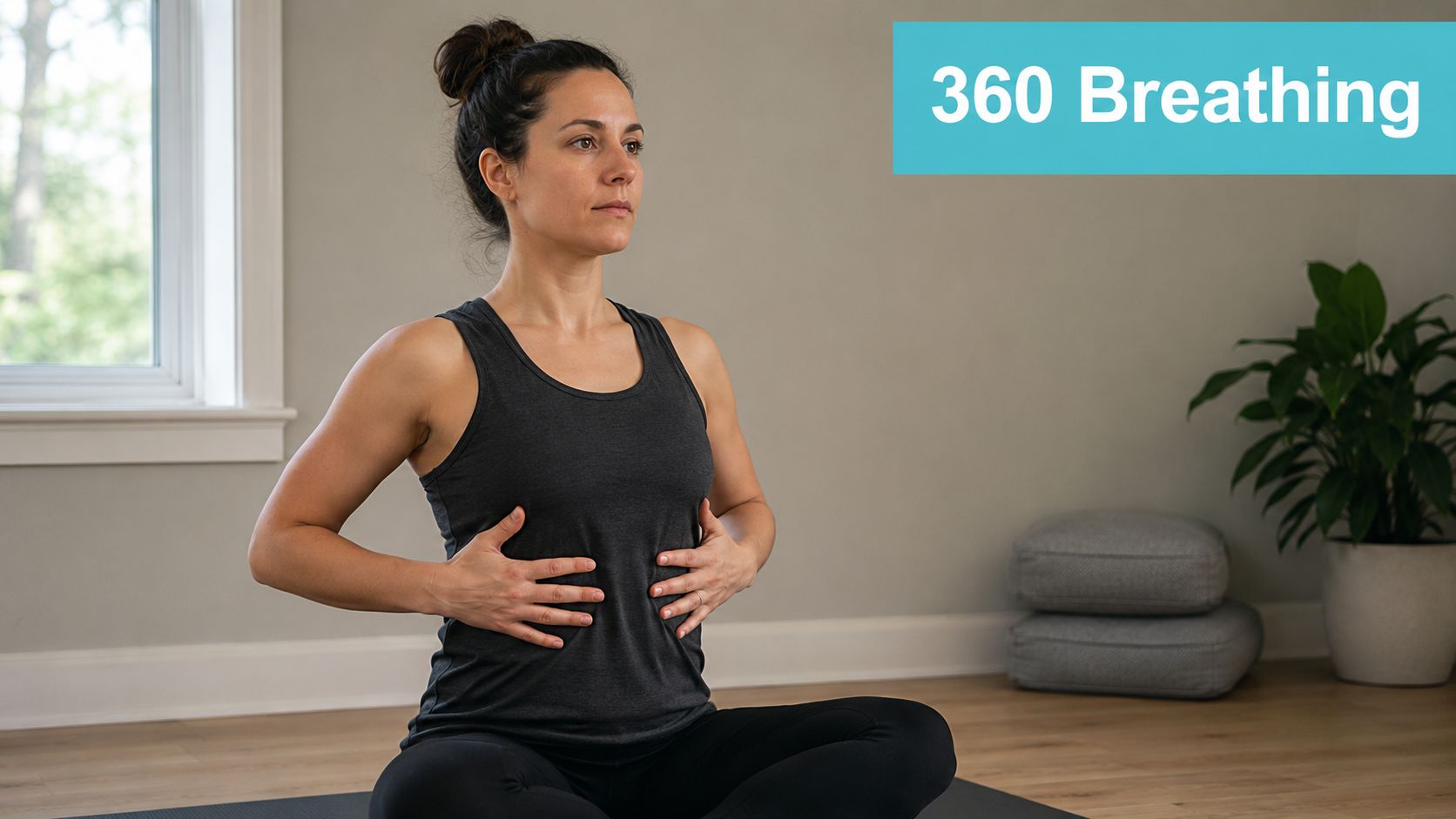
What 360 breathing should feel like
Your inhale should expand the ribcage in multiple directions, not just push the belly sharply upward. Your exhale should feel like a gentle narrowing through the lower trunk, not a hard sucking in.
Try this in sitting or lying down with hands on the lower ribs. Inhale and feel the ribs widen. Exhale and let the ribs soften while the lower abdomen firms gently.
Use it where it matters most
The breathing pattern only becomes useful when you apply it to effort. That means exhaling as you stand up, lift, push, pull, or transition positions. If you habitually hold your breath during those moments, you keep sending unnecessary pressure to the midline and pelvic floor.
A few smart places to practice:
- Before coughing or sneezing: Gentle brace and exhale if you can.
- During stairs: Exhale on the harder part of the step.
- During exercise transitions: Especially when moving legs away from the body or changing body mechanics.
This sounds simple, but it changes everything. Many women don't need harder core drills first. They need better pressure timing.
7. Prenatal Core Preparation and Prevention
This article focuses on recovery, but prevention matters too. Some of the best work happens before the postpartum stage begins.
Pregnancy changes the way the abdominal wall and pelvic floor manage pressure. You can't prevent every case of diastasis recti, and you shouldn't blame yourself if it happens, but you can improve how your body handles load before delivery and in the early transition afterward.
What helps during pregnancy
The best prenatal exercises aren't aggressive. They're positional, breath-based, and practical. Think supported core activation, ribcage mobility, posture awareness, side-lying work, and modified anti-rotation or quadruped drills that don't create obvious bulging.
I also like teaching movement strategies early. Rolling to the side to get out of bed, exhaling with effort, avoiding repeated breath-holding, and learning how to distribute load when carrying bags or older children all help reduce unnecessary strain.
- Breathing practice: Build the habit of rib expansion and relaxed exhale.
- Gentle deep core activation: Keep it light and coordinated.
- Pelvic floor awareness: Learn both contraction and relaxation.
- Postural reset work: Reduce rib flare and low-back hinging in standing.
Why this matters postpartum
Women who already understand breath-pressure control usually start postpartum rehab with less confusion. They know what “gentle engagement” feels like. They recognize doming earlier. They're less likely to jump into boot-camp style ab training because they've already learned what their core system needs.
This is especially valuable if you've had diastasis recti before, pelvic floor symptoms in a previous pregnancy, or a job or sport that involves repeated lifting.
Prenatal care doesn't guarantee an easy recovery. It does make the early phase less chaotic and more intentional.
8. Return to Sport and High-Load Activity Progression
The biggest gap in most online advice isn't how to start. It's how to advance.
A mainstream rehab article notes that early cardio should stay low impact and that impact should be added only as core and breathing control improve in guidance on progressing diastasis recti exercise and activity. That reflects a real problem. Women don't just want heel slides forever. They want a path back to running, jumping, barbell work, and sport.
When the basics are no longer enough
If you can walk, lift your child, perform low-load core drills, and tolerate modified planks without coning, you may be ready for a higher-level progression. But “ready” doesn't mean symptom-free only at rest. It means your core still behaves well when speed, impact, and fatigue increase.
That's where sport-specific rehab matters. Lake City Physical Therapy outlines this progression in its resource on returning to high-impact sport activities postpartum.
A smarter progression
The return to sport phase should layer demand instead of skipping steps.
- Runner example: Start with walk-run intervals only if abdominal control and pelvic symptoms stay stable during and after.
- CrossFit example: Reintroduce carries, squats, and pressing before kipping, high-rep sit-up volume, or heavy barbell cycling.
- Court sport example: Add landing mechanics, then lateral movement, then repeated cutting.
If the abdomen domes, the pelvis feels heavy, or leakage returns after training, your body is telling you the dose was too high.
This is one place where self-coaching often fails. High performers are used to pushing through. Postpartum tissue doesn't reward that mindset. It rewards good sequencing, honest symptom checks, and a program that respects healing while rebuilding power.
Diastasis Recti: 8-Point Exercise Comparison
| Method | Implementation Complexity 🔄 | Resource & Access ⚡ | Expected Outcomes ⭐📊 | Ideal Use Cases | Practical Tips 💡 |
|---|---|---|---|---|---|
| Transverse Abdominis (TA) Activation and Progressive Loading | Moderate, stepwise progression; needs skilled cueing | Low, minimal equipment; clinician guidance recommended | ⭐⭐⭐, reduces inter‑rectus distance, improves core stability and function 📊 | Early postpartum, prenatal prep, early-stage diastasis recti | Teach breath-coordination; use tactile feedback; progress holds before dynamic work |
| Tupler Technique (Diastasis Recti Specific Program) | Moderate, structured 12+ week protocol; adherence required | Moderate, program materials, possible splint; certified instructors improve fidelity | ⭐⭐⭐⭐, research shows high closure rates (≈80%+) with measurable milestones 📊 | Patients with significant separation seeking structured, evidence-based program | Work with certified instructor; establish baseline gap; progress only when form is mastered |
| Pelvic Floor Coordinated Core Rehabilitation | High, simultaneous pelvic floor and core coordination; specialist skills needed | Moderate–High, pelvic floor specialist, possible internal assessment | ⭐⭐⭐⭐, superior outcomes when pelvic floor dysfunction co-exists; reduces recurrence 📊 | Postpartum with incontinence, pelvic pain, prolapse; athletes returning to load | Screen for pelvic floor issues; address hypertonicity first; integrate breath training |
| Functional Movement Pattern Retraining | Moderate, requires movement analysis and real‑time cueing | Low–Moderate, little equipment; skilled observation/video feedback valuable | ⭐⭐⭐, improves daily function, prevents compensatory patterns and re‑injury 📊 | Mothers returning to childcare, workers, athletes needing practical rehab | Start slow; use mirror/video feedback; practice 1–2 functional tasks weekly |
| Eccentric Loading and Progressive Resistance Training | High, periodized progression and careful tempo control needed | Moderate, bands/weights and skilled instruction; gym access preferable | ⭐⭐⭐⭐, promotes strength, collagen remodeling and athletic performance 📊 | Postpartum 8+ weeks, athletes, return‑to‑high‑load activity | Ensure core stability first; use 3–4s eccentric tempo; increase load ~10% when tolerated |
| Breathing and Intra-abdominal Pressure Management | Low–Moderate, subtle skill that requires repetition and feedback | Low, no equipment; clinician coaching helpful | ⭐⭐⭐, foundational; improves IAP control, reduces leakage and compensations 📊 | All diastasis recti patients across recovery phases | Teach 360° diaphragmatic breathing supine first; coordinate exhale with exertion |
| Prenatal Core Preparation and Prevention | Moderate, trimester‑adapted programming and education | Moderate, access to women's health PT ideal; exercise modifications per trimester | ⭐⭐⭐, preventive: reduces severity and shortens postpartum recovery time 📊 | Pregnant patients, esp. with family history or prior abdominal surgery | Refer in 2nd trimester; emphasize safe mechanics and avoid high IAP activities |
| Return-to-Sport and High-Load Activity Progression | High, sport-specific testing, graded exposure and impact tolerance | High, specialized clinicians, equipment and training environment required | ⭐⭐⭐⭐, restores performance and reduces re‑injury risk when progressed appropriately 📊 | Female athletes, CrossFitters, runners, dancers returning to competition | Use entry criteria (8–12+ weeks), start at ~50% volume, progress ~10% weekly; retain core/pelvic cues |
Your Next Steps for a Strong, Functional Core
Healing diastasis recti takes more than a short list of exercises. It takes a system. The women who make the best progress usually do three things well: they stay consistent, they watch form closely, and they progress only when their body shows it can handle more.
That means paying attention to signs during exercise, not just after. If you see doming or coning, feel pelvic pressure, start leaking, or notice back pain increasing as the set goes on, that movement is too demanding right now. Regress it. Slow it down. Ease the body's position. Improve the exhale. Those small adjustments often matter more than adding another “core burner.”
It also helps to think beyond the gap itself. Diastasis recti rehab isn't just about pulling the abdominal walls closer together. It's about restoring pressure control, trunk support, and confidence in daily life. Can you get off the floor without bearing down? Can you carry your child without your midline bulging? Can you return to workouts without symptoms creeping back in? Those are the benchmarks that matter most.
Another hard truth is that generic online routines have limits. They can be useful for getting started, but they can't assess your tissue tension, breathing mechanics, scar mobility, pelvic floor coordination, or movement habits. If recovery feels stalled, if your symptoms are getting worse, or if you're trying to return to sport, in these circumstances, professional guidance becomes far more than a nice extra.
A women's health physical therapist can tell you whether you're dealing with simple deconditioning, a pressure-management problem, pelvic floor dysfunction, or a more complex presentation that needs individualized care. That's especially important if you have persistent pain, significant pelvic heaviness, leaking that isn't improving, a visible abdominal ridge during simple tasks, or concern about a hernia.
Lake City Physical Therapy is one relevant option for this kind of support. The practice provides women's health and pelvic floor physical therapy, including care related to abdominal separation, postpartum rehabilitation, and return-to-activity planning. If you want a plan that matches your symptoms, goals, and current stage of recovery, getting assessed is the fastest way to stop guessing.
The best exercises for diastasis recti are the ones you can control today and build from tomorrow. Start with breathing, deep core activation, and coordinated movement. Then progress with purpose.
If you're tired of trial-and-error core routines and want a personalized postpartum recovery plan, contact Lake City Physical Therapy. Their women's health physical therapists can assess diastasis recti, pelvic floor symptoms, movement mechanics, and return-to-activity goals so you can recover with a clear plan.

