Bowel Control After Childbirth: A Recovery Guide
You may be dealing with this right now and not telling anyone. You stand up after feeding the baby, feel a sudden rush of gas you can't fully control, or notice staining in your underwear and immediately wonder whether something went badly wrong. Most women I see feel embarrassed before they feel informed.
That silence is part of the problem. Bowel control after childbirth can change for reasons that are mechanical, neurologic, and sometimes injury-related. A generic “do your kegels” answer usually misses the issue. Recovery depends on what was stretched, what was torn, how your bowels are behaving, and whether someone checked the anal sphincter and pelvic floor in a way that guides treatment.
Understanding Postpartum Bowel Changes
A lot of new mothers expect bladder leakage. Fewer expect trouble controlling gas or stool. But postpartum bowel symptoms are part of the same recovery process, and they deserve the same attention.
In a prospective NIH-hosted study, fecal incontinence was most common at 6 weeks postpartum, when 6.4% of 173 women reported it, and it still affected 5.3% of 151 women at 1 year postpartum according to the NIH postpartum bowel symptoms study. That same study also tracked flatal incontinence, which matters because many women dismiss gas leakage as “not real incontinence” even though it reflects a bowel-control change.

What these symptoms usually feel like
For some women, the first sign is subtle. They can't hold gas the way they could before pregnancy. Others notice urgency, smearing, or leakage when they cough, lift the car seat, or try to get to the bathroom with too little warning.
Those patterns don't all mean the same thing. Sometimes the pelvic floor is overwhelmed after months of pregnancy pressure and the tissue is slow to recoil. Sometimes the anal sphincter took a direct hit during birth. Sometimes the muscles are tight and uncoordinated rather than weak. Sometimes the nerves were stretched, so the issue is timing and sensation more than strength.
The symptom doesn't tell the whole story. Gas leakage, urgency, and stool leakage can come from different combinations of weakness, poor coordination, scar restriction, and nerve recovery.
Why childbirth can change bowel control
Pregnancy loads the pelvic floor for months. Then labor adds compression, stretch, and downward pressure. Vaginal delivery can leave the area bruised, swollen, or less responsive even when there isn't a major tear.
That early “disconnected” feeling is common. Many women can't generate a good pelvic floor contraction at first, and many also can't relax well when they need to pass stool. That combination creates a frustrating cycle. You may leak when pressure rises, but also strain on the toilet because the muscles don't let go at the right time.
A practical shift helps here. Don't treat this as a shame problem. Treat it as a recovery problem with specific mechanics. Once you know whether the issue is temporary tissue shock, sphincter injury, nerve stretch, or a mix of all three, the path gets much clearer.
Establishing Safe Toileting Habits
A common postpartum pattern goes like this. You finally get a minute to use the bathroom, the urge is strong, you rush, hold your breath, push hard, and then feel more soreness, more pressure, or poorer control later in the day. I see that cycle often, and it is usually fixable.
Early bowel habits matter because they can either reduce strain on healing tissue or keep irritating a system that is already swollen, sore, and poorly coordinated. Good toilet mechanics also help sort out what the problem may be. If symptoms improve quickly with posture, breathing, and stool-softening strategies, the issue may be more about coordination and tissue recovery. If leakage stays significant despite good habits, especially after a known third- or fourth-degree tear, that raises concern for sphincter injury and the need for earlier specialist follow-up.
Here is the bathroom setup I teach first.
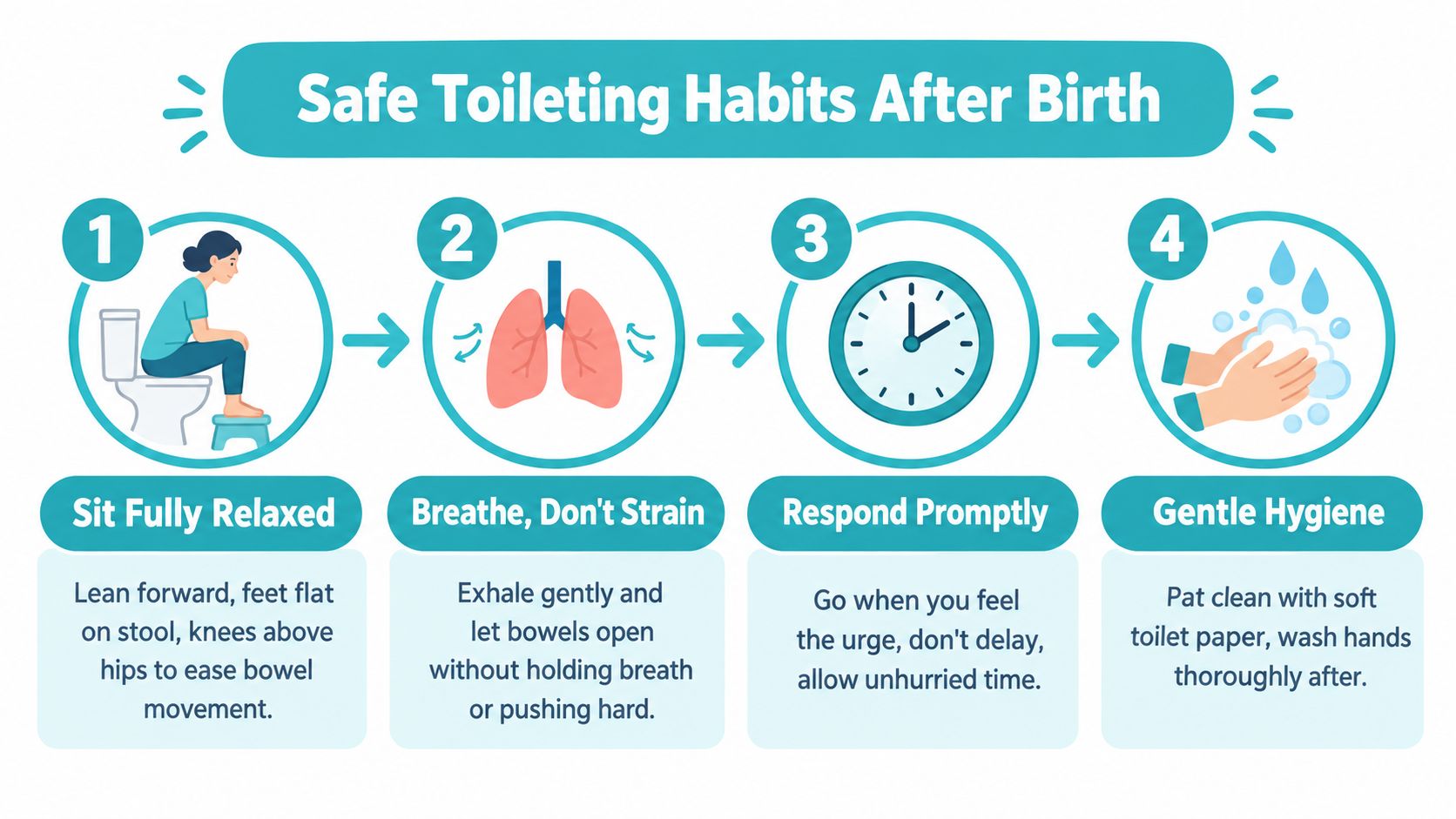
How to sit and breathe
- Use a supported position. Sit fully on the toilet seat, lean forward slightly, and place your feet on a small stool if needed so your knees are a bit higher than your hips. That position helps the anal outlet open and reduces the urge to strain.
- Exhale during effort. If stool does not come easily, avoid breath-holding and hard pushing. Breathe in, then exhale slowly while you let your belly soften.
- Let the pelvic floor release first. Many postpartum patients go straight to pushing. If the muscles are still guarding, pushing against that tension makes emptying harder.
- Go when you have a real urge. Waiting too long often means drier, firmer stool and more force on the next trip.
- Get off the toilet if nothing is happening. Ten minutes of repeated pushing usually makes symptoms worse. Reset, walk a bit, hydrate, and try again later.
Hydration and stool consistency count here. Standard postpartum guidance commonly includes enough fluid intake to keep stool soft and a clear warning to avoid straining during early healing. If your bowels are sluggish in the first days after birth, stool softeners may help when your medical team recommends them.
A visual walkthrough can help if this feels hard to picture.
What “pelvic floor exercise” should look like early on
Early rehab is not a high-rep kegel challenge. It is targeted retraining.
Pelvic floor muscle training has support in postpartum recovery, including the Cochrane pelvic floor training review, but the way you apply it matters. A good early program uses low-strain contractions, both sustained holds and quick squeezes, full relaxation between reps, and practice timing the contraction before a cough, lift, or position change. That last piece helps rebuild the protective brace reflex that often feels absent after delivery.
One-size-fits-all advice falls apart. A patient with stool leakage after OASI may need prompt assessment of sphincter function and scar healing. A patient with constipation, incomplete emptying, and urgency may need down-training, defecation mechanics, and coordination work first because more squeezing can make emptying worse.
Practical rule: If your exercise program does not teach relaxation, bowel-emptying mechanics, and how to contract before a cough or lift, it is incomplete for postpartum bowel symptoms.
If constipation is part of the picture, treatment often has to start there. A focused plan for pelvic floor therapy for constipation can help when the problem is not only weakness, but also difficulty coordinating the muscles to let stool pass.
What doesn't work well
A few habits routinely backfire:
| Habit | Why it causes trouble |
|---|---|
| Hovering over the toilet | Keeps the pelvic floor active instead of relaxed |
| Repeated hard pushing | Increases pressure on healing tissue |
| “Just in case” straining | Reinforces a poor emptying pattern |
| Fast, forceful kegels all day | Can raise muscle tension and worsen emptying |
Good bowel control after childbirth usually starts with lower pressure, softer stool, and better timing. Strength still matters, but early recovery goes better when the muscles can both contract and let go at the right moment.
Recognizing the Impact of Perineal Trauma
You get to six weeks postpartum, the stitches look closed, and everyone assumes the hard part is over. Then gas slips out without warning, or stool control feels less reliable than it did before birth. At that point, the question is not whether to do more kegels. The question is what was injured.
The treatment plan changes based on the mechanism. A repaired anal sphincter injury needs a different exam and a different timeline than bowel leakage driven mainly by nerve stretch, scar restriction, poor pressure management, or pelvic floor overactivity. I see women get stuck when those problems are treated as if they are interchangeable.
When the sphincter itself was injured
The highest-risk group is women with obstetric anal sphincter injury, or OASI. These are third- and fourth-degree tears that extend into the anal sphincter complex.
A prospective cohort of first-time mothers found higher bowel control problems after OASI than after uncomplicated vaginal birth. Anal incontinence incidence after OASI was 24% overall at 24 weeks postpartum, fecal incontinence alone occurred in 9%, fecal incontinence at 6 weeks was 26.6% versus 11.2% in vaginal controls, the gap remained at 6 months, and historical data reviewed in that paper also included stool incontinence in 7.8% of women with third- or fourth-degree tears, according to the prospective OASI cohort study.
That matters clinically because a sphincter injury is not just a “weak pelvic floor” problem. It raises the odds that symptoms are tied to structural damage, scar behavior, and impaired closure pressure. Those patients often need earlier follow-up, clearer bowel guidance, and a more specific rehab plan than a standard postpartum sheet provides.
When nerves and support tissues are the bigger issue
Some women have no major tear documented and still cannot control gas well, cannot defer urgency, or feel disconnected from the muscles. In that situation, I am more suspicious of pudendal nerve stretch, pressure-related inhibition, scar sensitivity from smaller tears or episiotomy, or a pelvic floor that grips hard but does not coordinate well.
This is why the postpartum exam has to go beyond “you're healed.”
A useful assessment asks:
- Was there a documented third- or fourth-degree tear?
- Were forceps used?
- Do you get urgency with very little warning?
- Can you contract the pelvic floor, and can you fully relax it?
- Does stool consistency make control harder?
- Is the scar tender, restricted, or pulling with bowel movements?
A weak squeeze, a delayed squeeze, and a repaired sphincter defect are different problems. They should not get the same exercise prescription.
A lot of women also do not know what degree of tear they had. Ask for the delivery record. Ask someone to explain it in plain language. Even education focused on prevention, such as when to start perineal massage, helps frame why perineal tissue history matters when bowel symptoms show up after birth.
The practical takeaway
Forceps delivery, a severe tear, or ongoing loss of gas or stool control changes the risk picture. Those findings should push the conversation past generic postpartum advice. Early referral matters most when symptoms may reflect a sphincter injury that needs to be identified, not guessed at.
Knowing When to Seek Specialized Care
At six weeks postpartum, many women are told everything looks healed. Then they get home, feel a sudden bowel urge while feeding the baby, and realize they do not have enough warning to make it to the bathroom. That is the point where “give it time” stops being useful advice.
Some bowel symptoms do settle as tissues calm down and routines normalize. Others point to a problem that needs a closer look now, especially if the issue may be a sphincter injury rather than simple weakness. A review of postpartum anal incontinence reports that symptoms are common after vaginal birth, are strongly associated with third- and fourth-degree tears, and may persist for months in a meaningful group of women, even though some improve within the first year, according to the review on postpartum anal incontinence and persistence.
Signs that should move you past wait-and-see
Early referral makes the most sense when the pattern suggests more than routine postpartum recovery:
- A known OASI. Obstetric anal sphincter injury needs follow-up that is more specific than a standard postpartum exercise sheet.
- Urgency with very little warning. If the bowel urge arrives and you cannot defer it, I worry about more than deconditioning.
- Ongoing loss of gas or stool control. Repeated leakage deserves an exam, even if it is intermittent.
- Constipation with smearing or leakage. That pattern often reflects poor coordination, incomplete emptying, or both.
- Symptoms that are not clearly improving over the first few weeks. Waiting longer can delay the right diagnosis.
- Major life restriction. If you are skipping walks, avoiding errands, or planning every trip around toilets, the problem is already affecting recovery.
Timing matters here. Women with a repaired sphincter injury often need confirmation that the repair is functioning as expected. Women without a major tear, but with poor bowel control, may need assessment for pudendal nerve stretch, sensory changes, scar restriction, or a pelvic floor that can squeeze but not relax well. Those are different problems. They should not all get the same kegel program.
Why supervised care often works better than generic exercises
Pelvic floor muscle training by itself does not fix every postpartum bowel-control problem. A Cochrane review found no clear evidence that pelvic floor muscle training alone reduces late postpartum fecal incontinence compared with no training, based on limited trial data. That fits what I see in clinic. The missing piece is often diagnosis, technique, and follow-up.
A supervised program can address the actual driver of symptoms. That may mean pressure management, bowel-emptying mechanics, scar work, rectal urge retraining, coordination training, or strength work if true weakness is present. For women who need that level of guidance, bowel incontinence physical therapy is usually more useful than repeating contractions without knowing whether the muscles are responding well, guarding, or working against the task.
One more practical point matters. Early referral is not only about starting therapy sooner. It is also about getting the right specialist involved if therapy is not enough. Persistent leakage after OASI may warrant urogynecology or colorectal follow-up. Suspected nerve-related symptoms still benefit from pelvic floor rehab, but the timeline and goals are different, and women deserve that explained clearly.
Managing Risks and Supporting Healing
Daily habits either protect healing tissue or keep provoking it. Most women don't need a perfect routine. They need one that reduces pressure, keeps stool easy to pass, and avoids overloading the pelvic floor before it's ready.

Build a lower-pressure day
Start with food and fluid. Soft, formed stool is easier to control than stool that is very hard or very loose. Many women do better when meals are regular, fluids are steady across the day, and constipation triggers are noticed early instead of after several missed bowel movements.
A simple framework helps:
- Keep fluids steady. Sip through the day instead of trying to catch up all at once.
- Choose stool-friendly meals. Oatmeal, fruit, cooked vegetables, and other well-tolerated fiber sources are often easier on an early postpartum system than irregular eating.
- Reduce pressure spikes. Exhale with lifting, especially when handling the infant car seat, laundry basket, or stroller.
- Delay impact work. Running, jumping, and aggressive core work can wait until symptoms, tissue healing, and pressure control support them.
Protect irritated tissue too
Sometimes the bowel-control issue is happening alongside hemorrhoids, perineal soreness, or skin irritation from wiping. That doesn't cause incontinence by itself, but it can make bowel movements more stressful and make women avoid emptying when they should. If the area is irritated, some women like to discuss soothing over-the-counter options such as hemorrhoid cream with witch hazel with their pharmacist or clinician.
Gentle care helps. Harsh wiping, repeated straining, and rushing through bathroom visits usually make the area feel worse.
Activity choices that help instead of hurt
Walking is usually a better early choice than pushing back into workouts that create repeated downward force. If an exercise increases urgency, pressure, heaviness, or leakage during or after the activity, that's useful feedback. The body is telling you the load exceeds current capacity.
Bowel control after childbirth improves more smoothly when the pelvic floor gets a chance to recover under reasonable load. The goal isn't inactivity. The goal is progression without repeated strain.
Planning Your Path to Recovery
Most postpartum bowel issues don't need panic. They do need a plan. The strongest recoveries usually happen when women stop guessing and start matching the treatment to the actual problem.
A realistic sequence
Think in milestones, not overnight fixes.
First, make bowel movements easier. That means soft stool, no repeated straining, and better toilet mechanics. Next, rebuild control with low-strain pelvic floor work that includes both contraction and relaxation. After that, add pressure management into real life, especially coughing, lifting, carrying, and exercise.
If symptoms persist, the next step isn't more random squeezing. It's assessment. Someone needs to determine whether the pattern points more toward sphincter injury, nerve recovery, scar mobility limits, bowel habit problems, or a coordination issue.
Questions worth asking your provider
Bring specific questions to your postpartum or pelvic health visit:
- What degree of tear did I have
- Was my anal sphincter involved
- Are my symptoms consistent with nerve stretch, muscle injury, or both
- Should I see pelvic floor physical therapy, colorectal care, or both
- What activity limits make sense for my symptom pattern right now
Those questions move the conversation from reassurance alone to actual decision-making.
Recovery is rarely one-size-fits-all
The women who struggle most are often the ones who were told everything was normal when their symptoms were clearly disruptive. Some do improve with time. Some need guided rehabilitation. Some need imaging, colorectal input, or a more careful postpartum follow-up than they initially received.
Support around meals can help during this stage too, especially if irregular eating is making constipation worse. A practical planning tool like the AI Meal Planner pregnancy guide can give you ideas for simple, consistent meals while you're juggling newborn life and recovery.
The main thing I want women to hear is this. Persistent bowel symptoms after birth are a signal, not a personal failure and not a sentence to live with forever. Good care starts with naming the problem accurately and acting on it early.
If you're dealing with gas leakage, urgency, or stool leakage after delivery, Lake City Physical Therapy offers pelvic floor evaluation and treatment that can sort out whether the issue is more about strength, coordination, scar healing, or pressure management. Their team works with postpartum patients on practical rehabilitation for bowel control after childbirth and can help you decide when self-care is enough and when more specialized treatment is the right move. Visit Lake City Physical Therapy to learn more.

