C Section Scar After 1 Year: What Healing Really Looks Like
“Just rub it” is often the first advice people hear about a C-section scar after 1 year. It's also incomplete. A closed incision tells you that the skin barrier has healed, not that every tissue layer underneath moves freely, that irritated nerves have settled, or that pelvic symptoms come from the skin at all.
At this stage, the useful question isn't just whether the scar looks normal. It's which layer is producing the symptom, and whether massage is appropriate for that pattern. A scar can be cosmetically quiet while causing numbness, burning, pulling, restricted movement, or discomfort during sex. Some symptoms belong with a pelvic-health physical therapist. Others require an obstetrician-gynecologist and imaging.
Why a One-Year C-Section Scar Is Not as Healed as It Looks

A scar can look quiet while the tissue beneath it is still changing. Skin closure happens earlier, but collagen continues to reorganize beyond 12 months, altering how the scar bends, stretches, and transfers force. Between roughly six and twelve months, the fascial layer may gradually become less thick and more aligned with surrounding tissue, yet it can remain less mobile than uninjured fascia. That difference may contribute to firmness, itching, tethering, or sensitivity even when the incision looks settled. An infographic explaining why C-section scars continue to heal and cause symptoms beyond one year.
The scar is also part of a connected abdominal system. Skin, fatty tissue, fascia, muscle, the peritoneal lining, and the uterine wall heal on different schedules. A fascial restriction can reduce the sliding needed for trunk extension or rotation. You may notice it when reaching overhead, lifting your child, coughing, or rolling in bed, although the surface line itself appears tidy.
A simple analogy helps: the skin is the cover of a book, while the deeper tissues are its pages and binding. A smooth cover does not prove that the binding moves normally. Likewise, a neat incision does not show whether deeper tissue is gliding comfortably.
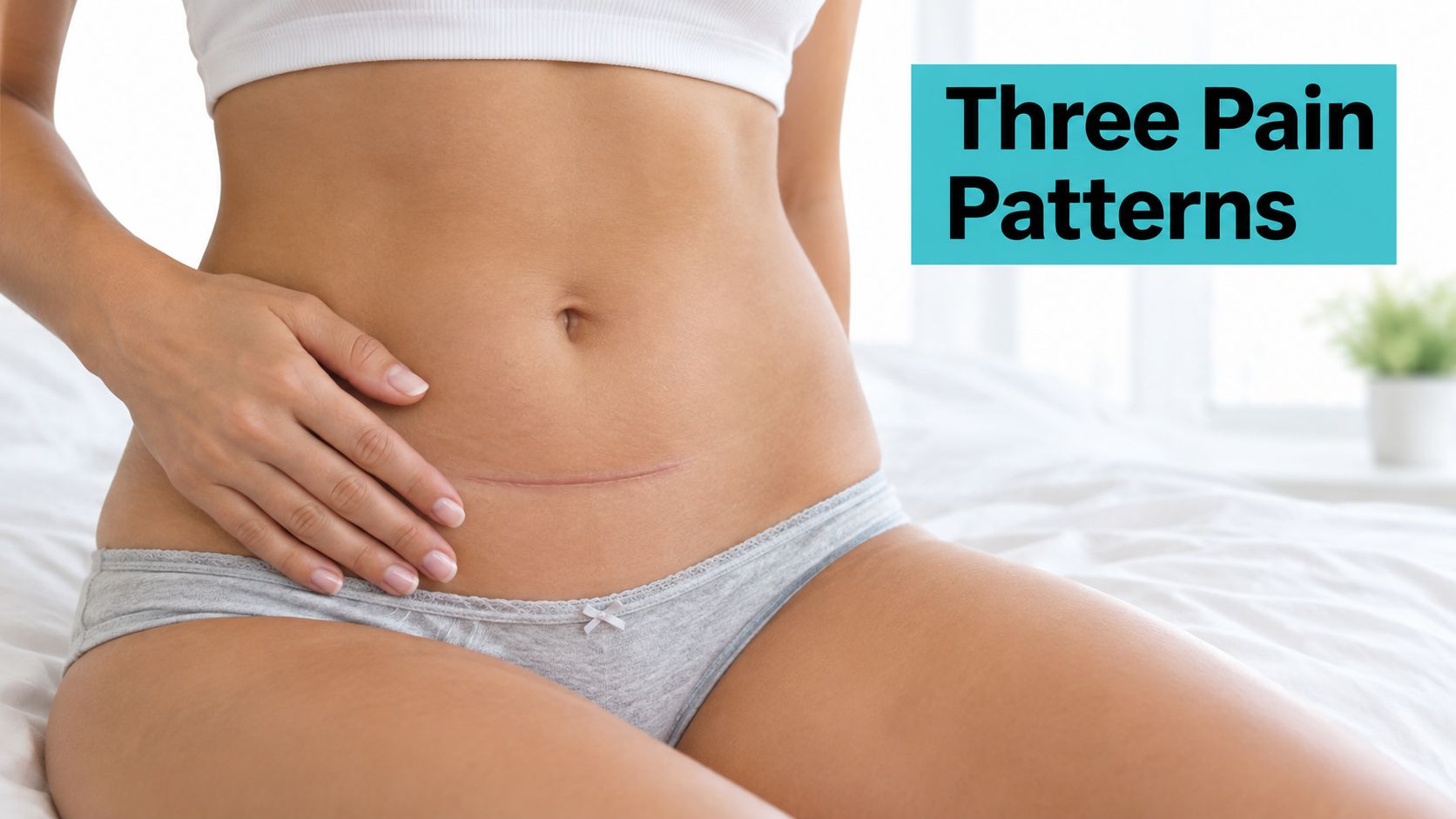
Three layers of symptoms
Persistent symptoms usually fit one of three broad patterns:
- Surface symptoms, including numbness, itching, tenderness, color change, or tight skin.
- Abdominal-wall symptoms, including burning, pulling, reduced glide, or pain during loading and movement.
- Pelvic or uterine symptoms, including cyclical pain, unusual bleeding, painful intercourse, or fertility difficulty.
Massage may help restricted, non-irritable tissue, but rubbing a burning or highly sensitive scar can aggravate symptoms. A pelvic-health physical therapist can assess scar mobility, abdominal-wall loading, breathing mechanics, and pelvic-floor coordination, then distinguish nerve sensitivity, contracture, adhesion-related restriction, and muscle guarding.
For earlier incision-care basics, see the C-section recovery guide for new parents. Persistent symptoms at one year call for a more specific assessment than routine wound care.
What a Healed Scar Should Look and Feel Like at 12 Months
A one-year scar can still look different from the surrounding skin without being unhealthy. It may be flat, slightly raised, pink, brown, or silvery, depending on your skin tone and how your collagen has reorganized. Some scars remain firmer than nearby tissue, and the line may feel less flexible when you pinch or move the skin.
Sensation can also be uneven. You might notice a numb patch above or below the incision, intermittent itching, mild tightness when twisting, or a brief twinge that disappears quickly. These experiences don't automatically signal a complication. Small nerves can be disrupted during surgery, and the abdominal wall may continue adapting as you return to exercise, lifting, and sexual activity.
Normal doesn't mean you must ignore it
The useful distinction is stable and manageable versus persistent, worsening, or function-limiting. A small area of numbness that isn't changing may be part of the scar's sensory history. Tightness that prevents a full stretch, causes you to avoid movement, or repeatedly appears during lifting deserves a closer look.
Reported continuous post-cesarean scar pain has been estimated at approximately 10–30%, with higher risk after repeat cesarean delivery, wound infection, hematoma, or a classical incision. Clinical discussion of persistent post-cesarean scar pain describes why pain quality and triggers matter more than appearance alone.
A practical baseline: If the scar is closed, stable, and only mildly different in color or sensation, observation may be reasonable. If it changes how you move, sleep, exercise, have sex, or care for your child, it's worth assessing.
Seek medical evaluation for new redness, warmth, drainage, fever, a bulge, or escalating pain. Those signs aren't a reason to press harder on the scar.
Reading the Three Pain Patterns Your Scar Can Produce
Pain becomes easier to discuss when you describe its behavior rather than calling everything “scar tissue.” The same incision can be associated with very different mechanisms, and each pattern points toward a different examination.
Burning or electric pain suggests nerve sensitivity
Neuropathic pain often feels burning, electric, prickly, or sharply localized. Light clothing or gentle touch may feel unpleasant, and one small spot can be much more reactive than the rest of the incision. Irritation or entrapment of the ilioinguinal or iliohypogastric nerves is one possible contributor.
Ask yourself whether the pain follows a narrow area, whether it radiates away from the scar, and whether a particular point reliably reproduces the familiar sensation. Those details are more useful to a clinician than a general statement that the incision hurts. A pelvic-health therapist or physician can assess sensation and determine whether a nerve-focused referral is appropriate.
Deep pulling points toward restricted tissue glide
Contracture tends to feel less like an electrical shock and more like deep pulling, tension, or resistance. You may notice it when extending your trunk, reaching overhead, rolling, coughing, lifting, or trying to lengthen the front of your body. The skin may look normal, but the tissue doesn't seem to slide easily over what lies beneath it.
A gentle movement comparison can be informative. Notice whether one direction feels more restricted than another, without forcing the area or trying to break through pain. A clinician can assess mobility in multiple directions and compare the scar with the surrounding abdominal wall.
Adhesion-related symptoms are deeper and less obvious
Adhesions can restrict movement between the abdominal wall and deeper tissues. The sensation may be tethering, dragging, or a deep pull, rather than pain that you can reproduce by touching the skin. Some people notice it with trunk movement or pressure changes, while others experience symptoms that seem pelvic rather than abdominal.
These categories can overlap. A person may have a numb surface, a sensitive nerve, and guarded abdominal muscles at the same time. That's why self-massage shouldn't replace an examination when symptoms persist.
When a Quiet Scar Still Changes How Your Body Moves
Consider a representative example. A mother reaches her one-year checkup with a flat, pale incision and no open areas. She tells the clinician that her low back aches after lifting her toddler, but she doesn't connect that discomfort to the scar because the scar itself rarely hurts.
During movement, she avoids fully extending her trunk. She shifts weight to one side when picking up the child and holds her breath during the hardest part of the lift. The abdominal wall isn't gliding evenly, so other areas take on work that the scarred region isn't handling comfortably.
The body can compensate without announcing the cause
A restricted abdominal wall can affect how the ribs, diaphragm, trunk muscles, and pelvic floor coordinate. If you brace constantly or avoid lengthening the front of your body, your breathing may become shallow and your pelvic floor may stay overactive instead of responding naturally to pressure.
That compensation can show up as back discomfort, hip tightness, painful intercourse, urinary urgency, or difficulty relaxing during bowel movements. None of those symptoms proves that the C-section scar is responsible. They do show why a skin-only assessment can miss the functional pattern.
Movement is part of the scar history. Ask not only, “Does it hurt when I touch it?” Ask, “What do I avoid, brace through, or do differently because of it?”
A pelvic-health physical therapist can observe breathing, lifting, trunk extension, abdominal-wall loading, and pelvic-floor coordination together. The examination may include gentle scar mobility, sensory screening, functional movement, and questions about coughing, exercise, intercourse, and daily care tasks.
The aim isn't to force the tissue to behave like it did before surgery. It's to identify the specific restriction and gradually restore comfortable movement when that approach is medically appropriate.
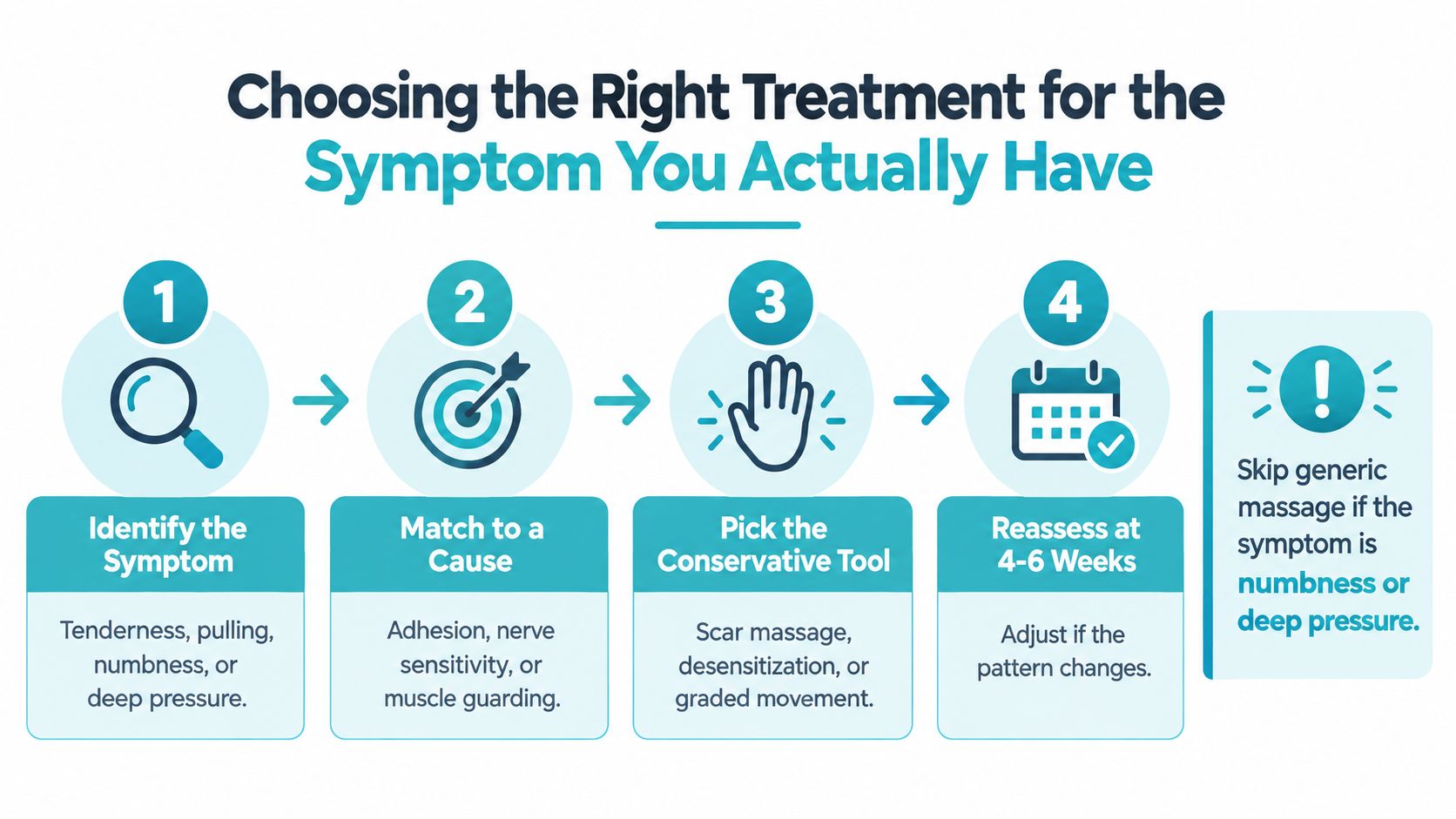
Choosing the Right Treatment for the Symptom You Actually Have
Massage isn't a universal treatment category. It's one possible tool for one layer of one problem. Start with the dominant symptom, then choose the intervention that matches it.
For superficial tethering or sensitivity, a clinician may use gentle scar mobility, graded desensitization, breathing coordination, and progressive exposure to touch. The pressure should be tolerable, not aggressive. The goal is to improve comfort and movement, not to create bruising or a flare.
For painful intercourse, pelvic-floor guarding, or urinary symptoms, pelvic-floor therapy may be more relevant than direct scar work. Treatment can include external and internal assessment when appropriate, down-training overactive muscles, coordination exercises, and strategies for reducing protective tension.
For pain during lifting or trunk extension, abdominal-wall rehabilitation may focus on breathing mechanics, load transfer, gradual strengthening, and restoring movement confidence. The therapist may modify how you exhale, brace, hinge, and carry before adding more demanding activity.
For swelling, seek assessment from a clinician trained in lymphedema care, including oncology-informed physical therapy when relevant. Swelling changes the treatment decision and shouldn't be handled with increasingly forceful scar pressure.
A simple matching guide
| Dominant symptom | More appropriate starting point | What to avoid assuming |
|---|---|---|
| Tender or tethered skin | Scar assessment and graded mobility | That harder pressure is better |
| Burning or electric pain | Sensory and nerve-focused examination | That all burning is adhesions |
| Painful sex or pelvic-floor tension | Pelvic-floor evaluation | That external massage will solve it |
| Pulling with lifting or extension | Abdominal-wall and movement rehabilitation | That weakness is the only issue |
| Abnormal bleeding or fertility concerns | Obstetric-gynecologic evaluation and imaging | That the external scar explains it |
A 2025 study on postpartum cesarean-healing information warned that excessive pressure or massage performed too early may disrupt healing and contribute to hypertrophic or keloid scarring, emphasizing clinician guidance before self-treatment. Read the study on postpartum cesarean-healing information
For a practical overview of scar-focused rehabilitation, you can review cesarean scar treatment options. If the concern is primarily cosmetic and you're considering procedural care, discuss the diagnosis first, then explore options such as advanced scar revision options with a qualified provider.
What the Evidence Actually Says About Silicone and Massage
Silicone sheets can improve the appearance of some external scars, but they are not a treatment for every symptom that remains after a C-section. A randomized trial found that silicone sheets produced statistically better patient-rated appearance than paper tape at 12 months. The difference was small and unlikely to matter clinically, and the Vancouver Scar Scale showed no significant advantage for silicone.
| Outcome measure | Silicone | Paper tape | Clinical significance |
|---|---|---|---|
| Patient-rated appearance | Statistically better | Comparison group | Difference was small and unlikely to be clinically meaningful |
| Vancouver Scar Scale | No significant advantage shown | Comparison group | No significant between-group advantage |
Use the scar's appearance and symptoms to set expectations. If it is flat and pale at one year, silicone sheets are unlikely to change much. Consider them when the skin remains raised, red, or itchy after month six, particularly if those symptoms are limited to the scar surface. Silicone cannot release deeper adhesions, restore abdominal-wall strength, or address a problem inside the pelvis.
Massage also needs a symptom-based limit. Firm rubbing is not automatically better treatment. It can aggravate neuropathic pain, swelling, or protective muscle guarding. Stop if contact makes the pain sharper, spreads burning, or leaves you more sore for an extended period.
Scar tissue behaves like a layered seam, not a mark sitting only on the skin. Gentle, graded contact may help some superficial tightness, but the appropriate pressure depends on tissue response, medical history, and whether symptoms are external or internal. Guidance on C-section scar massage can help you compare techniques before working directly on the area.
Use silicone for a raised, red, or itchy external scar. Do not use it instead of evaluation for abnormal bleeding, fertility changes, deep pelvic pain, or ongoing movement restriction.
A worsening response is a reason to stop, not proof that the scar is finally releasing.
The Uterine Scar the Outside Can't Show
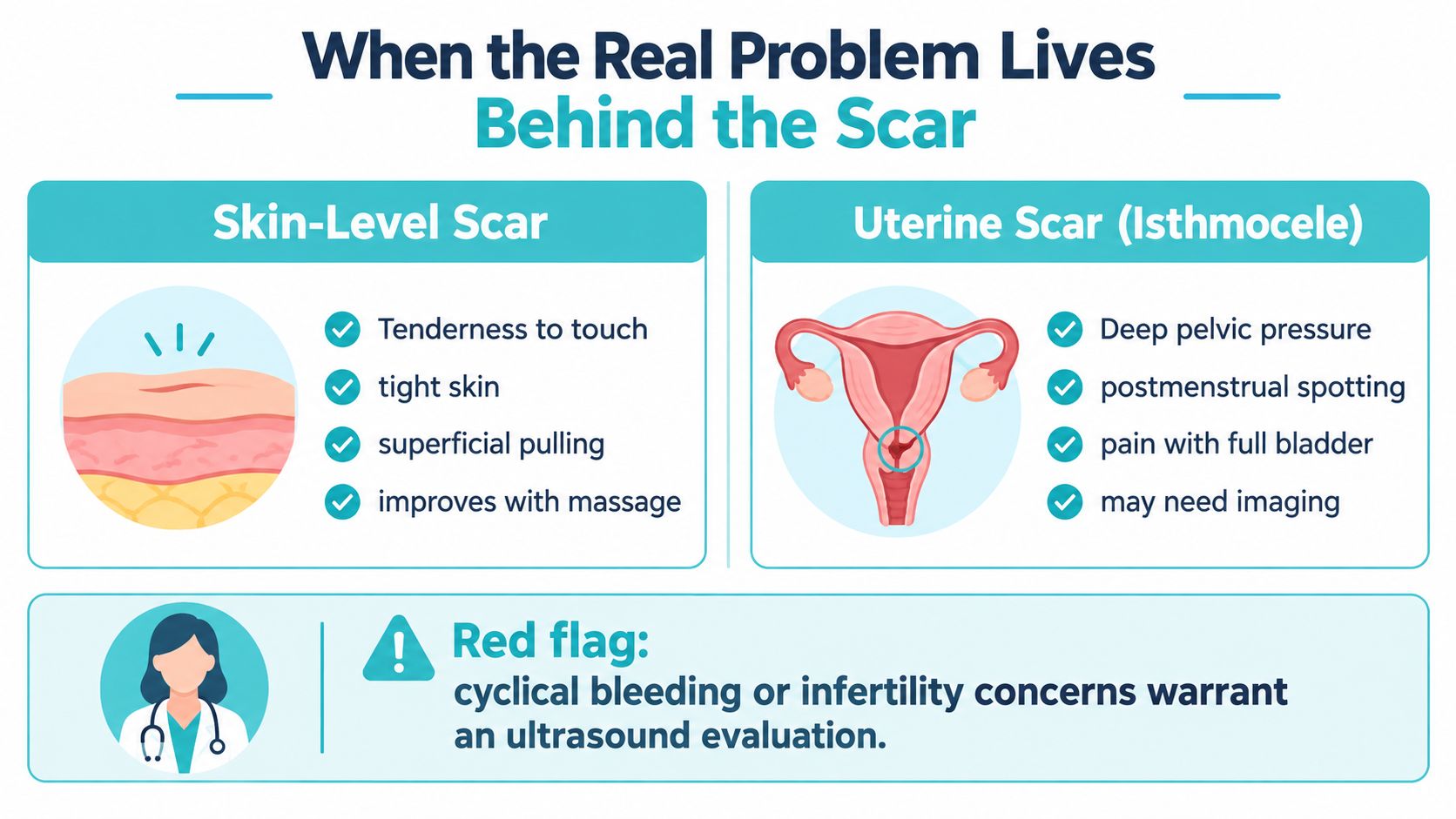
A smooth abdominal scar does not prove that every layer beneath it has healed normally. An isthmocele, also called a cesarean-scar niche, is an indentation or defect in the uterine wall at the previous incision site. It may be invisible from the outside, so the appearance of your skin cannot rule it out.
Imaging estimates depend on the test used. Studies have identified isthmoceles in roughly 24–70% of women examined with transvaginal ultrasound and in more than 50% of some sonohysterography study groups at 6–12 months after cesarean delivery. The same review reports that prevalence among asymptomatic women was estimated at roughly 24% in one ultrasound cohort, showing why an image alone cannot establish the cause of symptoms. Review the evidence on cesarean-scar niches
Symptoms that redirect the evaluation
Your symptoms and their timing matter more than the presence of an imaging finding. Arrange an obstetrician-gynecologist assessment for:
- Postmenstrual spotting, especially when it is new.
- Painful periods or cyclical pelvic pain.
- Deep pain during intercourse.
- Abnormal discharge or persistent pelvic pressure.
- Difficulty conceiving after trying to become pregnant.
- Internal-feeling pain, rather than tenderness limited to the abdominal skin.
An ultrasound finding does not automatically explain symptoms or mean surgery is needed. The clinician compares the image with your bleeding pattern, examination, reproductive goals, and other possible causes.
Skin treatment cannot repair a uterine defect
Scar mobilization reaches accessible soft tissue. It may help a superficial tether, abdominal-wall sensitivity, or movement restriction when those findings are present. It cannot be assumed to change a niche inside the uterus, and superficial mechanotherapy is not established as treatment for that defect.
That distinction matters when someone with postmenstrual spotting keeps increasing massage because the outside scar feels tight. More pressure cannot investigate or repair a uterine indentation, and it may irritate sensitive tissue.
If symptoms are mainly deep, cyclical, or connected with bleeding or fertility, begin with an OB-GYN or imaging specialist. Abdominal-wall restriction or pelvic-floor overactivity may also justify physical therapy. For education about C-section scar adhesions and related treatment considerations, use a source that explains how deeper adhesions differ from surface scar tightness.
Your One-Year Decision Pathway and When to Escalate
Start with safety. Don't self-massage a scar that has new or worsening redness, warmth, drainage, fever, a bulge, or rapidly escalating pain. Pregnancy-related concerns, new bleeding patterns, severe pelvic pain, and fertility difficulty also warrant medical review rather than a home treatment experiment.
Choose the care pathway that matches the pattern
Surface or movement symptoms usually fit a pelvic-health physical therapy assessment. This includes numbness, superficial tenderness, restricted skin glide, pulling with trunk extension, discomfort during lifting, or symptoms that change with abdominal-wall loading. The clinician can decide whether desensitization, gentle mobility, breathing work, and progressive strengthening are appropriate.
Bleeding, deep pelvic, or reproductive symptoms belong first with an obstetrician-gynecologist. The evaluation may include an examination and transvaginal imaging to assess a possible niche or another pelvic condition. Massage shouldn't delay that process.
Mixed symptoms may need combined care. For example, a person could have a superficial tether that affects movement and a separate uterine issue associated with postmenstrual spotting. Treating one layer won't necessarily resolve the other.
Reassess instead of escalating pressure
Conservative rehabilitation should have a clear response target. You might track whether lifting feels easier, whether trunk extension improves, whether touch is less threatening, or whether intercourse causes less guarding. If symptoms aren't improving after a reasonable trial, or if the pattern changes, return for reassessment instead of increasing pressure or adding more techniques.
Save this checklist:
- Describe the sensation: burning, electric, numb, itchy, pulling, or deep pressure.
- Record the trigger: touch, lifting, exercise, coughing, twisting, intercourse, periods, or bladder fullness.
- Check for red flags: fever, drainage, redness, warmth, bulging, worsening pain, bleeding, or fertility concerns.
- Choose the clinician: physical therapist for surface and movement issues, OB-GYN for pelvic and uterine symptoms, or both when the patterns overlap.
- Reassess the plan: change course when symptoms persist, worsen, or fail to match the original explanation.
A one-year C-section scar isn't a single problem to rub away. The right next step depends on whether the skin, nerves, abdominal wall, pelvic floor, or uterine scar is producing the symptom.
Lake City Physical Therapy offers women's health physical therapy for postpartum abdominal-wall restrictions, scar sensitivity, pelvic-floor symptoms, and return to activity. Visit Lake City Physical Therapy to review available clinic and telehealth options and schedule an evaluation matched to your symptoms.

