Chest Wall Pain After Mastectomy: Relief & Recovery
You may be a few weeks, months, or even years out from surgery. The incision is closed. Treatment may be over. People around you may assume the hard part is behind you. But your chest still feels tight, hot, numb, pulling, or sharp when you reach for a seatbelt, roll onto your side, hug someone, or lift a grocery bag.
That experience is common, and it deserves more than a quick reassurance to “give it time.” Chest wall pain after mastectomy is real. It can come from irritated nerves, but it can also come from muscles, fascia, scar restriction, rib mechanics, shoulder guarding, and the way your body adapted after surgery and radiation. Those details matter, because the right treatment depends on the right cause.
Your Life After Mastectomy and The Pain No One Mentioned
You finish treatment, the incision has healed, and everyone expects life to settle down. Then you reach for a plate, fasten a seatbelt, or try to sleep on your side, and the chest wall reminds you that recovery is still in progress.
I hear versions of this every week in oncology PT. “My scar feels stuck.” “The side of my chest burns.” “My shoulder and underarm hurt more now that I'm trying to do normal things again.” Those symptoms are common after mastectomy, but they are often poorly explained.
Persistent pain after breast surgery is common enough that it has a formal name, post-mastectomy pain syndrome, as noted earlier in this article. The label matters less than what is causing your pain. In practice, I look beyond the incision. Nerves can stay irritated, but muscles, fascia, scar tissue, ribs, and shoulder mechanics can also become a major part of the problem. That musculoskeletal piece is easy to miss, especially when the conversation stays focused on nerve pain alone.
That is one reason some women are told everything looks healed while daily movement still hurts.
Chest wall pain after mastectomy can show up as burning or sensitivity, but it can also feel like pulling with reaching, pinching near the scar, tightness across the chest, aching along the ribs, or pain that spreads into the shoulder blade and underarm. Those patterns affect real parts of life. Getting dressed takes longer. Exercise feels risky. Sleep becomes fragmented. Even a hug can make you brace.
Patients often worry that pain means they caused damage or that they should have pushed harder sooner. Usually, neither is true. The body often develops protective movement patterns after surgery and radiation. If those patterns are not addressed, pain can continue long after the skin has closed.
The good news is that persistent pain is not something you have to tolerate. Relief starts with sorting out whether the main driver is nerve irritation, musculoskeletal restriction, or a mix of both, because each responds best to a different treatment approach.
Why Does My Chest Wall Hurt Understanding The Causes
Chest wall pain after mastectomy usually comes from more than one source. In clinic, I sort it into two broad categories. One is nerve-related pain from nerves that were stretched, irritated, or cut during surgery. The other is musculoskeletal pain from tissues that healed with stiffness, guarding, weakness, or altered movement. Many women have a blend of both, which is why a single explanation often feels incomplete.
Nerve pain and persistent sensitivity
Post-mastectomy pain syndrome is often described as pain in the chest, armpit, or inner arm that lasts well beyond normal tissue healing. It is commonly linked to neuropathic pain, including irritation of the intercostobrachial nerve. That helps explain why the skin can look healed while the area still feels raw, sharp, burning, or strangely overreactive.
Nerve-related pain tends to behave like an alarm system that does not fully settle. Light touch can hurt. A bra band, seatbelt, or shirt seam may trigger symptoms out of proportion to the pressure involved. Some patients also notice numbness in one area and painful sensitivity right next to it.
Radiation and high postoperative pain can increase the chance that the nervous system stays sensitized. That does not mean ongoing pain is inevitable. It means the nerve component deserves specific treatment instead of being brushed off as something you have to live with.
Musculoskeletal pain and movement-related strain
This is the part that gets missed most often.
After mastectomy, the pain is not always coming mainly from nerves. Muscles across the chest can tighten. Scar tissue can limit glide between layers of skin, fascia, and muscle. The ribs and thoracic spine can become less mobile. The shoulder blade can start moving differently because the body has been protecting the surgical area for weeks or months.
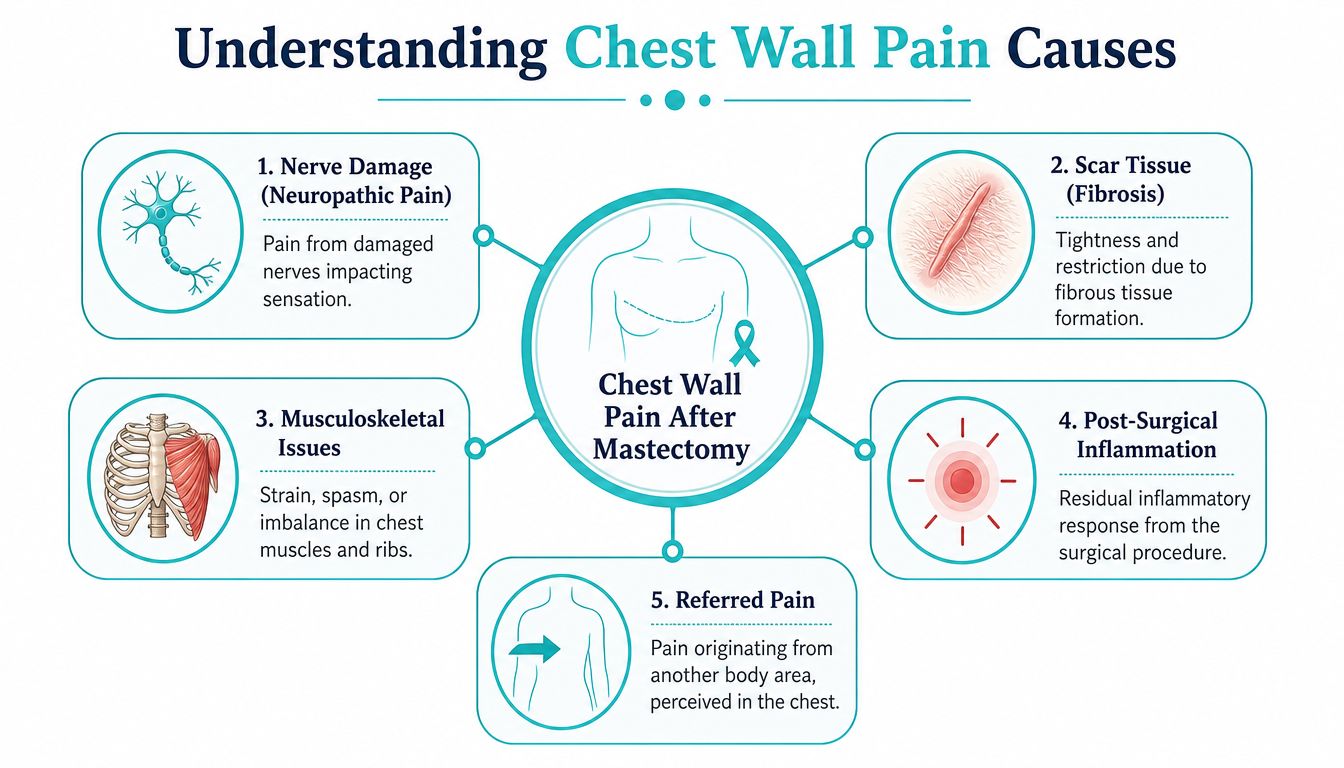
Those changes create a different pain pattern. Patients often describe pulling along the scar, pinching with reaching, aching along the ribs, heaviness in the chest, or pain near the shoulder blade that builds later in the day. That pattern points toward a mechanical problem, even when some nerve irritation is present too.
The AAPM&R discussion of PMPS highlights this clearly. It notes that chest wall pain after mastectomy is not always purely neuropathic and discusses underrecognized musculoskeletal contributors such as scapulothoracic bursitis, myofascial trigger points, and shoulder dysfunction. That matches what oncology physical therapists see every day. If shoulder mechanics are off and the chest wall is stiff, pain with dressing, reaching, lifting, and sleeping often follows.
Why the cause matters for treatment
The source of the pain changes the plan.
Nerve-dominant pain often responds best to desensitization, graded exposure to touch and movement, and strategies that calm an overprotective nervous system. Musculoskeletal pain usually improves when treatment restores chest wall mobility, scar mobility, rib and thoracic movement, shoulder range, and scapular control.
A practical clue helps. Burning, zinging, and skin sensitivity suggest a stronger nerve component. Pulling, pinching with motion, a stuck feeling, and pain that builds with posture or repeated arm use suggest a stronger musculoskeletal component.
Many women have both. That is why good care does not stop at naming the pain. It identifies what is keeping it going.
Decoding Your Symptoms and Recognizing Red Flags
You reach for a coffee mug, fasten a seatbelt, or roll onto your surgical side in bed, and the pain behaves in a very specific way. That pattern matters. It often gives better clues than the pain intensity alone.
Your job is not to label the tissue or guess the diagnosis. Your job is to notice the details. Where do you feel it? What movement brings it on? Does it burn at rest, or does it build with reaching, posture, and repeated arm use? Those answers help separate a pain problem that is mostly nerve-driven from one that also has a strong musculoskeletal component.

Common symptom patterns
Here is a practical way to sort what you are feeling:
| Sensation or pattern | More suggestive of | What patients often notice |
|---|---|---|
| Burning, stabbing, electric, zinging | Neuropathic pain | Skin sensitivity, pain with light touch, random sharp jolts |
| Numbness with painful sensitivity nearby | Nerve involvement | A patch that feels “dead” next to an area that feels overreactive |
| Pulling across the scar or chest | Scar or fascial restriction | Worse when reaching overhead or extending the arm |
| Deep ache near ribs, chest muscles, or shoulder blade | Musculoskeletal pain | Worse with posture, activity, fatigue, or repeated arm use |
| Pain under the arm with shoulder motion | Mixed pattern | Could involve nerve irritation, scar restriction, or shoulder mechanics |
Pain after mastectomy often shows up in the underarm, upper arm, scar area, side of the chest, or along the ribs. Some women feel one clear pattern. Many feel a mix. A burning patch near the scar can exist right alongside rib stiffness, guarded breathing, and a shoulder blade that is no longer moving well.
That mixed presentation is easy to miss. It is one reason some patients are told they have “just nerve pain” when part of the problem is mechanical and treatable with skilled movement-based care.
Clues that are useful in clinic
Certain descriptions point us in a direction quickly:
- “It burns or stings even when nothing touches it.” This suggests a stronger nerve sensitivity component.
- “It feels tight when I reach, stretch, or lie flat.” This fits better with scar restriction, chest wall stiffness, rib irritation, or muscle guarding.
- “My shoulder blade, underarm, or side ribs get worse later in the day.” This often points to movement compensation and overload, especially after repeated arm use.
- “My bra, shirt, or seatbelt bothers me.” Skin sensitivity can happen with nerve irritation, but it can also show up when the chest wall stays tense and protective for too long.
- “I can do a movement once, but repeated reaching sets it off.” That pattern often has a musculoskeletal driver.
One more point matters here. Long-lasting pain after breast surgery is recognized in the medical literature and in everyday practice. If you are months or years out and still hurting, that does not mean you missed your window to improve. It means the pain needs a more precise explanation and a more targeted plan.
Red flags that need medical attention
Some symptoms need prompt medical review by your surgeon, oncologist, or primary care team:
- Fever or chills
- Redness, warmth, drainage, or increasing swelling at the incision
- A new lump or a clear change in the surgical area
- Sudden or significant arm swelling
- New or worsening weakness in the arm or hand
- Shortness of breath, chest pressure, or symptoms that feel medically urgent
Trust a change in pattern. If the pain is new, severe, rapidly worsening, or clearly different from your usual symptoms, get it checked.
How We Diagnose Your Pain A Holistic PT Assessment
A good oncology physical therapy evaluation doesn't start with exercises. It starts with listening. The first visit is usually less about “fixing” and more about sorting out what's driving the pain.
What the first conversation usually covers
In an initial assessment, I want to know the full treatment story. Surgery type matters. Lymph node removal matters. Reconstruction, radiation, medication history, and the timing of symptoms all matter. A pain that began immediately after surgery behaves differently from pain that developed later as activity increased.
I also ask what the pain interrupts. Sleep. Reaching. Walking the dog. Drying your hair. Getting a shirt over your head. That functional piece is important because the goal isn't just lowering pain. It's restoring life around the pain.
If you can describe when the pain starts, what motion triggers it, and whether it feels burning, pulling, aching, or sharp, you're already giving your therapist valuable clues.
What the physical exam looks like
The exam is hands-on and movement-based. We look at how you stand, how you breathe, and whether you're unconsciously protecting the surgical side. Many women shift posture after treatment. The shoulder rounds forward, the rib cage stiffens, and the trunk stops rotating normally.
Then we test movement. Shoulder flexion, abduction, external rotation, trunk extension, thoracic rotation, and rib expansion all give useful information. A painful arc overhead suggests a different problem than pain at end range with a firm pulling sensation across the scar.
A therapist also checks:
- Scar mobility: Does the scar glide over the tissue beneath it, or does it feel tethered?
- Soft tissue tone: Are the pectorals, serratus, latissimus, upper trapezius, or intercostals overworking?
- Shoulder blade mechanics: Does the scapula upwardly rotate and glide well, or does it hitch and strain?
- Touch tolerance: Is the skin hypersensitive or numb?
- Strength and endurance: Can the shoulder girdle support daily tasks without overloading the chest wall?
Why this kind of assessment changes treatment
Specialized care is important. Two women can both say, “My chest hurts,” but one may need desensitization and nerve-calming strategies, while the other needs scar work, rib mobility, thoracic extension, and scapular retraining.
Sometimes the answer is mixed. That's common. The assessment helps prioritize what to treat first so you're not doing random stretches that aggravate symptoms or avoiding movement that would help.
The best plan is specific. It should explain what tissue seems involved, which movements are currently safe, what symptoms should improve first, and what setbacks to expect without panic.
Your Path to Relief The Power of Oncology Physical Therapy
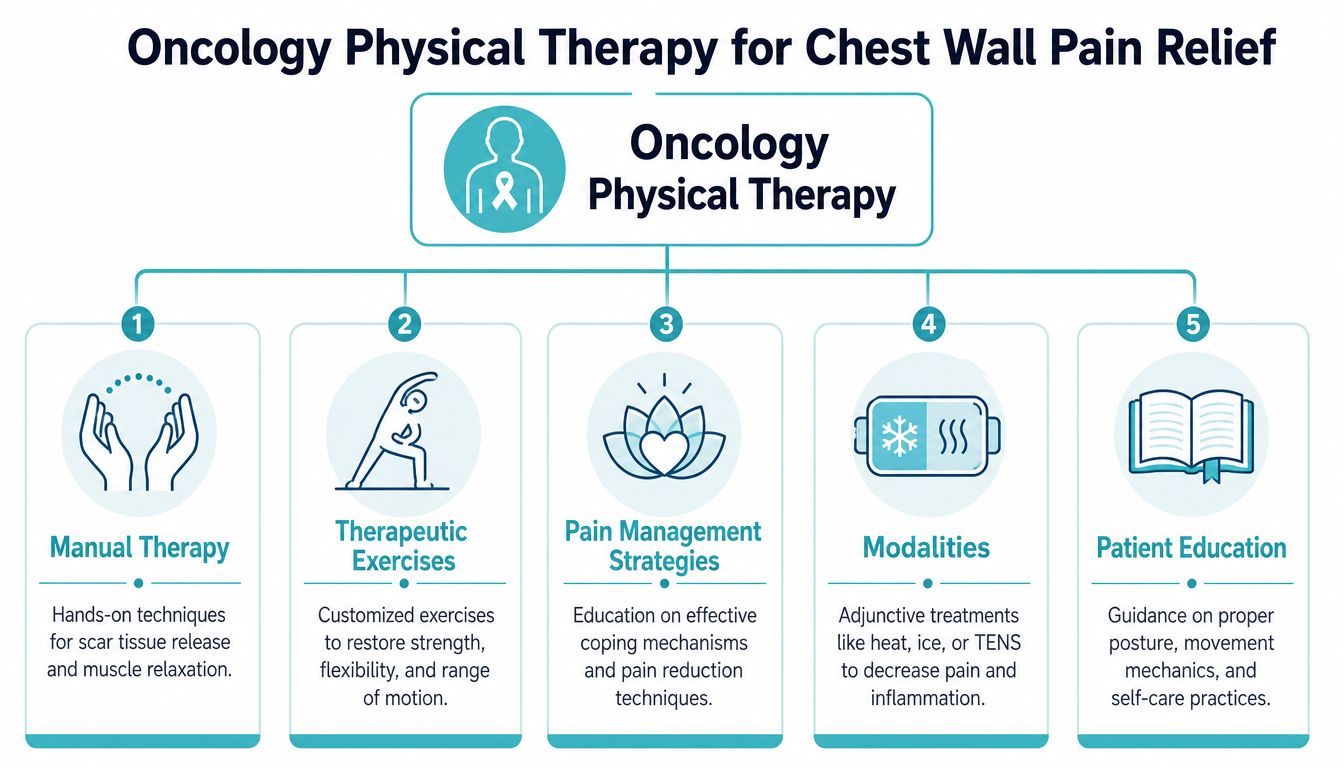
Recovery usually improves when treatment matches the actual pain generator. Specialized oncology physical therapy is useful because it looks at nerves, scars, movement, strength, swelling risk, and daily function together rather than treating each one in isolation.
Early guidance can make the process feel less uncertain. If you want a broader overview of what this field includes, this page on oncology physical therapy gives a useful picture of how rehabilitation supports cancer recovery.
Scar mobility work
A scar isn't a problem just because it exists. It becomes a problem when it stops layers from gliding. That can create a pulling sensation across the chest, a sense of restriction under the arm, or pain with reaching and rotation.
Scar mobilization uses gentle, graded manual techniques to improve skin and soft tissue movement. The pressure should be purposeful, not aggressive. In clinic, this may include skin rolling near the scar, directional glide work, fascial release around the chest wall, and teaching self-mobilization once the tissue is ready.
What usually doesn't help is rough, painful “breaking up scar tissue.” More force isn't better. Tissue responds best to consistent, tolerable input.
Range of motion and chest wall mobility
After surgery, many women stop using the shoulder and trunk normally. That protection makes sense at first. Later, it can become part of the problem.
Restoring motion often starts with low-threat movement:
- Supported shoulder flexion: Often done lying down or with a table slide.
- Gentle external rotation: Especially when dressing and hair care are limited.
- Thoracic extension and rotation: To reduce strain through the chest wall.
- Rib and breathing mobility: Because shallow breathing can reinforce stiffness.
The key is dosage. The right stretch creates a mild opening or pulling sensation that settles afterward. If an exercise causes a pain flare that lingers, the dose or choice is wrong.
A lot of patients also benefit from a whole-body model of healing rather than a narrow “stretch the chest” approach. Resources that discuss integrative rehabilitation in Salt Lake City can be helpful for understanding how movement, tissue recovery, and guided exercise fit together.
Posture and scapular retraining
Posture advice often gets oversimplified. This isn't about forcing your shoulders back all day. It's about giving the shoulder blade and rib cage better mechanics so the chest wall stops doing extra work.
Useful training might include:
- Lower trap and serratus activation: To support overhead motion
- Mid-back endurance work: So you don't collapse into guarding by afternoon
- Neck and upper chest relaxation: Because tension often shifts upward after surgery
- Functional reach practice: Teaching your body how to lift, carry, and reach without bracing
Pain around the side of the ribs or near the shoulder blade frequently improves when scapular movement improves.
Manual therapy for muscles, fascia, and ribs
Hands-on treatment is often most effective when it is precise. That can include soft tissue work to the pectorals and lateral chest wall, mobilization to restricted ribs, thoracic mobility work, and treatment to trigger points that refer pain into the breast or underarm region.
This is also where therapists can pick up patterns that imaging may miss. A rib that doesn't move well, a latissimus that overgrips, or a protective breathing pattern can all keep symptoms going.
Later in care, some women use symptom-calming tools at home. This video gives a simple example of movement-based support for the upper body:
Lymphedema precautions without fear
If lymph nodes were removed or radiation affected the area, exercise should be smart, not avoidant. Many women have been told conflicting things. Some become afraid to use the arm. Others return too quickly without monitoring symptoms.
Reasonable precautions include:
- Watching for heaviness, swelling, or fullness
- Building load gradually
- Using compression when medically indicated
- Protecting skin health
- Reporting new swelling early
The goal is confidence, not fragility. Avoiding the arm entirely usually leads to more stiffness and weakness.
Strength progression and returning to life
Eventually treatment has to move past symptom control. You need enough strength and endurance to live normally again.
That progression often includes:
- Foundational control: Breathing, scapular mechanics, gentle mobility
- Light resistance: Bands, bodyweight, supported carrying
- Functional loading: Lifting, pushing, pulling, and overhead tasks
- Return to preferred activity: Gardening, yoga, swimming, golf, childcare, or gym work
Recovery goes better when the program matches your goals. “Be able to carry laundry” is just as valid as “return to tennis.”
What works is usually steady, specific, and adaptable. What doesn't work is guessing, pushing through flares, or assuming all pain after mastectomy is untouchable nerve damage.
Collaborative Pain Management Strategies
A lot of women arrive in PT after hearing two versions of the same message. One clinician says the pain is nerve-related and offers medication. Another says it should fade with time. Both can be partly true, but neither explains the whole picture when the chest wall is stiff, the scar does not glide, the ribs are guarding, or shoulder mechanics have changed after surgery and radiation.
That is why pain management works best as a coordinated plan. Post-mastectomy pain is often mixed. Part of it may be neuropathic. Part may come from musculoskeletal problems that are commonly missed, such as myofascial restriction, protective muscle guarding, joint stiffness, or load intolerance through the chest and shoulder girdle. If treatment only targets one piece, progress often stalls.
Where medication and procedures fit
Medication can be useful when pain is intense enough to disrupt sleep, limit movement, or keep the nervous system on high alert. For symptoms that act more like nerve irritation, physicians may consider options such as gabapentin or topical medication. Those tools can reduce symptom intensity enough for you to move, breathe, and participate in therapy more comfortably.
Procedures also have a role in select cases. An ASRA review of post-mastectomy pain management describes options such as serratus plane blocks, pulsed radiofrequency, and neuroma-focused treatment when a specific pain generator is suspected. The trade-off is straightforward. These approaches may calm a stubborn pain source, but they do not restore chest wall mobility, scar movement, shoulder control, or tolerance for daily activity on their own.
PT as the coordination point
In practice, PT often helps sort out what the pain is coming from. Pain that worsens with reaching, posture, lifting, coughing, or turning in bed often has a strong musculoskeletal component, even if there is also burning, numbness, or sensitivity. That distinction matters because the treatment plan changes. Nerve sensitivity needs calming. Restricted tissue needs mobility work. Weak, guarded movement patterns need graded loading.
A good oncology PT assessment also helps the rest of the team make better decisions. If your symptoms point toward a neuroma or another medical pain generator, referral makes sense. If the main drivers are scar tethering, rib and thoracic stiffness, protective muscle overactivity, or altered shoulder mechanics, targeted rehab is usually the more direct path.
Swelling can complicate the picture too. If you notice heaviness, fullness, or visible swelling in the chest, breast area, trunk, or arm, care should address both pain and fluid management. Our guide to lymphedema after breast cancer explains what to watch for and when to get evaluated.
The goal is not merely less pain on a scale. The goal is better sleep, easier reaching, less pulling across the chest wall, and more confidence using your arm and torso in daily life. Medication can help settle symptoms. Procedures can help in selected cases. Physical therapy helps turn that symptom relief into function.
Your Recovery Timeline and Next Steps with Lake City PT
Recovery from chest wall pain after mastectomy rarely follows a neat calendar. Some women improve quickly once the right tissue is treated. Others have symptoms layered on top of radiation changes, long-standing guarding, lymphedema risk, or years of altered movement. That doesn't mean progress won't happen. It means the pace needs to fit the body in front of you.
What progress usually looks like
Most patients don't notice change as one dramatic moment. They notice that a shirt goes on more easily. They sleep longer before pain wakes them. They can reach a cupboard without bracing. They stop thinking about the scar every time they move.
Good rehab focuses on functional milestones:
- Sleep with less interruption
- Reach overhead with less pulling
- Tolerate a bra, seatbelt, or light touch more comfortably
- Lift and carry daily items with confidence
- Return to exercise without a flare cycle
If you're early after surgery, timely guidance can help prevent stiffness from becoming chronic. If you're years out, it is still worth being evaluated. Persistent pain often has treatable drivers, even when it has been present a long time. This guide to a physical therapy after mastectomy recovery timeline can help you understand where rehabilitation fits across the healing process.
Getting help shouldn't be complicated
A specialized visit should leave you with a clearer answer to three questions. What's most likely causing the pain. What movements are safe right now. What the first few steps are to start changing it.

Lake City Physical Therapy offers women's health and oncology-focused care across multiple clinics in North Idaho and Eastern Washington, with telehealth available as well. If chest wall pain after mastectomy is limiting your sleep, movement, or confidence, the next step is a skilled evaluation, not more guessing.
You don't need to wait for the pain to become unbearable. You also don't need to settle for being told that this is just how life feels now. The right plan should help you move better, hurt less, and trust your body again.
If you're dealing with chest wall pain after mastectomy and want expert, compassionate care, Lake City Physical Therapy offers specialized oncology rehabilitation, women's health physical therapy, and accessible support through multiple locations in North Idaho and Eastern Washington, plus telehealth and easy online scheduling.