Diastasis Recti Physical Therapy: Restore Your Core
You're a few weeks or months postpartum, or you've returned to training and noticed something doesn't feel right. Your abdomen still looks rounded. Maybe you see a ridge or coning when you sit up, lift your baby, or try a workout you used to handle easily. You may have been told to “close the gap,” avoid core work, or just wait it out.
That advice is incomplete.
Diastasis recti physical therapy works best when it treats the whole system, not just the space between the abdominal muscles. The goal is to restore tension, strength, pressure control, and confidence in movement. That means breath, pelvic floor coordination, trunk control, and, when your body is ready, progressive loading that rebuilds function for real life.
Understanding Diastasis Recti Beyond the Gap
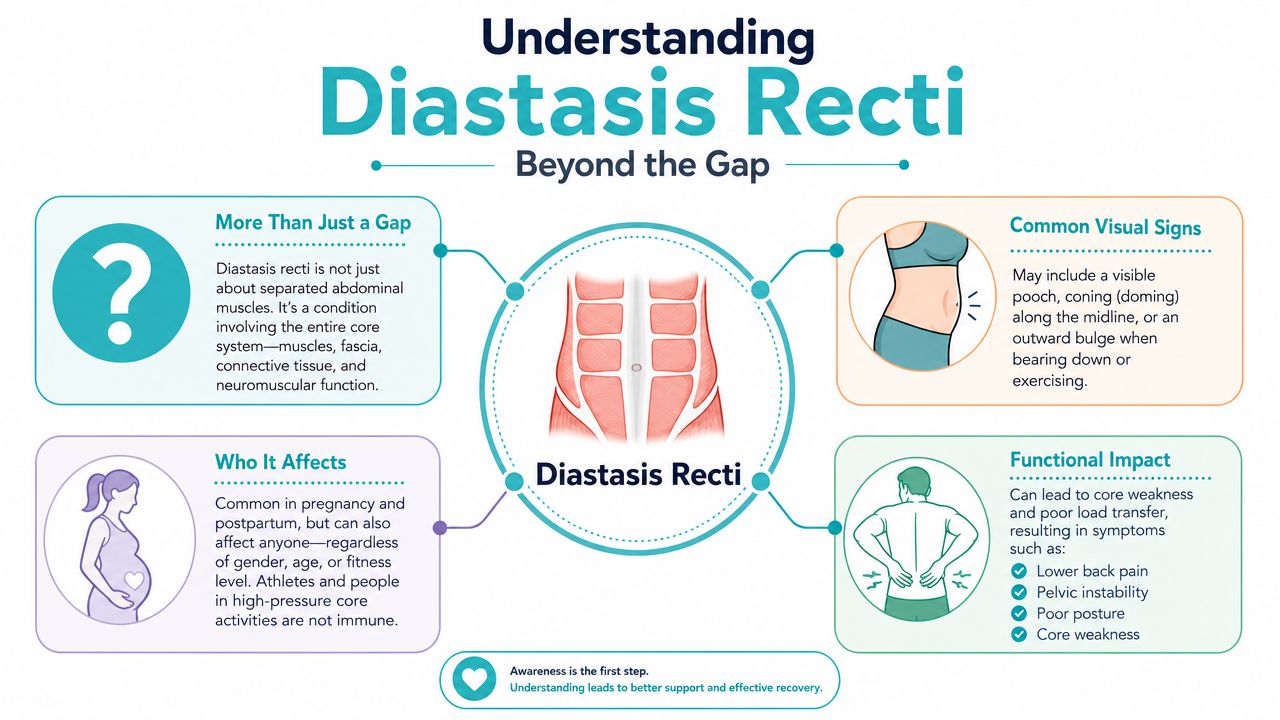
Diastasis recti is often described as a gap between the rectus abdominis muscles. That's true, but it's not the whole picture. What matters just as much is the linea alba, the connective tissue running down the midline of the abdomen. During pregnancy, and sometimes during repeated high-pressure training, that tissue can stretch and lose tension.
When that happens, the issue isn't only width. It's also how well the abdominal wall can manage pressure and transfer force.
A lot of women come in worried because they can still feel separation. They've been checking finger widths, comparing photos, and wondering why the “pooch” hasn't disappeared. The more useful question is this: Can your core create support, handle load, and coordinate well during daily life?
Research supports that shift in thinking. Focusing on abdominal strength, endurance, and transversus abdominis hypertrophy improves functional capacity and confidence, even without complete anatomical closure. Therapeutic goals should shift from “gap reduction” to “functional restoration,” as discussed in this review on functional restoration in diastasis recti recovery.
What women usually notice first
The first signs are often visual or functional, not diagnostic. Common complaints include:
- A lingering abdominal pooch that doesn't match your effort
- Coning or doming during sit-ups, getting out of bed, or lifting
- A weak or disconnected feeling through the trunk
- Pressure symptoms such as heaviness, especially with strain
- Back or pelvic discomfort during caregiving, exercise, or standing
Some women first notice these changes after pregnancy. Others notice them when they return to running, CrossFit, Pilates, or heavier gym work. The problem isn't always the activity itself. Often it's poor pressure management, low tissue tolerance, or loading that progressed too fast.
Why the old advice falls short
“Only do gentle core work” sounds safe, but it can leave women stuck. Gentle work has a place early on. It helps you reconnect to breath, pelvic floor, and deep abdominal control. But if rehab stops there, the core may never rebuild enough strength for carrying a car seat, deadlifting, sprinting, or getting through long days without symptoms.
Practical rule: A smaller gap isn't the only sign of progress. Better tension, better control, and less symptom provocation matter more.
This is also why patient education matters so much. Clear explanations reduce fear and improve follow-through. If you're interested in the communication side of rehab, this guide on how to effectively educate patients is useful.
For a more body-specific discussion of postpartum abdominal changes, Lake City PT's resource on belly changes after baby is a helpful companion.
How to Safely Check for Diastasis Recti at Home
A home check can give you a starting point. It shouldn't replace a full assessment, but it can help you notice patterns. The key is to assess more than width. You also want to feel tension through the midline and watch how your abdomen behaves under light effort.
A simple home self-check
Try this on a firm surface:
- Lie on your back with knees bent and feet flat.
- Place your fingers along the midline of your abdomen, around the area of your belly button first.
- Relax your shoulders and neck.
- Gently lift your head and upper shoulders just enough to engage the abdominal wall.
- Feel for two things at once:
- Width between the two sides of the rectus muscles
- Depth and tension under your fingers
Then repeat slightly above and slightly below the belly button.
If the tissue feels soft, deep, or hard to tension during a small effort, that matters. If it feels firmer and more responsive, that's often a better sign than width alone.
What you're actually looking for
A lot of online advice stops at “how many fingers fit.” That's incomplete.
Use this comparison:
| What you feel | What it may suggest |
|---|---|
| Wide but firm tension | Better force transfer than the width alone might suggest |
| Narrower but very soft | Less support than expected, despite a smaller space |
| Bulging or doming | Pressure isn't being managed well during the effort |
| Pain or pelvic heaviness | The task may be too much right now |
Coning or doming is especially useful feedback. It means pressure is pushing outward because the system isn't distributing load well. You might see this during the self-check, but also during everyday movements like getting out of bed, carrying laundry, pushing a stroller uphill, or standing from a low couch.
If your abdomen tents upward during effort, don't panic. Treat it as information. Reduce the challenge, improve the exhale, and try again.
What makes the check more accurate
A few details improve the value of a home screen:
- Use a small head lift, not a full crunch. You want a gentle activation, not a maximal effort.
- Check at rest and during exhale. Some women create better tension when they coordinate breath.
- Notice symptoms, not just shape. Pressure, leakage, or heaviness matter.
- Track function over time. Can you roll, lift, and carry with better control than before?
If you're unsure what early core work should look like after your self-check, this guide to postpartum core strengthening exercises can help you choose lower-pressure options.
Core Foundations for Healing Diastasis Recti
Before exercise progression works, the body needs a reliable foundation. That foundation is pressure management.
The abdominal wall doesn't work alone. Think of the trunk as a core canister. The diaphragm sits on top, the pelvic floor forms the base, the deep abdominal system wraps around the sides, and the spine and rib cage give the canister shape. When these parts coordinate well, the body can create support without excessive strain through the midline.
Start with breath, not bracing
A step-by-step protocol for diastasis recti physical therapy begins with diaphragmatic breathing to activate the transverse abdominis and pelvic floor before progressing to functional movement, as outlined in this rehab guide on early diastasis recti treatment.
That matters because many women have learned one of two habits:
- They grip the belly hard and hold tension all day.
- They bear down during effort without realizing it.
Neither strategy creates good support.
How to practice 360-degree breathing
Try this in crook lying, side-lying, or seated if lying down feels awkward.
- Inhale through your nose. Let the ribs widen. Think of breath expanding into your sides and back, not only pushing into your belly.
- Exhale slowly. As the air leaves, gently draw the lower abdomen inward and feel a subtle pelvic floor lift.
- Keep the effort light. This is not a hard squeeze. It's a coordinated response.
The right sensation is usually “organized” rather than intense. Your neck should stay quiet. Your ribs shouldn't flare up. Your belly shouldn't dome.
What “engage your core” should mean
Good cueing is simple:
- Exhale first
- Feel the lower ribs soften
- Gently gather the lower abdomen
- Add movement without losing control
That may look like raising one arm, sliding one heel, or preparing to stand up. If the breath disappears or the abdomen pushes forward, the movement is too advanced or too fast.
Strong cores don't start with harder exercises. They start with better timing.
Daily situations where this matters
This coordination isn't only for rehab drills. It should show up when you:
- Lift your baby or toddler
- Stand from bed or the couch
- Carry groceries
- Push a stroller
- Return to gym training
A lot of frustration comes from doing the “right exercises” for a few minutes a day, then spending the rest of the day breath-holding and bearing down during everything else. The body learns from repetition. Daily movement counts.
Your Progressive Exercise Plan for Functional Recovery
Most women don't need a random list of ab exercises. They need a sequence that matches healing tissue, symptom response, and real-life demands. A good plan builds from awareness to strength to function.
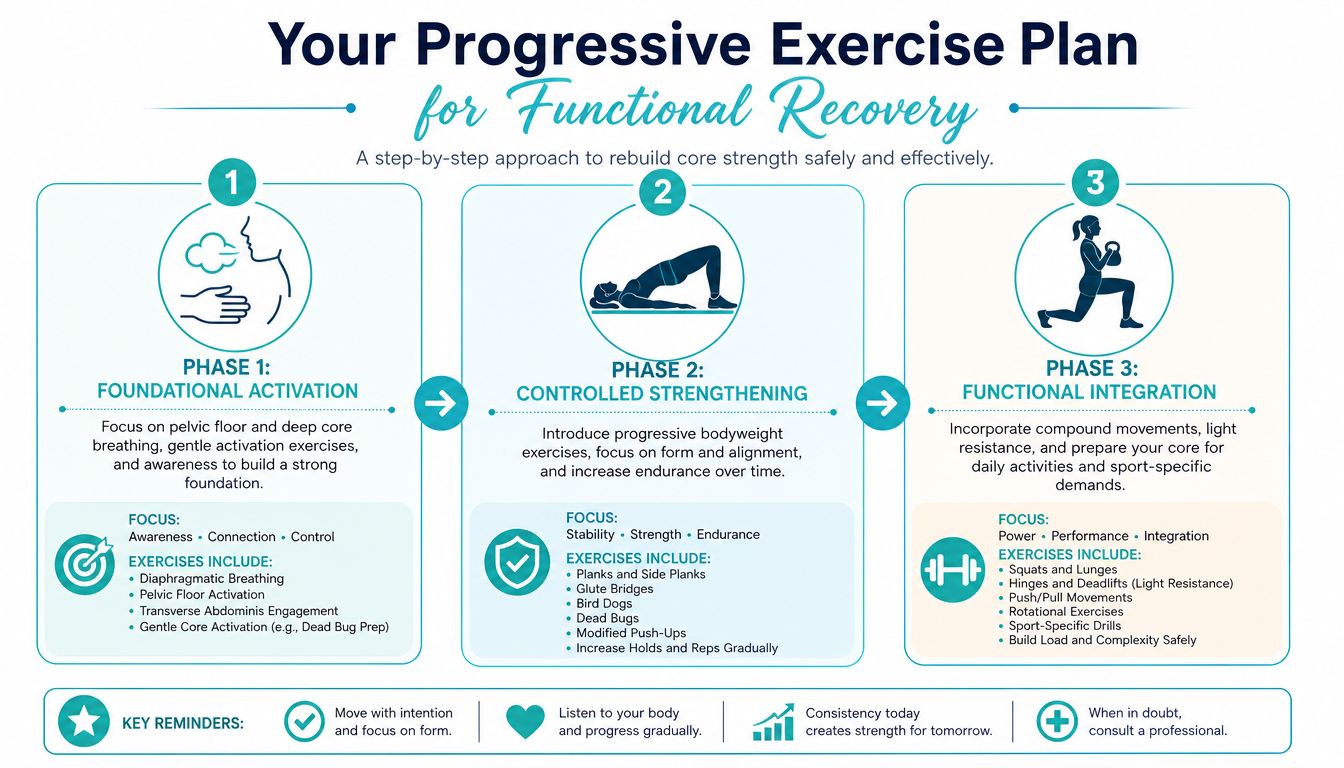
Phase 1 with low-load activation
This phase is about reconnecting, not exhausting yourself. You're pairing the breath strategy above with controlled movement.
Useful starters include:
- Abdominal bracing with exhale while keeping the abdominal wall flat and responsive
- Heel slides performed slowly, one side at a time
- Supine marches if you can keep tension through the midline
- Modified bridges with attention to rib position and pressure control
These drills are often small. That doesn't mean they're easy. If you can maintain tension without doming, leaking, or feeling pelvic heaviness, you're building the right base.
A practical way to think about this phase is quality before challenge. One clean set is better than several rushed ones.
Phase 2 with integration in more positions
Once basic activation holds up well, the body needs variation. Core function doesn't happen only on your back. It happens in side-lying, quadruped, sitting, standing, and transitional movement.
Many home programs fall short because they never teach the trunk to manage gravity in upright positions.
You might progress to:
- Pelvic tilts coordinated with breath
- Hands-and-knees weight shifts
- Bird-dog variations with short lever positions
- Wall-supported squats with exhale on effort
- Standing load transfer, such as a carry with light resistance
The point isn't to collect exercises. The point is to improve force transfer in more realistic positions.
Here's a useful checkpoint before moving on:
| If this is happening | Stay or regress |
|---|---|
| Repeated doming during reps | Reduce range or load |
| Pelvic pressure or heaviness | Stop and reassess |
| Breath-holding on every effort | Lower complexity |
| Good tension with smooth breathing | Progress gradually |
To compare exercise options and common modifications, this roundup of the best exercises for diastasis recti gives a practical overview.
A short visual demo can also help you connect the concepts to movement:
Phase 3 with progressive overload
In this context, modern rehab has changed.
Recent expert consensus emphasizes that progressively overloading the abdominal wall with a variety of heavy loads is essential to induce muscle hypertrophy and effectively decrease inter-recti separation, according to this evidence-based discussion of progressive loading for diastasis recti.
That doesn't mean “jump into max effort.” It means the abdominal wall needs enough mechanical challenge to adapt.
For some women, that progression includes:
- Loaded carries
- Goblet squats
- Deadlift patterns
- Resistance-based anti-rotation work
- More advanced trunk flexion or plank variations, when tolerated well
This is also where old blanket rules become less helpful. “Never do crunches” isn't as useful as asking whether a given exercise creates good tension and acceptable symptom response. Some women aren't ready for a flexion-based movement yet. Others can reintroduce it gradually and do well.
What works and what doesn't
What tends to work:
- Individualized progression
- Multi-position training
- Load matched to tissue tolerance
- Clear symptom rules
- Consistency over intensity spikes
What usually doesn't work:
- Only breathing forever
- Only checking the gap
- Avoiding all challenge
- Copying athlete-level core work too soon
- Pushing through pressure, doming, or heaviness
If you're a clinician building structured programs, organized planning matters here. Resources like these templates for improved patient care show how to map progression more clearly from evaluation to exercise dosing.
Recovery gets better when the exercises match the woman in front of you, not the trend she found online.
Red Flags Timelines and When to See a Physical Therapist
Some women can make steady progress with a self-guided plan. Others need skilled assessment much earlier. The difference usually comes down to symptoms, movement quality, and how the body responds to load.
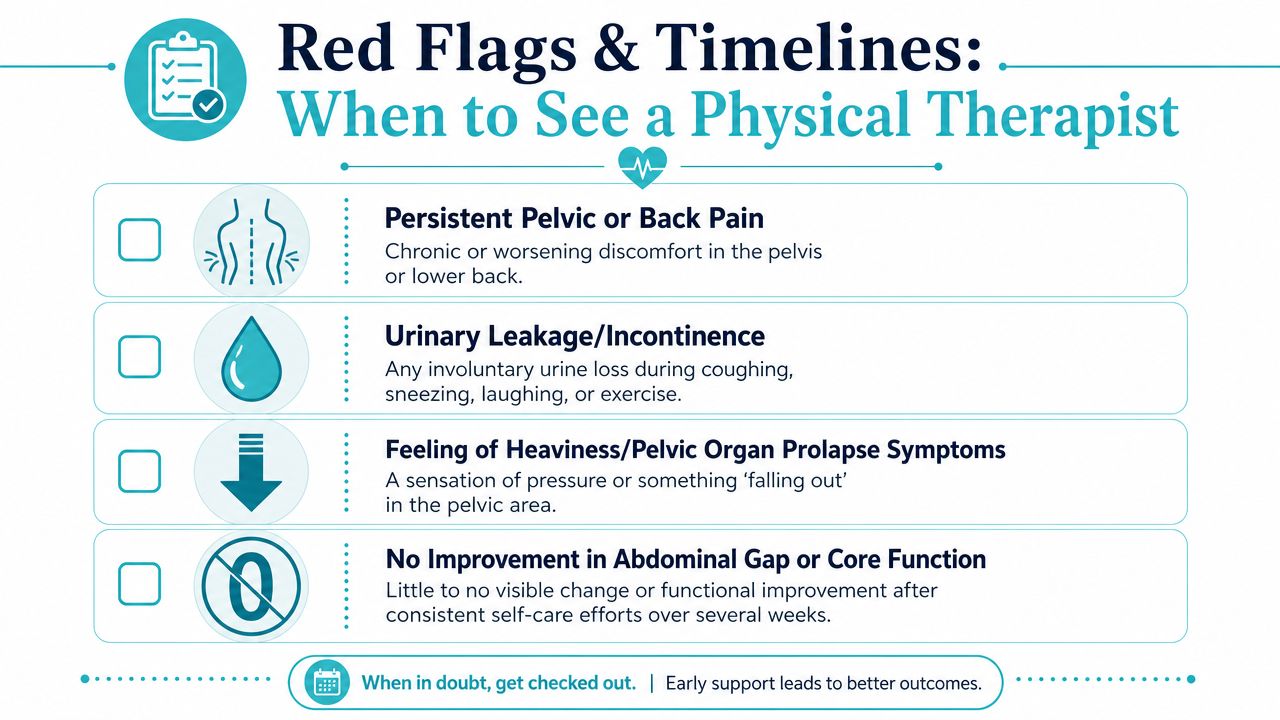
Signs you shouldn't ignore
Stop self-progressing and get assessed if you notice:
- Pelvic pressure or vaginal heaviness during exercise or lifting
- Urinary leakage with coughing, jumping, or effort
- Persistent back or pelvic pain
- Abdominal doming you can't control, even after reducing the challenge
- A sense that your core never turns on
- Symptoms that worsen as activity increases
Traditional crunches or heavy lifting that sharply increase abdominal pressure can provoke pelvic pressure or vaginal heaviness. If that happens, stop and check in with a trained therapist instead of trying to push through.
A realistic view of recovery timelines
Expectations matter here.
Eight weeks of core stability training can yield significant reductions in inter-recti distance, but clinicians may recommend waiting up to 18 months to assess full structural change because connective tissue heals more slowly than muscle, as noted in this clinical review on diastasis recti recovery timelines.
That means two things can be true at once:
- You may feel and function better well before the tissue is done adapting.
- You may still be improving after the early postpartum phase.
A lot of women get discouraged because they expect a quick visual fix. The body rarely works that way. Better lifting capacity, less doming, improved endurance, and less heaviness are meaningful wins.
Why professional guidance changes the outcome
A physical therapist can do what a mirror and online checklist can't:
- Assess linea alba tension by feel
- Watch rib cage, breath, and pelvic floor strategy together
- Identify whether symptoms point to prolapse, pelvic floor dysfunction, or pressure mismanagement
- Dose loading appropriately
- Progress exercises based on response, not guesswork
That matters even more if you want to return to running, CrossFit, dance, volleyball, triathlon, or strength training.
Some postpartum symptoms also overlap. For example, if bowel habits, straining, or local irritation are part of the picture, this guide on effective relief for postpartum hemorrhoids can be a useful adjunct while you sort out the larger pressure-management issue.
How Lake City Physical Therapy Guides Your Recovery
A strong diastasis recti plan isn't just a handout. It's an assessment, a strategy, and a progression that fits your body, your symptoms, and your goals.
At Lake City Physical Therapy, care is built around the principles that matter in recovery. Functional restoration over obsession with the gap. Breath and pressure management before random ab work. Progressive loading when your body is ready for it. That means your treatment can address the whole picture, including pelvic floor symptoms, return to sport, lifting demands, postpartum recovery, and day-to-day movement patterns.

What individualized care looks like
You're not handed the same sequence as every other postpartum woman. A women's health physical therapist can evaluate:
- How you breathe under load
- How your abdominal wall develops tension
- Whether your pelvic floor is overworking, under-recruiting, or mistimed
- What movements trigger symptoms
- How to progress you safely toward lifting, running, sport, or feeling capable again
That kind of one-on-one care helps you stop second-guessing every exercise.
Access that fits real life
Lake City Physical Therapy serves women across North Idaho and Eastern Washington, including Coeur d'Alene, Post Falls, and Spokane, with telehealth available for women who need expert guidance remotely. That combination is especially helpful for new moms, busy professionals, and active women balancing rehab with work, childcare, and training.
If you've been told to wait, avoid everything, or accept a weak core as your new normal, there's a better option. Diastasis recti physical therapy should help you move better, lift better, and trust your body again.
If you're ready for a personalized plan that goes beyond generic postpartum ab exercises, schedule an evaluation with Lake City Physical Therapy. Their women's health specialists can help you rebuild core strength, improve pressure control, and return to the activities that matter to you.

