Endometriosis Pain During Period Guide
You're curled around a heating pad, trying to decide whether you can make it through work, school, or the day at home. The pain may have started before bleeding, tightened into deep cramping once your period arrived, and continued after the flow began to slow. When standard advice is to take an over-the-counter painkiller and tolerate it, it's easy to wonder whether you're overreacting.
You're not. Endometriosis pain during your period is a real pain condition with inflammatory, nerve-related, and muscular components. Pelvic floor physical therapy doesn't replace gynecologic care, medication, or surgery when those treatments are appropriate. It addresses another part of the problem that can remain after hormonal treatment or lesion removal, especially when pelvic muscles guard, spasm, or become painful to touch.
Recognizing When Period Pain Is Not Normal
A patient once described her periods as “three days of losing the ability to be a person.” She planned her calendar around bleeding, kept pain medication nearby, and assumed that vomiting, missing commitments, and lying still in a dark room were just the price of having a period. Because relatives had experienced painful cramps too, she had learned to call her symptoms normal.
That assumption deserves a closer look. Mild cramping can occur with menstruation, but pain that repeatedly limits ordinary activities needs clinical attention. If you're missing work or school, avoiding movement, struggling to sleep, or organizing your life around the next period, the issue isn't whether you can endure it. The issue is why your nervous system and pelvic organs are producing so much pain.
A practical rule: Pain that repeatedly takes away your ability to participate in daily life is a reason to seek evaluation, not a test of your toughness.
Endometriosis is one possible explanation. It affects up to 10% of people of reproductive age globally, and painful periods are reported in 62% of cases, according to an American Family Physician review of endometriosis. That doesn't mean every severe period is endometriosis. Fibroids, adenomyosis, pelvic inflammatory conditions, ovarian problems, and other disorders can create similar symptoms. It does mean severe menstrual pain should be treated as a clinical red flag, rather than automatically labeled routine dysmenorrhea.
Signals worth documenting
Write down what happens before, during, and after bleeding. Include the location of pain, how it feels, what activities become difficult, and whether symptoms occur with bowel movements, urination, or intercourse. Note the strategies you tried and whether they helped, partly helped, or made no meaningful difference.
Bloating can also complicate the picture because abdominal fullness may appear around the same time as pelvic pain. For a plain-language explanation of common premenstrual bloating patterns and supportive measures, why bloating happens before periods may help you separate a familiar cycle-related symptom from a broader pattern that deserves medical discussion.
Your pain experience doesn't need to match someone else's to be valid. Endometriosis can produce severe symptoms, but symptom intensity alone can't confirm the diagnosis. The useful next step is a careful history, appropriate examination, and a plan that addresses both possible disease activity and the way your muscles and nervous system are responding.
The Biological Drivers of Endometriosis Cramping
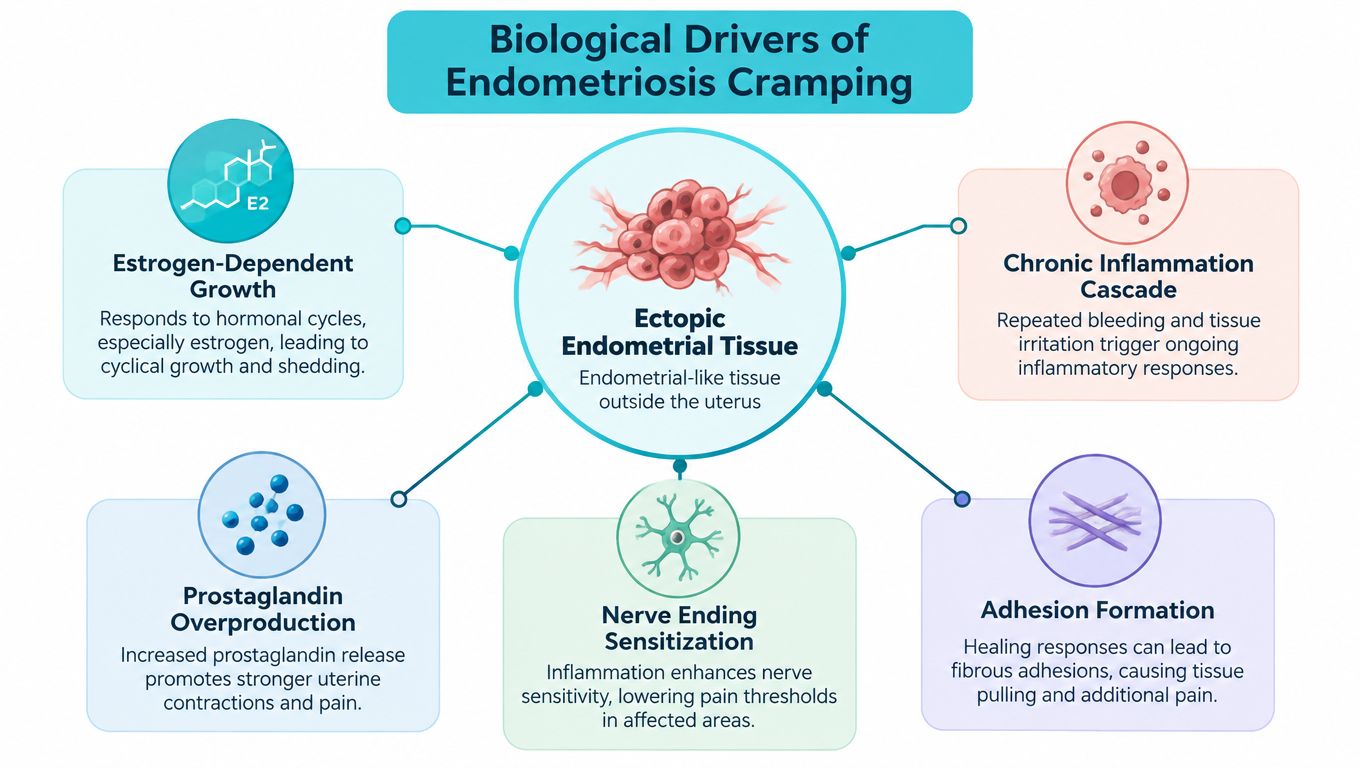
The uterus normally contracts during menstruation. Endometriosis adds another source of irritation around that process. Endometriotic lesions respond to hormonal cycling and can bleed with each cycle. The blood and injured tissue remain outside the uterus, where they can trigger an inflammatory response rather than leaving the body through menstrual flow.
Inflammation acts less like a single switch and more like a chemical alarm system. Prostaglandins, cytokines, and other inflammatory mediators can activate nearby sensory nerve endings. Those nerves then send stronger danger signals into the spinal cord and brain, which helps explain why endometriosis cramping may feel deep, burning, stabbing, pulling, or dramatically out of proportion to what someone else considers a typical cramp. This mechanism is described in the review of inflammation and pain mechanisms in endometriosis.
Why the pain can have different qualities
A deep ache often reflects irritation in pelvic tissues and the surrounding connective structures. A sharp or electric sensation suggests that nerves may be sensitized or directly irritated. Deep infiltrating lesions can irritate nerve fibers, adding a neuropathic component to the inflammatory pain.
The body can also form adhesions, bands of scar-like tissue that restrict normal movement between structures. An ovary, bowel, bladder, uterus, or pelvic wall may not glide freely during movement or muscular contraction. That restriction can create a tugging sensation, pain with intercourse, or a feeling that the pelvis is bracing against itself.
Not every person has the same combination of mechanisms. Some people have prominent inflammatory pain. Others have substantial muscular guarding or nerve sensitivity. A small visible lesion burden doesn't automatically predict mild pain, and intense pain doesn't prove that a particular lesion is responsible. The treatment question is therefore broader than “Can we see a lesion?” It also includes “Which tissues are sensitive, which muscles are overactive, and what movements or pressures reproduce symptoms?”
Why anti-inflammatory treatment may only solve part of the problem
Medication can reduce inflammatory signaling, and hormonal treatment can reduce the cyclical activity that feeds lesions. Those approaches can be valuable, but pain may persist if the pelvic floor remains contracted or if repeated pain has changed the nervous system's response to ordinary pressure.
That's why a complete assessment looks beyond the uterus and ovaries. It considers the abdomen, hips, spine, breathing mechanics, pelvic floor coordination, bowel and bladder habits, and the patient's ability to relax after a contraction. Endometriosis cramping is often a layered problem, so a layered plan makes more sense than expecting one intervention to solve every component.
Primary Dysmenorrhea Versus Endometriosis Symptoms
Primary dysmenorrhea and endometriosis can feel similar at first. Both may involve cramping, low back discomfort, fatigue, and a need for heat or medication. The distinction isn't something you can prove from a symptom checklist, but the timing, persistence, associated symptoms, and functional impact can help you explain your experience to a clinician.
The following comparison is a starting point, not a diagnosis.
Comparing Period Pain Profiles
| Feature | Primary Dysmenorrhea | Endometriosis Pain |
|---|---|---|
| Timing | Often follows the start of bleeding and follows a predictable menstrual pattern | May begin before bleeding, continue through the period, or occur outside menstruation |
| Pattern | More closely tied to the menstrual window | Can become cyclical at first and later include non-cyclical pelvic pain |
| Response to usual care | May improve with appropriately timed anti-inflammatory medication, heat, and rest | May remain substantial despite common first-line measures |
| Pain location | Often centered in the lower abdomen or back | May involve the pelvis, back, bowel, bladder, hips, or areas affected by nerve irritation |
| Bowel or bladder symptoms | Not usually the defining feature | Pain with bowel movements or urination can occur, particularly around menstruation |
| Intercourse | Not typically a central symptom | Deep pain with intercourse can accompany pelvic tissue sensitivity or muscular guarding |
| Daily function | Discomfort may be manageable even when unpleasant | Pain may repeatedly restrict work, school, movement, sleep, or relationships |
Period pain that begins before bleeding, lasts into the period, or becomes persistent outside the cycle can still be endometriosis, and these patterns are often poorly distinguished from ordinary dysmenorrhea in general symptom summaries. The Mayo Clinic overview of endometriosis symptoms also emphasizes that symptoms overlap and that symptoms alone aren't enough to establish a diagnosis.
The questions that improve a medical appointment
Instead of saying only “my periods are bad,” describe the sequence. “The pain starts before bleeding, peaks on the first day, and hurts when I have a bowel movement” gives a care team more useful information. Mention whether you feel pressure, burning, stabbing, heaviness, or pain that travels into the back or legs.
Also describe what happens between periods. Persistent pelvic pain, pain with penetration, urinary urgency or discomfort, bowel changes, or pain around ovulation can change which providers and tests are appropriate. These symptoms don't confirm endometriosis, but they make a broader evaluation more important.
Do not wait for your pain to become constant before asking for help. A cyclical pattern can be clinically meaningful even when you feel relatively well between periods. Bring a written symptom record, medication list, and questions about referrals, imaging, hormonal options, surgery, and pelvic floor therapy.
Why Endometriosis Pain Spreads and Worsens Over Time
Pain can begin as a predictable menstrual event and later appear with sitting, walking, intercourse, bowel movements, urination, or ordinary pelvic pressure. That progression doesn't mean the pain is imagined. It can reflect changes in both the tissues generating the signal and the nervous system processing it.
Repeated danger signals can make the nervous system more protective. In a process called central sensitization, the spinal cord and brain become more responsive to incoming signals. Sensations that were previously tolerable may feel painful, and a painful stimulus may produce a larger or longer response. A review reports central sensitization in 41.4% of patients with endometriosis, with associated pain hypersensitivity, allodynia, and lower pressure-pain thresholds during menstruation. The finding is discussed in this review of central sensitization and endometriosis-related pain.
The pelvic floor can become part of the pain loop
The pelvic floor is a group of muscles that supports the pelvic organs, contributes to continence, and helps coordinate urination, bowel movements, sexual activity, and movement. When the brain anticipates pain, these muscles may tighten as a protective response. If they don't fully relax afterward, they can become tender, fatigued, and less able to lengthen when the pelvis needs to move.
That guarding creates a self-reinforcing loop:
- Menstrual inflammation increases pelvic pain.
- The body braces to protect the area.
- Tight muscles reduce comfortable movement and create pressure.
- The nervous system receives more signals from sensitive tissue.
- The next cycle begins with less reserve and more threat sensitivity.
A tight pelvic floor isn't always the original cause. It may be a secondary response that continues after the initial trigger has settled. Treating it still matters because secondary muscle pain can become an independent source of symptoms.
Why pain can occur outside the menstrual window
Pain with penetration may involve sensitive pelvic tissues, restricted mobility, or overactive muscles that can't lengthen comfortably. Pain with a bowel movement may reflect pressure on already sensitive structures, difficulty relaxing the pelvic floor, or disease affecting tissues near the bowel. Bladder discomfort can involve pelvic muscle tension and sensitized nerves, even when a urinary infection isn't present.
This is why endometriosis care sometimes needs to shift from a narrow menstrual-cramp approach to multidimensional chronic pain management. The Cleveland Clinic discussion of endometriosis pain describes how symptoms can progress from cycle-only pain to pain with urination, bowel movements, intercourse, or non-cyclical pelvic pain.
Pain that spreads doesn't prove that the disease has spread anatomically. It may indicate that muscles, nerves, connective tissues, and the central nervous system now contribute to the experience. A treatment plan should respond to that wider pattern rather than focusing only on the original cramping.
Conservative Management and Medical Treatment Options
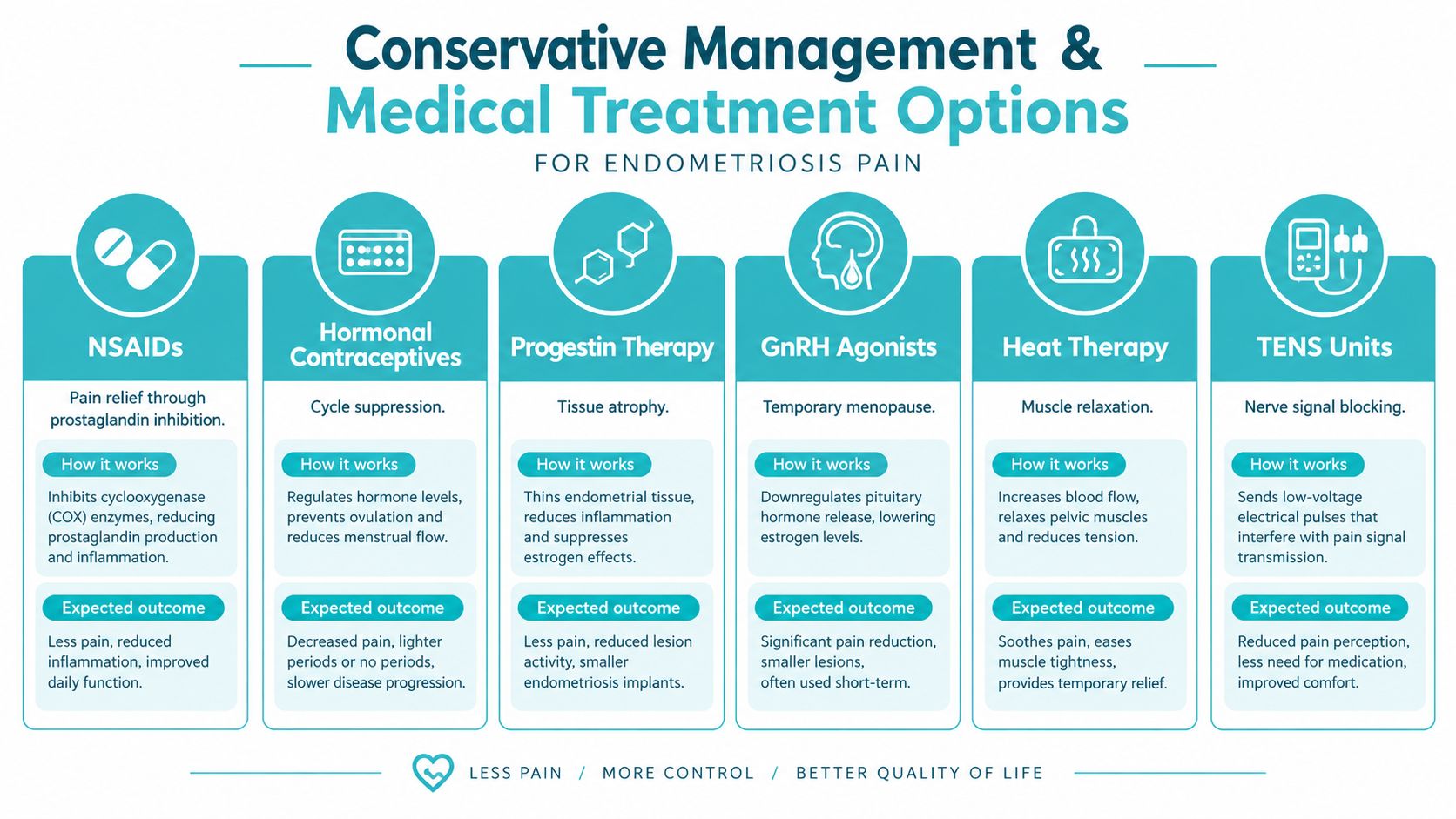
Treatment works best when it matches the mechanism. Anti-inflammatory medication may help inflammatory pain, hormonal suppression may reduce cyclical lesion activity, and physical therapy may address muscle guarding and movement-related sensitivity. These tools aren't interchangeable, and one option's limitations don't make the others ineffective.
A clinician may recommend taking an anti-inflammatory medication before the anticipated period rather than waiting until pain has fully escalated. Follow the medication's safety instructions and ask a healthcare professional whether it's appropriate for you, especially if you have kidney disease, stomach ulcers, bleeding concerns, medication interactions, or other medical conditions.
Hormonal contraceptives or progestin-based treatment may reduce hormonal cycling and bleeding. GnRH-based treatment can also suppress ovarian hormone activity, but side effects and individual risks require careful medical supervision. Surgery may be considered when symptoms remain disabling, medication isn't tolerated or effective, or a specialist identifies disease that needs operative management.
Build a plan you can evaluate
Use a symptom diary for several cycles. Record the first day of bleeding, when pain begins, pain locations, bowel and bladder symptoms, sleep disruption, activity limits, medication timing, and the result of each intervention. A diary can reveal whether pain is strictly cyclical, whether medication timing matters, and whether symptoms persist after bleeding ends.
Heat can help some people by reducing muscle tension and providing a competing sensory input. Gentle walking or changing position may be more useful than prolonged bed rest for some patients, while others need rest during a flare. Don't force stretching into sharp, burning, or escalating pain. A TENS unit may be worth discussing with a clinician or physical therapist when surface electrical stimulation is appropriate for you.
Medical treatment doesn't always resolve the muscular and nervous system components. Symptoms can progress from cycle-only pain to pain with urination, bowel movements, intercourse, or non-cyclical pelvic pain, which is why information about natural endometriosis treatment approaches should be considered alongside, not instead of, individualized medical evaluation.
If pain continues after hormonal treatment or surgery, that doesn't mean treatment has failed in every respect. It may mean that inflammation, scar-related restriction, nerve sensitivity, and pelvic floor guarding now need their own assessment.
The Role of Pelvic Floor Physical Therapy in Pain Relief
Pelvic floor physical therapy begins with listening. A thorough evaluation may examine the pelvis, abdomen, spine, hips, breathing pattern, posture, movement strategies, and external muscle tenderness. An internal examination is not automatic, and it should only happen with informed consent. You can ask what the therapist is assessing, why it matters, and what alternatives are available.

The therapist is looking for more than strength. Many people with endometriosis-related pain don't need more squeezing or strengthening at the start. They may need to learn how to down-train, or reduce resting muscle activity, coordinate the pelvic floor with breathing, and release muscles that remain braced during movement or attempted relaxation.
What treatment may include
External soft-tissue work can address abdominal, hip, buttock, back, and inner-thigh muscles that contribute to pelvic tension. If appropriate and consented to, internal myofascial techniques can assess and treat tender pelvic floor muscles, restricted tissue mobility, and trigger points. Treatment should be gradual. Reproducing severe pain isn't proof that therapy is working.
A therapist may also use:
- Breathing coordination: Slow diaphragmatic breathing can help the rib cage, abdomen, and pelvic floor move together instead of reinforcing a constant brace.
- Down-training practice: The focus is on sensing release, lengthening, and reduced effort, not repeatedly contracting already overactive muscles.
- Graded movement: Gentle exposure to walking, sitting, hip motion, or sexual activity can help restore confidence without pushing into a flare.
- Pain neuroscience education: Understanding sensitization can reduce fear and help you distinguish a painful signal from evidence of immediate tissue damage.
- Home strategies: A personalized program may include heat, relaxation positions, mobility work, pacing, and flare planning.
These interventions don't remove endometriotic lesions. They target the secondary mechanical drivers that can keep pain active, including muscle spasm, restricted mobility, poor relaxation, and protective movement patterns. The approach may be useful before surgery, after surgery, or while a medical diagnosis is still being clarified. Endometriosis and physical therapy care can be coordinated with gynecologic treatment rather than treated as a competing pathway.
A pelvic floor therapist may also help you prepare for a medical appointment by translating symptoms into functional details. “I can't relax during a bowel movement,” “penetration causes deep pain,” or “my abdomen tightens before bleeding” gives your wider care team information that a pain score alone can't provide.
This educational video may help you understand how pelvic health assessment and treatment can fit into care:
The right pace is the pace that leaves you feeling informed and more capable, not frightened of your body. If an internal technique causes a flare that isn't discussed, or you feel pressured to continue, say so. Consent, communication, and adjustment are part of competent treatment.
Navigating Diagnostic Delays and Building Your Care Team
Many people spend years being told that severe period pain is something they have to tolerate. Multiple reviews report an average delay of 6.6 to 10 years from symptom onset to confirmed endometriosis diagnosis, as summarized in a scoping review of diagnostic delay in endometriosis. That delay makes early symptom support important, even before a surgical diagnosis is established.
Start with a written record and a specific request. Ask for evaluation of endometriosis and other causes of secondary dysmenorrhea, not only medication for the next period. If symptoms include bowel, bladder, intercourse, fertility, or persistent pelvic pain concerns, say that clearly. A normal initial test or an incomplete response to medication shouldn't end the conversation.
Your care team may include a primary care clinician, gynecologist, endometriosis-focused surgeon when appropriate, pelvic floor physical therapist, pain specialist, gastroenterology or urology clinician, and mental health professional familiar with chronic pain. You don't need every referral at once. Add support according to the symptoms that are limiting your life.
A reasonable next-step plan
- Bring your symptom diary to an appointment.
- Ask what diagnoses are being considered and what would change the treatment plan.
- Request a pelvic floor assessment when pain includes muscle guarding, painful intercourse, bowel or bladder difficulty, or pain with movement.
- Ask an endometriosis specialist about the role of imaging, hormonal treatment, and surgery when symptoms remain disabling.
- Continue supportive therapy while diagnostic decisions are being made.
You don't have to wait for formal surgical confirmation to address painful muscles, restricted movement, fear of activity, or difficulty relaxing the pelvic floor. For a practical overview of evaluation and treatment decisions, the steps for possible endometriosis treatment can help you prepare for a more focused discussion with your healthcare team.
Lake City Physical Therapy provides women's health pelvic floor therapy that can assess pelvic, abdominal, and movement-related contributors to endometriosis pain, with education and individualized strategies before or after medical treatment. Visit Lake City Physical Therapy to review available clinic and telehealth options and schedule a consultation.

