Lymphedema Management PDF: Your Complete Patient Guide
A lot of people find lymphedema the same way. You notice that one arm, leg, breast, or side of the body just doesn't look or feel the same anymore. A sleeve fits tighter. A sock leaves a deeper mark. Your skin feels heavy, full, or oddly firm. If this started after cancer treatment, surgery, radiation, or lymph node removal, the uncertainty can be unsettling.
The good news is that lymphedema is manageable. It takes consistency, the right techniques, and a plan that fits daily life. It also helps to know you're not dealing with something rare. The National Center for Biotechnology Information chapter on lymphedema notes that the number of people living with lymphedema in the United States is estimated to be up to 10 million, which exceeds the combined total of those living with HIV, Parkinson's disease, multiple sclerosis, muscular dystrophy, and ALS in the U.S. (NCBI Bookshelf overview of lymphedema).
Your Guide to Understanding and Managing Lymphedema
Lymphedema happens when the body's lymphatic system can't move fluid the way it should. That fluid then builds up in the tissues and causes swelling, pressure, heaviness, or skin changes. For some people it starts gradually. For others, it becomes obvious over weeks or months.
A helpful way to think about it is this. Your lymphatic system is part drainage system, part cleanup crew. When lymph nodes or vessels are damaged or removed, the fluid doesn't have a clear route out. Traffic backs up. The result is swelling that tends to linger instead of coming and going like ordinary, temporary puffiness.
This guide is built like a practical resource kit. If you're looking for a lymphedema management PDF you can use day to day, the information below mirrors what certified lymphedema therapists teach patients and families in clinic. It's meant to help you recognize symptoms, know what needs urgent attention, and build a home routine that supports long term control.
Lymphedema management works best when patients stop waiting for the swelling to “just go away” and start treating it as a condition that responds to daily care.
Many newly diagnosed patients worry that swelling means something is spiraling out of control. Usually, it means you need a structured response. The earlier you learn what to watch, what to do, and when to call a specialist, the easier it is to protect function and keep symptoms from becoming more disruptive.
Lymphedema Symptoms Staging and Red Flags
Lymphedema isn't just “being swollen.” Temporary swelling can happen after travel, heat, exercise, or a long day on your feet. Lymphedema tends to be more persistent. It often comes with heaviness, tightness, aching, reduced flexibility, or skin that feels thicker than usual.
Common symptoms patients notice first
Early changes are often subtle. You may notice:
- A feeling of heaviness in an arm or leg before obvious swelling shows up
- Tight clothing or jewelry that suddenly fits differently
- A sense of fullness or pressure in the affected area
- Less movement in nearby joints because the limb feels tight
- Skin changes such as firmness, thickening, or a stretched feeling
If your swelling is in the arm after breast cancer treatment, this overview of arm lymphedema treatment options can help you connect symptoms with the kinds of therapy often used.
Red flags that need prompt medical attention
Some symptoms do not belong in the “watch and wait” category.
Practical rule: Sudden swelling, increasing pain, skin that feels hot, new redness, or fever should be treated as a reason to contact your medical team right away.
Those signs can point to infection, inflammation, or another medical issue that needs evaluation before you continue routine self-care.
Seek prompt medical attention if you have:
- Rapid swelling that comes on over hours or a short span of time
- Heat or redness in the swollen area
- Pain that is new or escalating
- Fever or feeling unwell
- Open skin or drainage
- A major change after injury, surgery, or travel
The four stages of lymphedema
The staging language can sound technical, but the basic pattern is straightforward.
| Stage | Description | Key Signs |
|---|---|---|
| Stage 0 | Latent or subclinical | No visible swelling yet, but heaviness, tingling, or fatigue may appear |
| Stage 1 | Early and mild | Swelling is present, often softer, and may improve with elevation |
| Stage 2 | More established | Swelling doesn't fully resolve with elevation and tissue changes begin |
| Stage 3 | Advanced | Marked enlargement, hardening, and more pronounced skin changes |
Stage 0 often surprises people. You can have symptoms before visible swelling starts. That's one reason early assessment matters.
Stage 1 is where many patients first realize something is wrong. The area may pit when pressed, and the swelling may improve somewhat with rest or elevation.
Stage 2 usually means the swelling is becoming more persistent. Tissue can feel firmer, and self-management needs to be more disciplined.
Stage 3 is advanced lymphedema. At that point, the limb or region is much harder to manage without specialized support.
The Four Pillars of Complete Decongestive Therapy
Complete Decongestive Therapy, often shortened to CDT, is the main non-surgical framework used to manage lymphedema. It's not one technique. It's a coordinated system built around four parts that work together. The framework includes manual lymphatic drainage, compression, exercise, and skin care, and clinical guidance explains that compression and bandaging increase external tissue pressure to reduce fluid while exercise and elevation help improve lymph return (British Lymphology Society best practice guidance).

Manual lymphatic drainage
This is a specialized, gentle hands-on technique. It is not deep tissue massage. It uses light, specific movements to encourage fluid to move toward areas where the lymphatic system can handle it more effectively.
Patients often describe it as surprisingly subtle. That's normal. The technique works because it follows lymphatic pathways, not because it uses force.
Compression
Compression is what helps hold the gains from treatment. Without it, swelling often returns. Compression may include bandaging, sleeves, gloves, stockings, or custom garments depending on the body area involved and the stage of lymphedema.
Many home programs fail because people wear the wrong garment, use one that no longer fits, or stop using compression once they feel better.
Exercise
Gentle movement helps the muscles act like a pump. That pumping action supports fluid return. The best exercise plan is usually not extreme. It is controlled, repeatable, and paired with proper breathing and, when prescribed, compression.
For many patients, physical therapy is where this becomes practical. This overview of lymphedema and the role of physical therapy explains how treatment plans are adapted to real bodies, real symptoms, and real daily demands.
Skin care
Skin care sounds simple, but it carries real weight in lymphedema management. Swollen tissues are more vulnerable. Dry skin, cracks, cuts, and nail injuries can create a path for infection.
Good lymphedema care isn't just about shrinking swelling. It's about protecting the skin and reducing the chances that a manageable problem becomes a medical setback.
When these four pillars work together, patients usually do better than when they focus on only one piece. A sleeve without skin care isn't enough. Exercise without compression may not hold improvements. Massage without a maintenance plan rarely lasts.
Your Daily Lymphedema Self Management Plan
Daily management is where control is won or lost. The most effective home programs are boring in the best way. They are repeatable, realistic, and built into your day instead of saved for “when things calm down.”
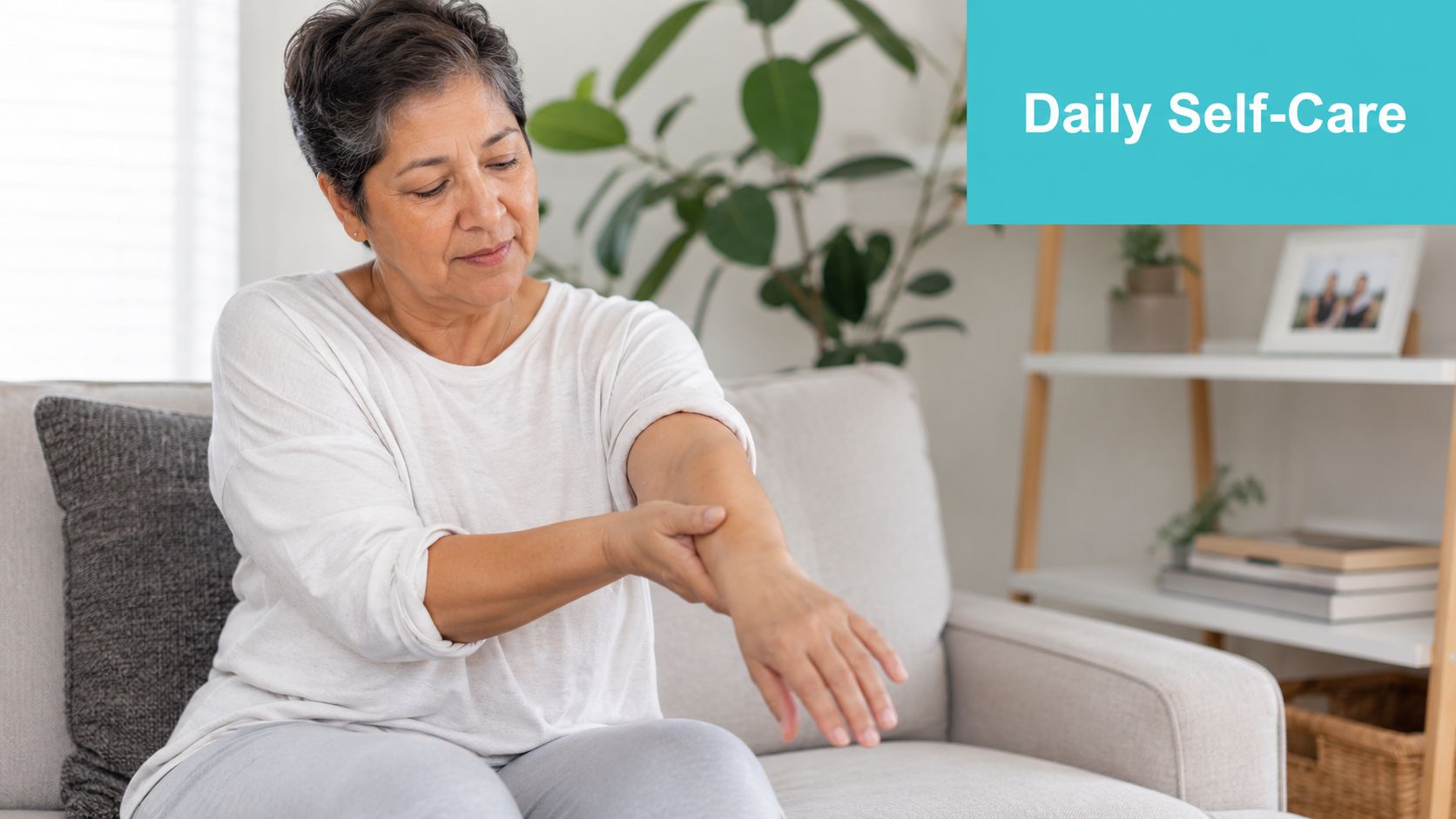
Guidance for long-term care emphasizes that consistent compression matters. The National Lymphedema Network education page notes that compression stockings of at least 40 mmHg are recommended for lower-limb disease, and if swelling returns, the garment may no longer be effective or the limb size may have changed, which means reassessment is needed (National Lymphedema Network therapy guidance).
Start with a simple morning check
Before you get dressed, look at the affected area.
- Check swelling pattern by comparing how the area looks and feels to your usual baseline
- Check the skin for redness, dryness, cracks, blisters, or scratches
- Check your garment fit by noticing whether it feels unusually tight, too loose, or starts to bunch
- Check comfort with movement by gently bending the nearby joints
You don't need to obsess over every small change. You do need to notice trends.
Build your skin care routine
Healthy skin lowers the chance of complications.
- Wash gently with a mild cleanser and rinse well
- Dry carefully especially in skin folds and between fingers or toes
- Moisturize daily to reduce dryness and cracking
- Protect the area when gardening, cooking, shaving, or handling pets
- Watch nails and cuticles because even small injuries can become a problem
Patients often underestimate how much skin condition affects symptom stability. A tiny break in the skin can turn into a major interruption in care.
Wear compression the way it was prescribed
Compression only works when it fits and when you use it.
- Put it on correctly before swelling builds through the day
- Smooth wrinkles because folds can create pressure points
- Replace worn garments when they lose support or stop fitting well
- Ask for reassessment if swelling returns, the garment slips, or it suddenly feels easy to put on
For many people, the hardest part is consistency. They wear compression on busy days, skip it at home, then wonder why the swelling rebounds by evening.
If you're looking for broader ways to improve lymphatic system function, the basics still matter most. Movement, breathing, compression, and skin protection usually outperform complicated hacks.
Use gentle exercise, not punishment
A good lymphedema exercise session should leave you feeling looser, not flared up.
Try a short sequence such as:
- Deep breathing with relaxed shoulders
- Slow range of motion for the nearby joints
- Light muscle pumping movements like opening and closing the hand or ankle pumps
- Walking or other light activity that you can tolerate comfortably
For older adults or family caregivers who want safe movement ideas that also support independence with eldercare exercises, simple guided routines can make daily activity feel less intimidating.
This short video can help you visualize safe self-care movement and technique:
Practice simplified self drainage only as taught
Self-manual lymph drainage can be useful, but it needs to be taught correctly. The pressure is light. The sequence matters. Rubbing harder doesn't move more lymph.
A safe general rule is to follow the sequence your therapist gave you and stop if you notice pain, skin irritation, dizziness, or a clear increase in symptoms.
Your best home routine is the one you can keep doing when life gets busy, you're tired, and motivation drops.
That's exactly what a good Lymphedema Management PDF should help you do. Not impress you. Support you.
The Proven Effectiveness of Consistent Lymphedema Care
Patients often ask whether all this daily work actually pays off. It does.
A JAMA Surgery review reports that complete decongestive therapy has a success rate of over 80%, with swelling reductions of 59.1% for upper extremities and 67.7% for lower extremities. It also reports that 86% of patients maintain these results long-term with consistent self-management (JAMA Surgery review on lymphedema treatment outcomes).
That matters for two reasons. First, it confirms that lymphedema responds to treatment. Second, it shows that maintenance is not a side note. It is part of the treatment itself.
What helps results last
The pattern in clinic is familiar. People who get better and stay better usually do a few things well:
- They follow through with compression, skin care, movement, and home techniques
- They notice changes early instead of waiting for a major flare
- They get reassessed when garments stop fitting or symptoms shift
- They treat self-care as routine maintenance instead of emergency cleanup
What tends not to work
Some strategies sound appealing but don't hold up well in real life.
- Doing treatment only during flares
- Stopping compression once swelling improves
- Using random online massage methods
- Trying to “push through” worsening symptoms without guidance
The difference between a stable limb and a stubborn one is often consistency, not intensity. Short, regular care usually beats occasional all-out effort.
When to See a Specialized Lymphedema Therapist
Self-management is important, but there are times when home care isn't enough. A specialized lymphedema therapist can assess tissue changes, teach the right sequence for self-care, fit or recommend compression, and adjust the plan as your body changes.
Make an appointment if any of these apply
- You were just diagnosed and haven't had a formal treatment plan
- Your swelling is getting worse despite using your home program
- Your compression garment doesn't fit right or seems less effective
- You've had a recent surgery, injury, or medical change affecting the area
- You're getting repeated skin issues or frequent irritation
- You're not sure whether what you're doing is helping
Why specialized care matters
A certified lymphedema therapist does more than provide massage. They look at stage, skin condition, movement, garment fit, fibrosis, symptom triggers, and what you can realistically manage at home.
That matters because lymphedema management has trade-offs. A stronger compression option may control swelling better but be harder to apply. A more detailed home program may work beautifully on paper but fail if it takes too long to maintain. Good therapy accounts for both the clinical goal and the patient's actual life.
The best plan is the one that controls swelling and still fits the way you live.
If you've been told to “just wear a sleeve” but your symptoms keep changing, that's a strong sign to get a more complete evaluation.
Begin Your Lymphedema Management at Lake City PT
When you need help beyond a general handout, working with a team that understands oncology recovery and lymphedema care can make the process much less overwhelming. Lake City Physical Therapy offers specialized care through Certified Lymphedema Therapists who build individualized plans for swelling management, compression, movement, scar mobility, and return to daily activity.

Patients can access care across multiple locations, including Coeur d'Alene, Hayden, Post Falls, Rathdrum, Liberty Lake, Spokane South Hill, Eagle, and Boise. Telehealth options are also available for consultations in many cases, which can be especially helpful when you need guidance on garments, home techniques, or next steps.
If you want a practical starting point, download the free Lymphedema Management PDF and keep it where you'll use it. On the fridge. In a treatment folder. Next to your compression supplies. Then take the next step and schedule an evaluation if symptoms are new, changing, or not well controlled.
Common Questions About Lymphedema
Is lymphedema curable
Lymphedema is generally managed rather than permanently cured. That can sound discouraging at first, but it doesn't mean you're powerless. Many people do very well when they use the right combination of compression, exercise, skin care, and follow-up.
Can I still exercise and travel
Usually, yes. In fact, well-chosen movement is part of management, not something to fear. Travel is also possible, but it helps to plan ahead, wear prescribed compression if recommended, move regularly, and watch for changes in swelling.
Can I get a regular massage
Not every massage is appropriate for lymphedema. Deep pressure over a vulnerable area may irritate symptoms. If you want bodywork, ask your medical team whether it's safe and whether the provider understands lymphedema precautions.
Does diet affect lymphedema
Diet doesn't replace treatment, but general health still matters. A steady, sustainable eating pattern that supports skin health, energy, and overall function can make self-management easier. Extreme diets and “detox” promises usually create more confusion than benefit.
If my swelling improves, can I stop my routine
That's a common mistake. Improvement usually means the routine is working. It doesn't mean the underlying tendency has disappeared. Most patients need some level of ongoing maintenance to keep symptoms controlled.
If you're dealing with swelling after cancer treatment, surgery, or lymph node removal, Lake City Physical Therapy can help you move from uncertainty to a clear plan. Their team provides compassionate, evidence-based lymphedema care, including evaluation, personalized treatment, compression guidance, and practical home strategies that fit daily life.