Pelvic Floor Urinary Incontinence: A Clear Guide
Among female healthcare workers reporting urine leakage in a 2024 survey, 89.1% said it affected their quality of life, according to an International Continence Society conference abstract. Knowing about health doesn't make bladder symptoms less disruptive, or make it easy to ask for help.
Pelvic floor urinary incontinence isn't a single problem with a single exercise solution. A cough-related leak, a sudden bathroom emergency, and leakage alongside pelvic pain can need different care. Before adding more Kegels, identify when you leak, whether your muscles can release, and what you're trying to get back to doing.
Match Your Leak Before You Start Squeezing
Urinary incontinence is common among women of many ages, and it shows up more often during pregnancy, after childbirth, and around menopause. Common doesn't mean inevitable, and it doesn't mean you have to organize your life around pads.
The usual response to leaking is to squeeze harder. That misses something basic: pelvic-floor-related leakage can involve the muscles and connective tissues supporting the bladder outlet, the ability to close the urethra, or the timing of that closure. Some bladders leak because the muscles guarding the exit can't generate enough force. Others leak because the bladder signals urgency too strongly, or because a contraction arrives after the pressure spike it was meant to meet. Each of those problems calls for different training.
Leak pattern, likely type, and first step
Use this lookup table to describe your symptoms, not to diagnose yourself.
| Leak pattern | Likely type | What is failing | First step |
|---|---|---|---|
| Leak with cough, sneeze, lift, run, or jump | Stress | Urethral closure loses to a pressure spike | Supervised pelvic floor training with a pre-contraction, called the Knack |
| Sudden urge and leak before the toilet | Urgency | Bladder signaling and the ability to defer emptying aren't coordinated | Bladder training plus relaxation, not endless squeezing |
| Both urge leaks and pressure leaks | Mixed | Both mechanisms contribute, with one often more troublesome | Diary first, then prioritize the main trigger |
| New leaks after pregnancy or birth | Often stress or mixed | Support tissues and nerves may be recovering | Postpartum assessment and appropriate clearance, then supervised training |
| Leaks plus a bulge or heaviness | Stress with possible prolapse | Organ support may be reduced | Assessment for prolapse before a generic program |
| Constant dribble, poor emptying, blood, or new weakness | Not simple stress leakage | Retention, infection, or neurologic problems may contribute | Medical review before exercise |
Stress here means physical pressure, not emotional stress. A sneeze or a jump landing increases pressure against the bladder outlet, and the closure response has to keep up with that spike in a fraction of a second.
Urgency means a compelling need to urinate that's difficult to postpone. Someone might reach the front door comfortably, then leak while fumbling for the key. Adding more squeezes to that pattern often makes things worse, because the problem is the bladder's signal and the habit of rushing, not a weak muscle.
Before committing to strengthening, check three things beyond your leak pattern. First, tension: can the muscle let go fully between contractions? A pelvic floor that stays partly gripped can't respond quickly when a cough hits. Second, timing: can you produce a contraction before the pressure arrives, not after the leak has started? Third, access: can you feel the right muscles working at all, or does effort go to your glutes and belly while the pelvic floor stays quiet?
Postpartum onset describes when symptoms started, and a bulge or heaviness raises a separate question about pelvic support. Neither identifies the full diagnosis by itself, which is why the table is a starting point rather than an answer.
Practical rule: Match the treatment to the leak, not the other way around.
For more context about possible contributors, read our guide to what causes urinary incontinence. Circle the row that describes your most troublesome leak, and bring that description to your appointment.
How the Pelvic Floor Times a Hold
Say you're carrying groceries when you feel a sneeze coming. Your bladder doesn't necessarily need emptying, but your body must briefly resist the pressure created by the sneeze. Successful control requires more than a strong squeeze performed afterward.
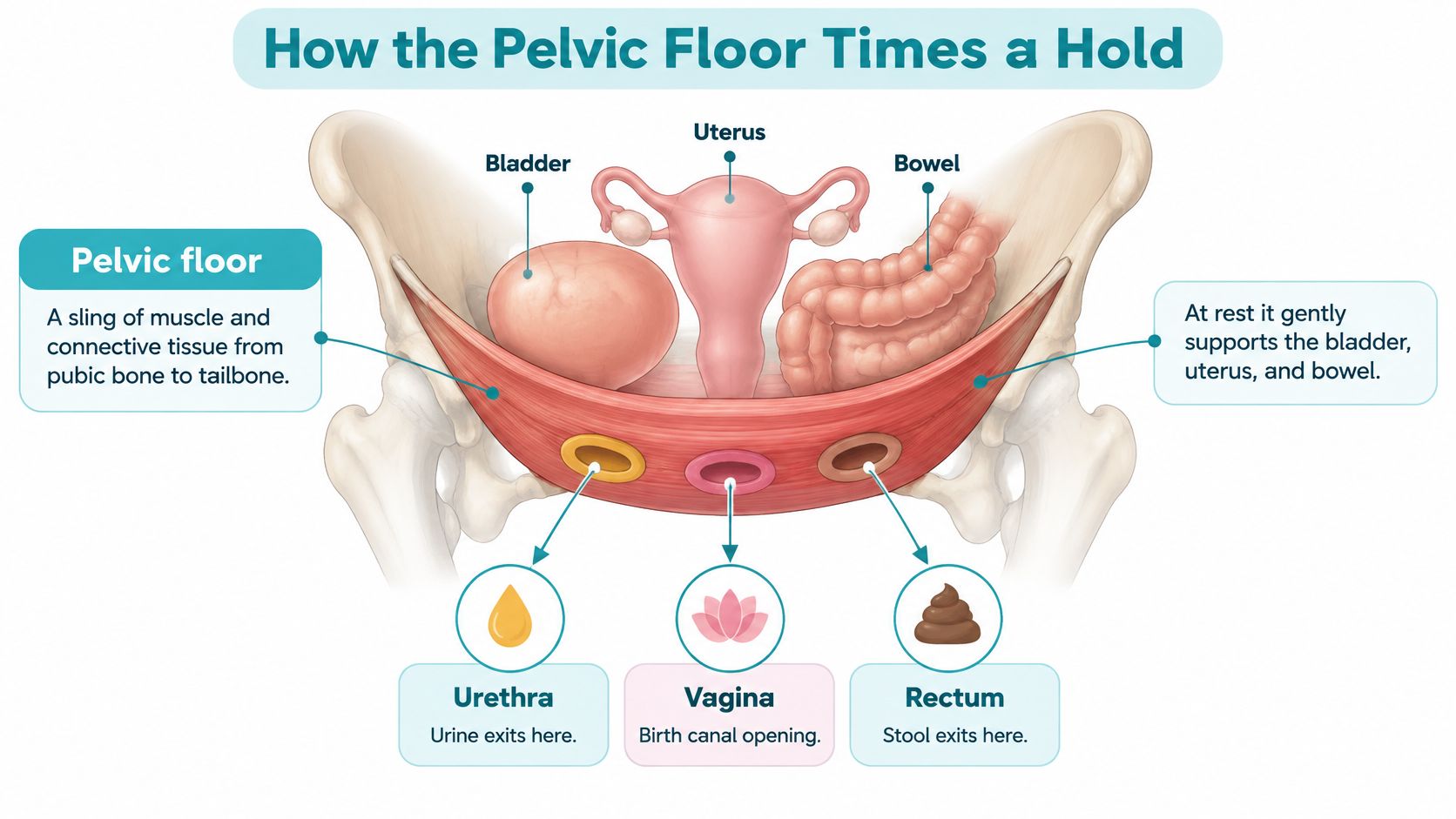
The pelvic floor is a hammock-like sling of muscle and connective tissue spanning the base of the pelvis, from the pubic bone toward the tailbone. It supports pelvic organs and surrounds the pathways through which urine, vaginal contents, and stool pass.
This illustration shows how that support sits beneath the pelvic organs.
Think of a door closing before a gust
During a cough or lift, coordinated pelvic floor activity helps support the bladder neck and increase closure around the urethra. Think of a door that closes before a gust arrives, rather than one you slam after the wind has entered.
In stress leakage, closure can be late, insufficient, or poorly supported. Someone may produce a noticeable contraction while lying down but struggle to recruit it during a fast, unexpected movement.
Urgency leakage involves a different problem. Bladder signaling, sometimes accompanied by an involuntary bladder contraction, creates a compelling need to empty, even when it's not convenient or appropriate. The pelvic floor may need better coordination rather than more force.
Strength without timing is a lock you haven't engaged when you need it.
A muscle also needs an off switch
An overactive pelvic floor doesn't release adequately between tasks. A person can feel tightly clenched yet still have poor functional control, and may also experience pain or difficulty emptying.
That distinction matters because effort isn't the same as an effective pelvic floor contraction. Breath-holding, gripping the buttocks, and pressing the inner thighs together can make an exercise feel strenuous without producing the intended lift and closure.
- A useful contraction feels like a gentle closing and lifting action, with breathing continuing.
- A useful release lets the muscles return to their resting state rather than staying partially clenched.
- A warning sign is pain, bearing down, or increasing difficulty urinating after practice.
Don't repeatedly interrupt your urine stream as an exercise routine. Muscle assessment is better performed away from urination, where a clinician can check both the lift and the release without disrupting emptying.
The important question isn't just whether you can squeeze. It's whether you can contract, release, and coordinate the movement with the task.
What a Useful Incontinence Workup Checks
A useful appointment should turn a vague complaint into a practical treatment decision. You don't need medical vocabulary, and you shouldn't have to prove that your leakage is severe enough to deserve attention.
The Pelvic Floor Dialogues patient-knowledge report describes a finding that 71% of women with urinary incontinence lacked knowledge about the condition. Clear explanations and accessible care are part of treatment, not rewards for already understanding the problem.
The workup combines your account with a diary and targeted examination.
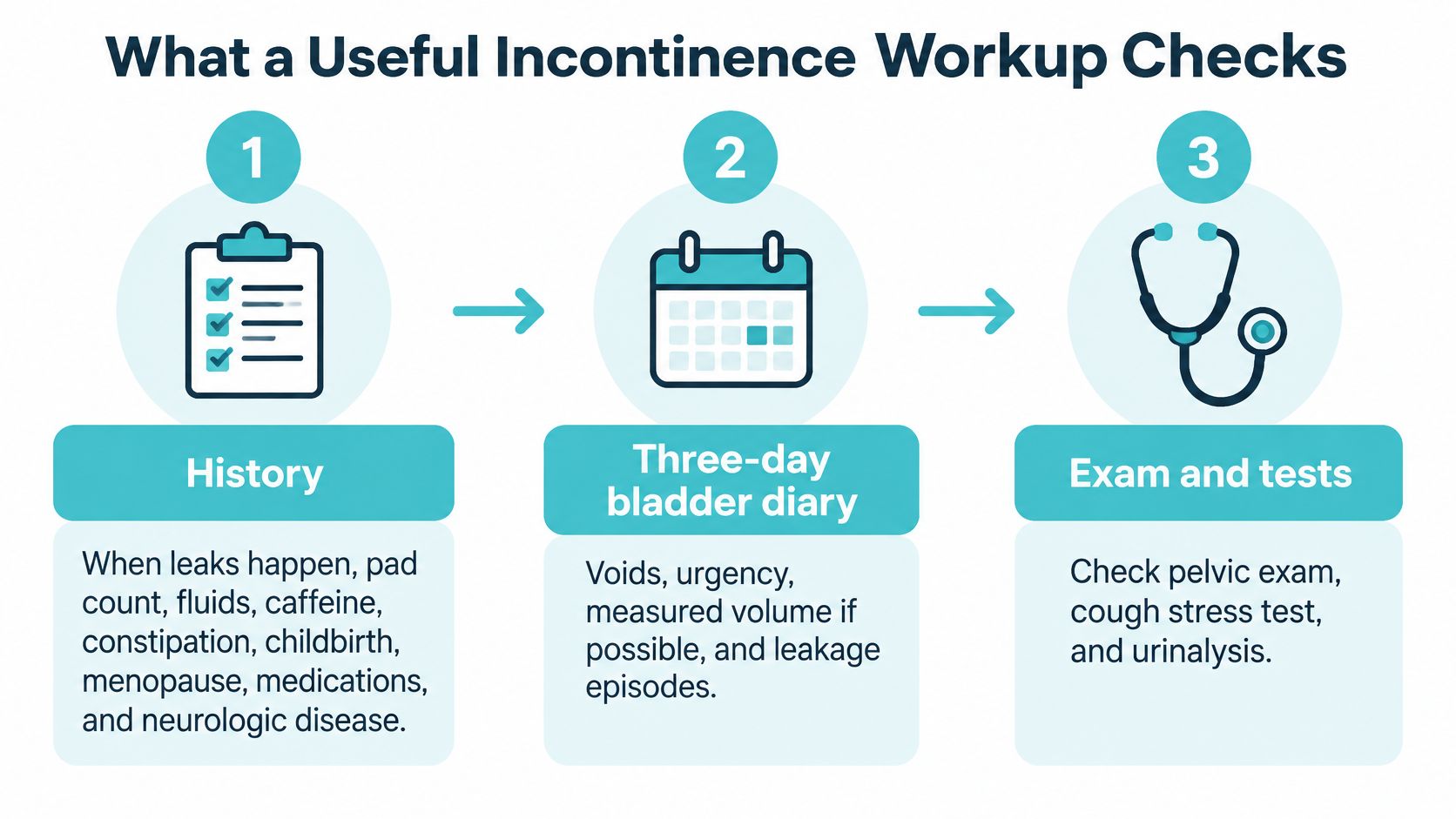
What to expect at the appointment
-
A symptom history. Describe triggers, pad use, drinks, caffeine, constipation, childbirth, menopause, medications, and relevant neurologic conditions. Include when symptoms began and whether the change was sudden.
-
A bladder diary. Record bathroom visits, urgency, drinks, and leakage over representative days. If practical, measure urine volume; otherwise, useful notes are better than abandoning the diary because it isn't perfect.
-
Urine testing when indicated. Infection, blood, or a new change in frequency may need investigation before anyone assumes a muscle problem.
-
A pelvic examination with your consent. The clinician may check for prolapse, tissue changes associated with menopause, scars, tenderness, and your ability to locate the pelvic floor. Our pelvic floor exam guide explains this part of assessment.
-
A functional check. A cough stress test may help demonstrate pressure-related leakage. Muscle testing should assess lift, breathing, substitutions, and relaxation, not strength alone.
-
An emptying assessment when needed. A post-void residual measurement checks how much urine remains after urination when symptoms suggest incomplete emptying.
Urodynamics, cystoscopy, and imaging aren't automatically necessary for an uncomplicated first presentation. Clinicians select them when symptoms, prior treatment, examination findings, or surgical planning justify further investigation.
Make your description concrete
Prepare these statements in your own words:
- My trigger: I leak when I cough, hurry to the toilet, or do another specific activity.
- My burden: I use this many pads during a typical day, and avoid these activities.
- My previous efforts: I've tried these exercises, products, or treatments, with this result.
This video is another resource to discuss with your clinician.
Leave knowing whether the working diagnosis is stress-led, urgency-led, mixed, prolapse-related, or in need of further medical investigation. Ask for the explanation in plain language if the answer isn't clear.
How Supervised Pelvic Floor Training Is Built
Pelvic floor muscle training, or PFMT, is first-line care for female stress and mixed urinary incontinence, but the useful prescription is a progressive program, not occasional squeezing. Guideline-based programs generally involve at least three months of supervised training, with contractions practiced several times daily, as described in this clinical guidance on pelvic floor muscle training.
Correct practice improves the muscles' ability to contribute to urethral closure during pressure-producing activities. Supervision helps determine whether the exercise you're doing is the exercise you need.
The training process should include instruction, repeatable practice, and progression.
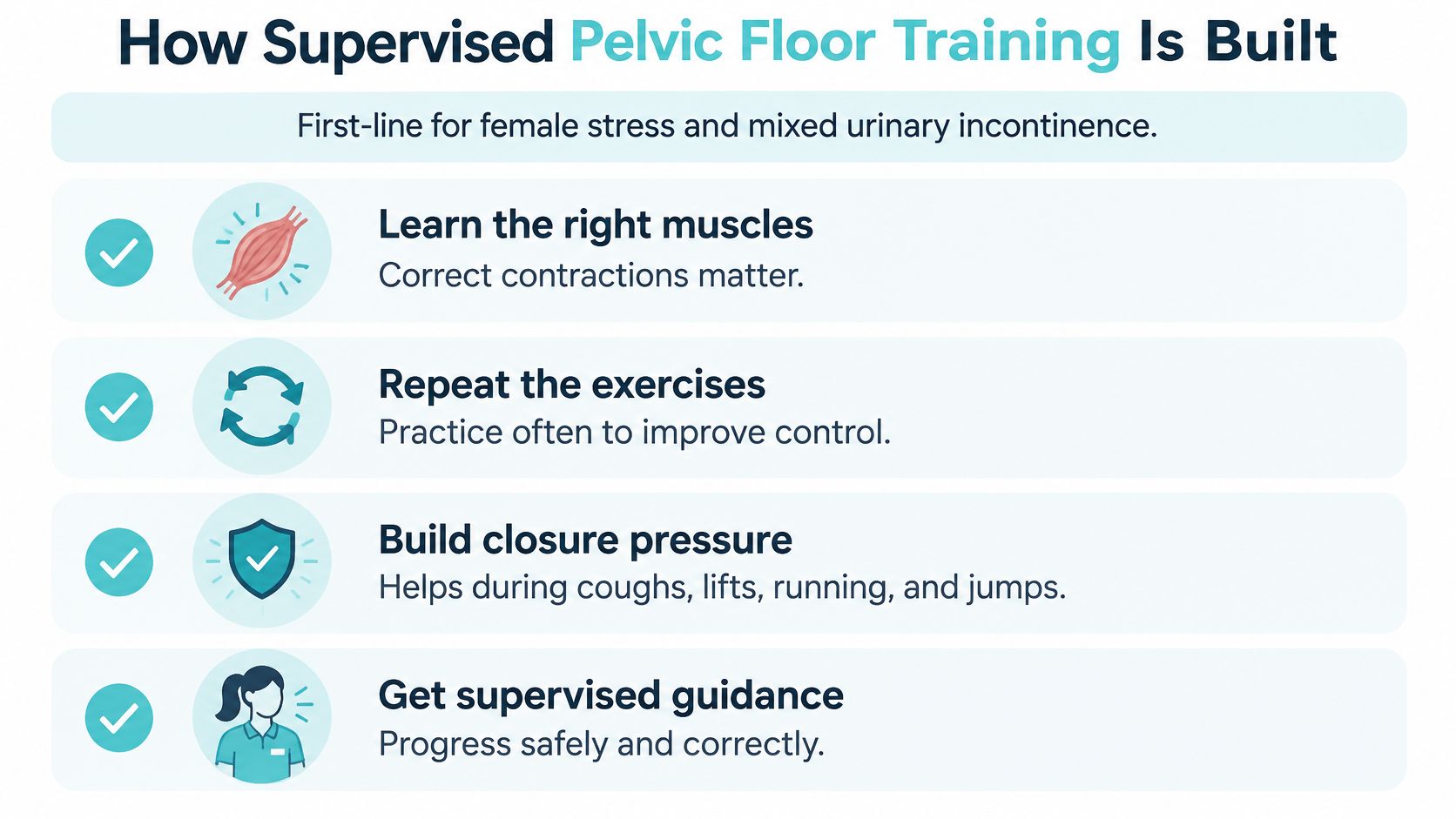
Build a program you can perform correctly
-
Find the intended movement. Your clinician checks that you can close and lift without bearing down. If the cue makes you brace your abdomen or hold your breath, change the cue or position before adding repetitions.
-
Choose a repeatable starting effort. Begin with holds you can finish without losing the lift or developing pain. A shorter, controlled contraction followed by full release is more useful than a long hold that becomes straining.
-
Write down the dose. Your home plan should specify hold duration, rest, repetitions, daily practice, and when to stop. There isn't a universal set count that overrides your examination, fatigue, or ability to relax.
-
Practice the Knack. This means contracting immediately before a predictable cough, lift, or impact. Practice with a manageable task first, then release afterward rather than staying clenched through the day.
-
Progress toward real movement. A clinician may move practice from supported positions into standing, sit-to-stand, carrying, and eventually the activity that causes trouble. For a runner, successful practice on a treatment table isn't the final test.
-
Reassess instead of endlessly repeating. Review symptoms, exercise technique, endurance, relaxation, and functional tasks. Adjust the program when the current exercise becomes easy, remains impossible, or aggravates symptoms.
Make adherence practical
Attach practice to a dependable part of your day, but don't turn every quiet moment into another contraction. Record what you complete so your clinician can distinguish an unsuitable dose from a program that hasn't fitted your schedule.
If childcare, shift work, fatigue, or lack of privacy prevents practice, say so. A workable home plan is more useful than an ambitious sheet you can't follow.
A collaborative review of female stress urinary incontinence care supports supervised instruction while emphasizing the difficulty of managing complicated or severe cases. Leakage alongside prolapse, pain, or poor relaxation requires an individualized approach, not just a longer hold.
Good-session check: You can complete the prescribed movement, breathe normally, and let the muscles go afterward.
Don't expect every practice session to produce an immediate dry cough or run. Judge the exercise by clean technique today and changing function over the treatment block.
Bladder Drills and Devices Beside Exercise
Exercise doesn't have to do every job. Bladder retraining addresses urgency habits, support devices address selected mechanical problems, and feedback tools can help someone learn a movement they can't yet identify.
These scenarios show why different tools belong in different plans.

The teacher who rushes after the bell
Say a teacher routinely postpones bathroom breaks, then hurries down the hallway with overwhelming urgency. Her plan needs to account for work access as well as bladder behavior.
Bladder training uses a planned schedule and gradual, tolerable changes rather than repeated emergency trips. During an urge, she might pause, breathe, and use a gentle pelvic floor contraction if her clinician has confirmed that it's appropriate, then walk rather than rush when the urge settles.
She shouldn't force herself through pain or use dehydration to get through class. The next diary should show less urgency-related leakage, not merely fewer drinks.
The runner who needs support during impact
A runner may have reasonable voluntary control yet continue leaking during repeated landings. A continence pessary or another suitable support device can help selected patients manage stress leakage while rehabilitation continues.
A clinician should select and check the device, including comfort, tissue health, and emptying. It isn't a permanent substitute for understanding why impact remains difficult, and new pain or trouble urinating needs review.
The next diary should show fewer leaks during a comparable workout, with no new discomfort or emptying problem.
The person who can't locate the contraction
Someone who can't tell a lift from bearing down may benefit from biofeedback, which makes muscle activity easier to interpret. Selected patients may use other aids, such as vaginal cones or electrical stimulation, under professional guidance.
These tools aren't interchangeable, and they aren't necessary for everyone. A weighted device doesn't prove that weakness is the only problem, and stimulation doesn't remove the need to learn voluntary coordination.
The next record should show a more reliable voluntary contraction and release, alongside symptom tracking. If you're considering chair-based treatment, our Emsella chair reviews guide provides context for that discussion, not a replacement for assessment.
Other helpful adjustments stay simple:
- Caffeine timing: Record whether symptoms cluster after caffeinated drinks before making broad restrictions.
- Constipation care: Address straining and difficult stool passage as part of the overall plan.
- Pad strategy: Choose protection suited to urinary leakage while treating the cause, rather than judging progress by whether you can tolerate a smaller pad.
Devices and habit changes need extra caution when pain, prolapse, or retention is present.
Results to Expect and When to Escalate
The 2018 Cochrane review summarized in NIDDK bladder-control information included 31 trials involving 1,817 women from 14 countries and found that women with stress incontinence reported cure after training more often than those receiving no treatment or inactive control, 56% versus 6%.
Training outcomes readers can use as benchmarks
These are group results, not a personal guarantee or a deadline for recovery.
| Result | Stress incontinence | Any incontinence type |
|---|---|---|
| Reported cure at end of training | More frequent with training than inactive care | Training favored over comparison groups |
| Leakage episodes | Track pressure-triggered episodes separately | Track total episodes and urgency |
| Cure or improvement | Both are meaningful outcomes | Include partial improvement, not just complete dryness |
| Evidence base | Included in the review described above | Review covered stress, urgency, and mixed symptoms |
| Later review | Training approaches continued to be evaluated | An expanded evidence base doesn't establish a universal prescription |
The systematic review available through Europe PMC also supports assessing quality of life, not leakage counts alone. Being able to exercise, sleep comfortably, or enjoy sex without worrying about leakage can matter even when symptoms haven't disappeared completely.
Choose a personal goal that can be tested fairly. For example, compare the same lifting task, a similar walking route, or a typical workday rather than comparing an unusually quiet day with a demanding one.
When a different plan makes more sense
More squeezing isn't the right response to every plateau. If urgency, pelvic pain, or difficulty releasing dominates, the clinician should reconsider the diagnosis and exercise emphasis before increasing the load.
- No meaningful change: Review technique, actual practice, triggers, and whether the original diagnosis still fits.
- Persistent urgency: Discuss bladder-focused care and whether medication review or additional treatment is appropriate.
- Continuing stress leakage: A pessary or surgical consultation may be reasonable when symptoms remain disruptive despite a fair conservative trial.
- Concerning symptoms: Blood in urine, recurrent infections, poor emptying, or neurologic changes require medical evaluation rather than another exercise prescription.
Inability to urinate, new leg weakness, saddle-area numbness, or loss of bowel control warrants urgent medical attention. Don't wait for a routine therapy appointment.
Lack of improvement is information about the plan, not a verdict on your effort.
A useful reassessment identifies what should change next. That may mean a different exercise, treatment for excessive tension, investigation of another contributor, or discussion of options beyond rehabilitation.
Book Supervised Care When Home Efforts Stall
Book an assessment when leaks limit daily activities, home exercises haven't helped, urgency or pain is the main concern, or heaviness accompanies leakage. You don't have to wait until you stop exercising, traveling, or having sex before asking for care.
Bring your diary, trigger list, medication list, and relevant childbirth, surgery, or cancer-treatment history. Use concrete descriptions of what happens, how you manage it, and what you've already tried.
Make the appointment workable
Tell the booking team about barriers early. Cost, transportation, caregiving, privacy, and difficulty understanding written instructions can all affect whether a plan is usable.
- Ask for accessible instructions: Request plain-language wording and a demonstration you can repeat back.
- Discuss follow-up format: Ask whether telehealth or a home-focused plan is appropriate after assessment.
- State your goal: Name the activity you want back, such as lifting your child or finishing a run without leakage.
At Lake City Physical Therapy, we offer pelvic floor physical therapy for incontinence, prolapse, endometriosis, and painful sex. Confirm current services and locations when arranging care.
Questions worth asking
Ask whether your clinician will assess relaxation as well as strength, individualize treatment for your leak pattern, and set a clear reassessment point. You should understand what you're practicing, why it fits your symptoms, and what would prompt a change.
If symptoms began suddenly or include blood, retention, or new neurologic changes, seek medical review first. Routine therapy shouldn't delay investigation of a potentially urgent problem.
Otherwise, schedule your assessment this week. Bring enough detail to start a focused conversation, not a perfectly completed diary.
We offer pelvic floor physical therapy to help address urinary incontinence with care matched to your symptoms and goals. Visit Lake City Physical Therapy to review our services and arrange an assessment, so your next step is based on your leak pattern rather than another generic Kegel routine.

