Physical Therapy Cost: What You’ll Pay and Why It Varies
A typical U.S. physical therapy episode averaged about 9.9 visits, with mean total spending of $1,708 and a median of $792, based on national data from 2008–2012. Those historical figures describe the whole treatment episode, not necessarily what the patient paid personally.
That distinction matters when you're comparing clinics or deciding whether you can afford care. An advertised session price leaves out the questions that determine your budget: how much your insurance recognizes, what portion you owe, and how many appointments your treatment requires.
The most useful physical therapy cost estimate covers your expected course of care, including the evaluation, follow-up treatment, and any separately billed services.
What a Typical Physical Therapy Episode Costs
A $1,708 average and a $792 midpoint describe the same set of patients, according to a national analysis of ambulatory physical therapy episodes published in Physical Therapy using Medical Expenditure Panel Survey data from 2008–2012. The distance between those two numbers is the first thing worth understanding about episode costs.
| Measure | Mean | Median |
|---|---|---|
| Total spending per episode | $1,708 | $792 |
| Out-of-pocket spending among patients who paid | $351 | $144 |
The analysis also reported an average of 9.9 visits per episode, and 54% of episodes involved some out-of-pocket spending by the patient.
These measures answer different questions. Total spending counts everything paid for the care delivered, by insurers and patients combined. Out-of-pocket spending counts only the patient's personal contribution, and only among the people who paid anything at all. The $351 and $144 figures describe that paying subset, not everyone treated. Patient payments already sit inside the total, so adding the two rows together would count the same money twice.
Why the mean runs higher than the median
The mean is the arithmetic average, and expensive episodes pull it upward. An episode with many visits, intensive treatment, or high per-session prices can sit far above the typical case, and the average absorbs all of that.
The median is the midpoint: half of episodes cost more, half cost less. It describes the middle episode better than the mean does, but the middle episode is still not your episode. A straightforward movement problem and a complicated recovery require different amounts of care.
The dates matter too. Inflation, regional wages, provider contracts, and changes in insurance design can all shift prices over time. Use these figures to understand how episode spending distributes, not as a quote for care today.
Practical rule: Budget for the whole treatment episode first, then work out which share belongs to you.
Turn the benchmark into a usable estimate
Build the estimate in three steps. First, get the clinician's expected visit range and your insurer's allowed amount per visit for the planned services, then multiply, pricing any evaluation or reassessment separately if it carries a different rate. Next, apply your plan's cost-sharing rules to find your portion of that total. Finally, add the price of any uncovered services on top.
Episode math also makes clinic comparisons fairer. A lower advertised follow-up price wins the comparison only when visit count and appointment contents match. A clinic quoting more per session can still deliver a cheaper episode if its plan needs fewer visits or bills fewer separate services. When a clinic quotes only a follow-up price, ask whether that figure covers every service likely to appear on the claim.
How Visit Count and Treatment Length Drive Your Bill
A treatment episode isn't the same appointment repeated until you feel better. The therapist changes the work as your function improves, and those changes should influence both scheduling and your budget.
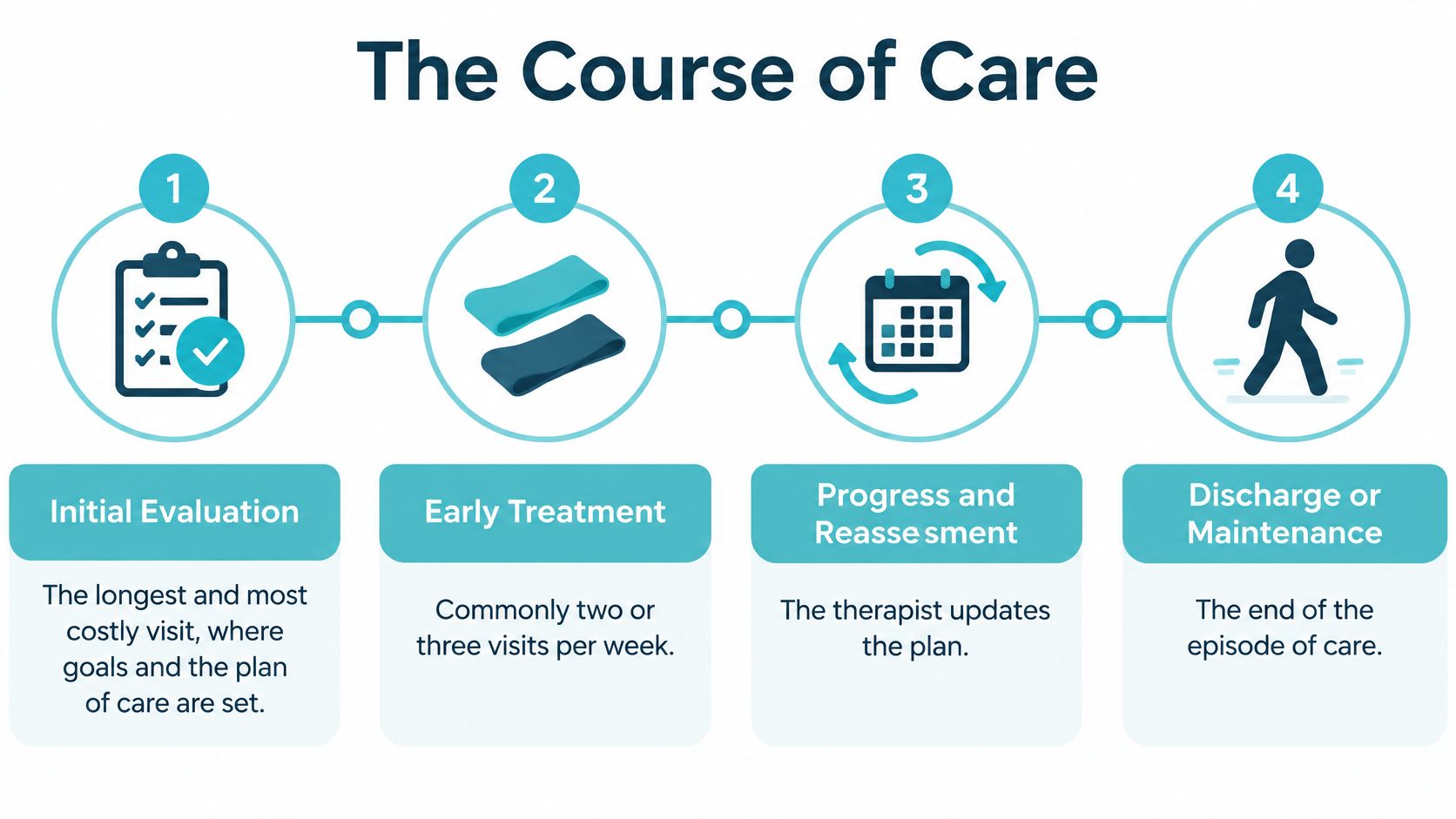
Follow the course of care
- Initial evaluation: The therapist reviews your history, examines the relevant movement or function, and establishes goals. This appointment may have a different price from follow-up treatment, so don't assume the advertised session fee applies.
- Early treatment: Appointments focus on the problems preventing safe movement or daily activity. The schedule should reflect your needs and your ability to practice independently, rather than a fixed schedule for every patient.
- Progression: As you learn the exercises and strategies, visits may become less frequent. The therapist can use appointments to adjust difficulty, check technique, and address remaining limitations.
- Reassessment: Your therapist measures progress against the original goals. Ask whether this happens within a treatment visit or involves a separately billed reevaluation.
- Discharge: The episode ends when the agreed goals are met or the plan is otherwise closed. If ongoing support is proposed, ask what it's intended to accomplish and how it differs from active rehabilitation.
Identify what could extend treatment
Post-surgical precautions, postpartum recovery, and pelvic floor retraining can affect how quickly treatment progresses. A longer calendar period doesn't automatically mean more appointments, though. Some patients need time between visits to practice or recover.
Missed appointments can interrupt progression, and cancellation charges may create costs outside your insurance benefit. Ask for the clinic's cancellation terms before scheduling.
A home program is another important planning tool. Tell your therapist if an exercise hurts, feels confusing, or doesn't fit your childcare or work schedule. An achievable program is more useful than an ambitious program you can't follow. Our guide to how long pelvic floor therapy takes explains why an individualized timeline matters.
At evaluation, ask:
- Expected range: What visit range should I budget for initially?
- Discharge milestones: What changes will tell us I'm ready to finish?
- Home-based support: Which parts of treatment can I safely manage between appointments?
How Insurance Turns a Charge Into What You Owe
After the Part B deductible, patients generally pay 20% of the Medicare-approved amount for medically necessary outpatient physical therapy, according to Medicare's physical therapy coverage guidance. That 20% applies to the approved amount. A clinic's listed charge can sit well above that figure and still not be the number your share is calculated from.
An estimate makes sense only when you separate three amounts: what the clinic submits, what the plan recognizes, and what you owe. Those three rarely match. Over a full course of care, the total you fund is the sum of your share on each covered line, not the sticker price times the number of visits.
Learn the billing terms in order
The billed charge is the amount the clinic submits for a service. It opens the claim. Your payment is calculated later.
The allowed amount is what the insurer or payment program recognizes for that covered service. On an in-network claim, the provider's contract decides how the gap between the charge and the allowed amount is handled. The billed charge works like a sticker price. The allowed amount works like the contracted price. Cost sharing is built from the contracted price.
The deductible is covered spending you may pay before the plan starts sharing applicable costs. Some benefits apply the deductible differently, so check how it treats outpatient therapy.
Coinsurance or a copay is your share once that sharing begins. Coinsurance is a percentage of the applicable allowed amount. A copay is a fixed amount under your benefit terms. Medicare's general outpatient rule, the 20% above, is coinsurance on the approved amount. A commercial plan may use a copay, a different percentage, or both, depending on the benefit.
From one billing line to the episode you fund
A follow-up visit can include several services, such as therapeutic exercise and manual therapy. Each can appear as its own billing line. Timed procedures can involve more than one unit. A quoted amount for a single code covers that line. The visit total adds every line and every unit.
Stack those visits and you have the episode budget. A higher allowed amount on one code raises the coinsurance on that line. The episode total can still come out lower when the deductible is already met, when a copay replaces a percentage, or when the plan uses fewer units than a fee-schedule quote assumed. The upfront line looks expensive. The amount you owe across the course does not have to follow it.
Before the deductible is met, an in-network patient may owe the allowed amount for covered services rather than the full billed charge. After it is met, the plan's coinsurance or copay applies to the recognized amount. Supplemental or secondary insurance may pay part of what remains.
The treatment setting, the provider's payment arrangement, and the services delivered also change the result.
Ask for your estimated patient responsibility, not just the amount the clinic plans to submit to insurance.
For pelvic health care, our explanation of whether pelvic floor therapy is covered by insurance can help you prepare benefit questions. Confirm coverage for the planned treatment, rather than relying only on a general statement that your plan covers physical therapy.
Why Location and Provider Type Change the Price
The same category of physical therapy service doesn't have a single national price. In a national analysis of 1,666 U.S. hospitals, median commercial-insurer payments for evaluation services ranged from approximately $151 to $215, according to Yale's report on outpatient physical therapy pricing.
The analysis also found that cash prices were generally higher than negotiated commercial rates, and prices tended to be lower at rural facilities than urban facilities. Those are hospital-sample findings, not proof that every rural clinic or insurance rate is cheaper.

Compare location and billing setting separately
| Price driver | What to verify |
|---|---|
| Geographic location | The local estimate for your planned services |
| Hospital-based outpatient setting | Whether the estimate includes every applicable facility and professional charge |
| Independent practice | How evaluation and treatment services appear on the bill |
| Insurance contract | Whether the specific location and treating provider participate in your network |
A hospital-based clinic and an independent practice may use different billing arrangements. Neither label, by itself, tells you your final responsibility. Even at the same clinic, patients with different insurance contracts or deductible balances can owe different amounts.
Consider a pelvic-floor evaluation followed by therapeutic exercise and manual therapy. The clinic may price those services line by line rather than offer a single all-inclusive session fee. Comparing only the evaluation charge could miss differences in follow-up costs.
Request a local, itemized comparison
The hospital sample may not represent every private practice, but it demonstrates why a national average can't replace a local quote. Compare the same planned services and expected treatment course at each location.
We have Lake City Physical Therapy locations in Hayden and Post Falls, Idaho, giving North Idaho patients local options to consider. Request a written estimate separating the billed charge, negotiated rate, deductible responsibility, copay or coinsurance, and visit limits.
Also confirm which location the estimate covers. A price from another facility or a different insurance network may not apply to your appointment.
Payment Options and Ways to Cut Your Costs
A lower session price can still produce the larger episode bill if it leads to more visits, excludes needed services, or sits outside your insurance contract. Choose the route by comparing expected total responsibility: what you pay at the desk, what your plan later counts, and what completing the plan costs in time and travel.
Payment and access routes compared
| Route | Typical cost pattern | Main risk | Ask before booking |
|---|---|---|---|
| In-network insurance | Patient pays applicable deductible, copay, or coinsurance based on covered benefits | Visit caps and authorization limits | What deductible remains, and what is the annual visit limit? |
| Out-of-network insurance | Patient share may be larger | Billed charge may exceed the plan's allowed amount | Will the clinic bill the insurer directly, and what could remain unpaid? |
| Self-pay or cash | Clinic's stated rate for each visit | Patient pays the full agreed price | Are reduced-rate or package options available, and what do they include? |
| Direct access, no referral | May reduce preliminary appointments and episode costs | Plan may still require a referral | Does my plan cover treatment started through direct access? |
| Telehealth follow-up | Plan's virtual-care benefit or clinic's self-pay rate | Cannot replace hands-on examination or treatment | Are virtual visits covered for my planned care? |
| Financial assistance or payment arrangements | Eligible discounts or payments spread over time | Terms may not reduce the total price | What assistance is available, and can I receive the terms in writing? |
Check benefit limits before choosing insurance
A 2025 analysis described an average privately insured physical therapy session cost of $192, nearly four in five analyzed ACA plans limiting annual therapy visits, and a direct-access comparison averaging 7.6 visits and $1,004 per episode versus 12.2 visits and $2,236 through physician referral, according to Chicago Sun-Times reporting on physical therapy coverage.
Those figures describe patterns, not a promise for your case. Different diagnoses, deductible balances, and referral rules can change both visit count and allowed amount. Permission to begin treatment and permission to receive insurance payment are different questions. Confirm both before skipping a referral.
Compare convenience with total spending
Self-pay can make the appointment price clearer, but ask whether payments count toward your deductible and whether the clinic will still submit claims. A cash rate that does nothing to satisfy a deductible can be expensive if you later need covered care.
Lake City Physical Therapy offers telehealth, which can reduce travel for appropriate follow-up appointments such as exercise review, movement coaching, or home-program adjustments when the therapist determines virtual care is appropriate. It will not provide hands-on examination or treatment. Online bill payment can also make it easier to keep receipts and match payments to your estimate.
The lowest upfront price isn't necessarily the lowest total cost. Compare the services included, likely visit count, and time required to attend.
Financial help is the least predictable route, so treat it as a written agreement rather than a hope. Ask about sliding-scale fees, payment plans, prompt-payment discounts, package terms, and whether eligible visits can be paid through an HSA or FSA. Spreading payments changes timing, not necessarily the total. Verify your account rules and get any clinic payment agreement in writing before you rely on it. If you are budgeting contributions around tight monthly cash flow, HSA planning for tight monthly budgets can help you decide how much to set aside.
Pelvic Floor, Prenatal and Cancer Care Costs Explained
Pelvic health costs include more than the clinic bill. The 2025 APTA pelvic-health report identifies cost, insurance limitations, long waits, geographic distance, childcare, and delayed referrals as recurring barriers, and notes that about one-quarter of surveyed pelvic-health practices use fully or partly cash-based models. It also summarizes research suggesting that removing PT copays can reduce later use of some higher-cost services for certain employer-plan populations. Treat that as pathway evidence, not a promise that one patient will avoid surgery, injections, or specialist appointments.

Compare care pathways, not just session fees
Incontinence, painful sex, prolapse, pregnancy-related dysfunction, and cancer-related lymphedema do not follow one rehabilitation schedule. A fair comparison weighs clinically reasonable plans for the same condition, then prices the episode from evaluation through discharge.
- Earlier evaluation versus delay: A higher-priced first visit can still make sense if it produces a usable conservative-care plan and prevents extra appointments later. Delay does not automatically cost more, but waiting can turn a small problem into a longer plan.
- Assessment plus home care versus repeated appointments: A thorough assessment with an achievable home program may support fewer visits when that fits the diagnosis. Some patients still need repeated skilled care, so visit count should follow recovery rather than a target number.
For added context before you call clinics, compare your notes with pelvic floor therapy costs on Bornbir. Use general price discussions as preparation, then build your budget from your own benefits and plan.
Include comfort and continuity
We offer Pelvic Floor Physical Therapy, Prenatal & Postpartum Physical Therapy, and Lymphedema Physical Therapy. Our guide to what to expect at pelvic floor therapy can help you prepare for the appointment and raise questions about comfort, privacy, and goals.
Add travel, childcare, time away from work, and fatigue to the personal budget. For oncology care, pain, swelling, mobility limits, and low energy can change how often visits are realistic, so continuity may matter as much as the advertised fee.
Confirm Your Estimate Before Your First Visit
Build your estimate from your benefits and proposed treatment plan, not from a national average. You may need a preliminary estimate before evaluation and an updated version after the therapist understands your needs.

Gather the inputs and set the visit range
- Collect benefit details: Obtain the estimated allowed amounts, remaining deductible, copay or coinsurance terms, annual visit limit, and authorization expiration date. Confirm referral requirements if you want direct access.
- Set a clinical range: Use the evaluating therapist's expected visit range and discharge milestones. Ask for a lower and upper budget rather than treating the initial schedule as a guaranteed total.
Save the written estimate alongside your insurer's benefit information. Note whether the estimate includes the evaluation, follow-ups, and any services with different rates.
Calculate your share without double-counting
For a simple deductible-plus-coinsurance plan, apply the remaining deductible only up to the total covered allowed amount. Then apply coinsurance to the covered amount left after that deductible payment.
Patient estimate = deductible applied to this episode + coinsurance on the remaining covered allowed amount.
As a hypothetical arithmetic example, not a clinic quote, suppose ten visits have an allowed amount of $120 each, producing $1,200 in covered allowed charges. With a $300 remaining deductible and 20% coinsurance, the remaining covered amount is $900; coinsurance is $180, giving an estimated patient total of $480 before extras.
If your plan uses a flat copay, multiply that copay by the applicable visits, then check whether a deductible or other cost sharing also applies. Actual claims can differ when services, benefits, or deductible balances change.
Add extras and confirm in writing
Separately billed services, uncovered items, and cancellation fees belong on separate lines. For example, a hypothetical uncovered $50 reassessment would be added to your patient total, while a covered reassessment would follow the plan's applicable rules.
Compare the completed estimate with any available self-pay arrangement, especially for care beyond covered benefits. Patients can pay their bills online through our website, but confirm the amount and payment terms before relying on a payment schedule.
Request a written estimate and verify benefits with your insurer before the first appointment. Ask what circumstances could change the total.
Lake City Physical Therapy offers pelvic floor, prenatal and postpartum, oncology, and lymphedema care, along with telehealth options for appropriate treatment. Visit Lake City Physical Therapy to explore care options and contact our team with questions about planning your appointments and understanding your estimated costs.

