Scar Tissue Pain: Causes, Red Flags, and Treatment
An incision may look closed while pulling when you lift your child, burning when clothing brushes against it, or causing a deeper ache during sex. Scar-related pain can come from sensitive nerves or tissue that does not glide easily beneath the skin. A healed surface does not show how freely the deeper layers move, and it is not a reason to press or massage the area forcefully.
After cesarean delivery, scar-specific pain was reported by 16.7% of patients from three to less than six months, 11.4% from six to less than twelve months, and 8.8% at twelve months or longer (systematic review and meta-analysis). These figures describe pain associated with the scar; a deeper pelvic or abdominal source may feel close to the incision but need a different assessment. If pain persists or interferes with daily activities, discuss it with a clinician.
What Scar Tissue Pain Is and How It Differs From Healing
A scar is a little like a patch sewn into fabric. The patch may look smooth, but the stitching underneath can pull on nearby threads. In the body, those threads include nerves and layers of tissue that need to move as you bend, reach, breathe, and walk. If healing tissue sticks to its surroundings or a nerve becomes irritated, the scar may feel tight, tender, or painful despite looking ordinary.

Some tenderness and sensitivity can be part of healing. The concern is a different pattern: pain that continues, returns, spreads beyond the incision, or limits movement and everyday activities rather than gradually easing. The length of time symptoms last matters, but so does their effect on sleep, work, lifting, exercise, and intimacy. A clinician can help assess whether the pain fits the expected course of healing or needs a closer look.
Chronic postsurgical pain is a recognized problem, particularly after operations that involve cutting nerves or carry a high risk of nerve injury. A narrative review reports that chronic postoperative pain occurs in approximately 30%–50% of patients after procedures such as mastectomy, limb amputation, and thoracotomy (review of chronic postsurgical pain). That doesn't mean every sore incision signals a complication. It does mean ongoing pain is more than a cosmetic issue and shouldn't be dismissed merely because the skin has closed.
This distinction is relevant after breast, abdominal, pelvic, and orthopedic operations, where incisions may cross or irritate small nerves. If you're planning surgery and want practical background on healing and scar care, managing scars after cosmetic surgery can provide additional context. Whatever the procedure, a healed-looking surface doesn't tell the whole story; how the scar feels and what it stops you from doing matter, too.
Why Scar Tissue Becomes Painful After Surgery
A closed incision can still hurt for more than one reason. The skin may be sensitive, a small nerve may be irritated, or tissue beneath the incision may not move freely. These layers sit close together, so pain felt at the surface can have a deeper source.
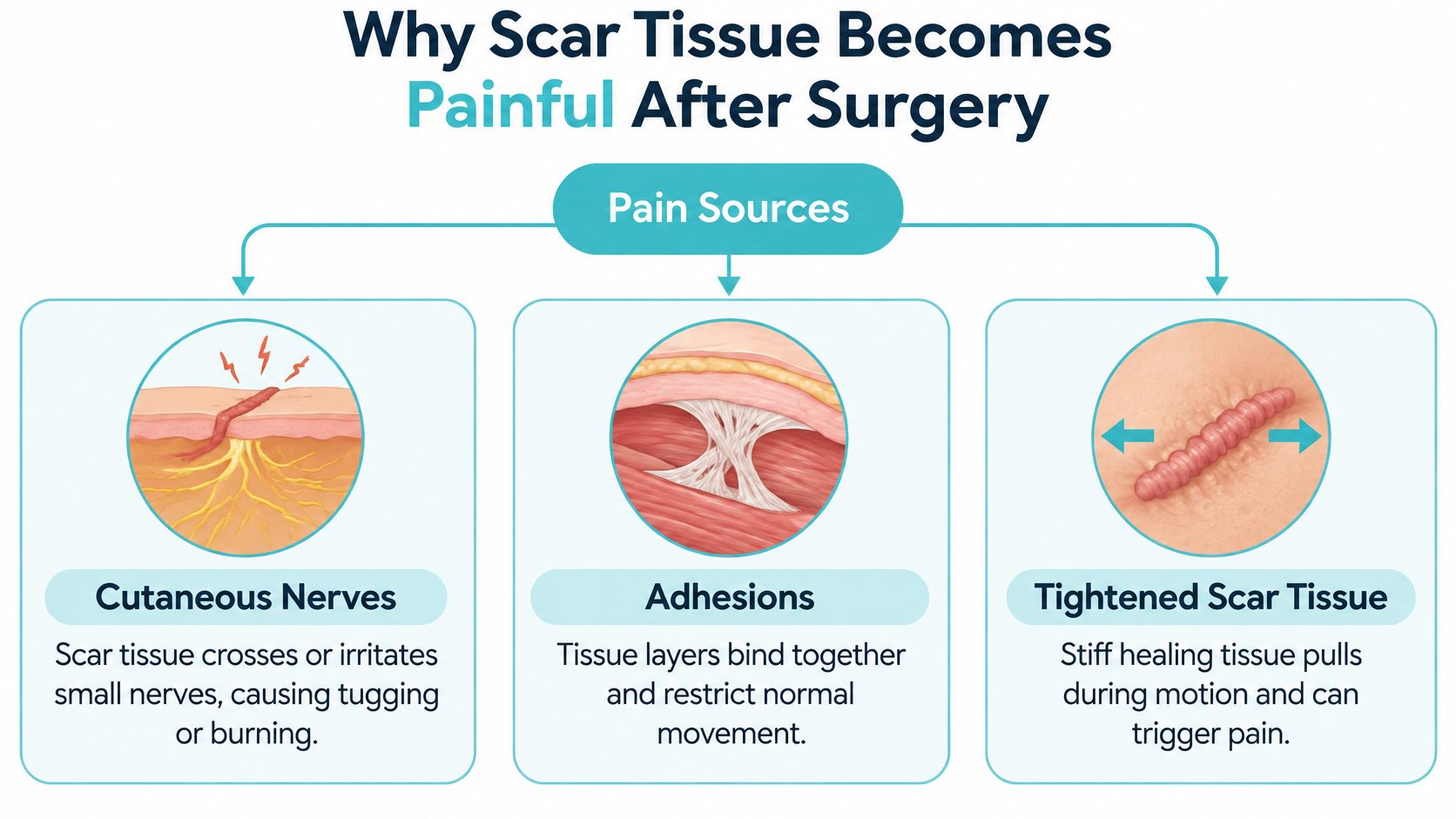
As a cut heals, small sensory nerves can become caught in dense scar tissue, regrow in an irregular way, or form a neuroma, a bundle of nerve endings that may be sensitive. Local inflammation can also make the area react to pressure that would not usually hurt.
Deeper in the body, adhesions can bind tissue layers that normally slide over one another. A nerve may also become tethered, like a cord held too tightly, limiting its usual glide. Stretching or moving can then pull on the restricted area. Around abdominal and pelvic incisions, the skin, muscle, connective tissue, and deeper structures all need to move together. A scar that looks settled on the outside may still be restricting movement below it. Forceful massage is not a safe way to test or treat that restriction, especially before the wound has healed and a clinician has assessed it.
After cesarean delivery, persistent pain may reflect these deeper mechanisms as well as sensitivity in the skin. Adhesions or nerve tethering can continue to affect movement even when the incision looks healed, so the visible scar alone cannot identify the source. Learn more about C-section adhesions and tissue restriction.
Two scars that look alike can feel very different because appearance does not show what happened to the nerves or deeper tissue. Pain may come from the skin, restricted movement beneath it, nerve irritation, or a combination. If the wound is not healing normally, have a clinician assess it before trying scar work. Information about outpatient wound care in Southern California explains services that may help with wound concerns.
Recognizing the Symptoms of Painful Scar Tissue
Consider someone whose incision has closed but who still feels a sting when a waistband rubs against it. They may also notice a deeper pull when reaching overhead, turning in bed, or having sex. Those experiences are useful clues for a clinician, not proof of a specific diagnosis.
Nerve-related pain may feel burning, shooting, electric, itchy, or numb. Sometimes it travels beyond the visible scar or hurts with light touch. When an ordinarily harmless touch, like fabric or a gentle brush, feels painful, clinicians call that allodynia. It can happen when the nervous system becomes unusually sensitive in the area.
The timing and trigger can help distinguish patterns. Pain at rest that follows a defined nerve area may suggest deeper nerve involvement. Pain that increases when the scar or surrounding tissue is stretched may point toward tethering or restricted glide (clinical discussion of painful scar mechanisms). A pulling feeling during a movement doesn't confirm an adhesion, but it gives your provider a useful starting point for assessment.
For your appointment: Note where the pain starts, what it feels like, and which movements or kinds of touch bring it on.
Symptoms can interfere with sleep, mood, lifting, caregiving, exercise, and intimacy. Some people find it difficult to carry a child or return to their usual activity; others notice discomfort while dressing or during breast and trunk movement after surgery. If you're recovering from breast surgery, information on scar tissue after mastectomy can help you understand why the area around the incision may need to be considered along with the scar itself. Sharing clear examples of what hurts, and when, helps a clinician assess the whole pattern rather than judge by appearance alone.
Red Flags That Need Prompt Medical Evaluation
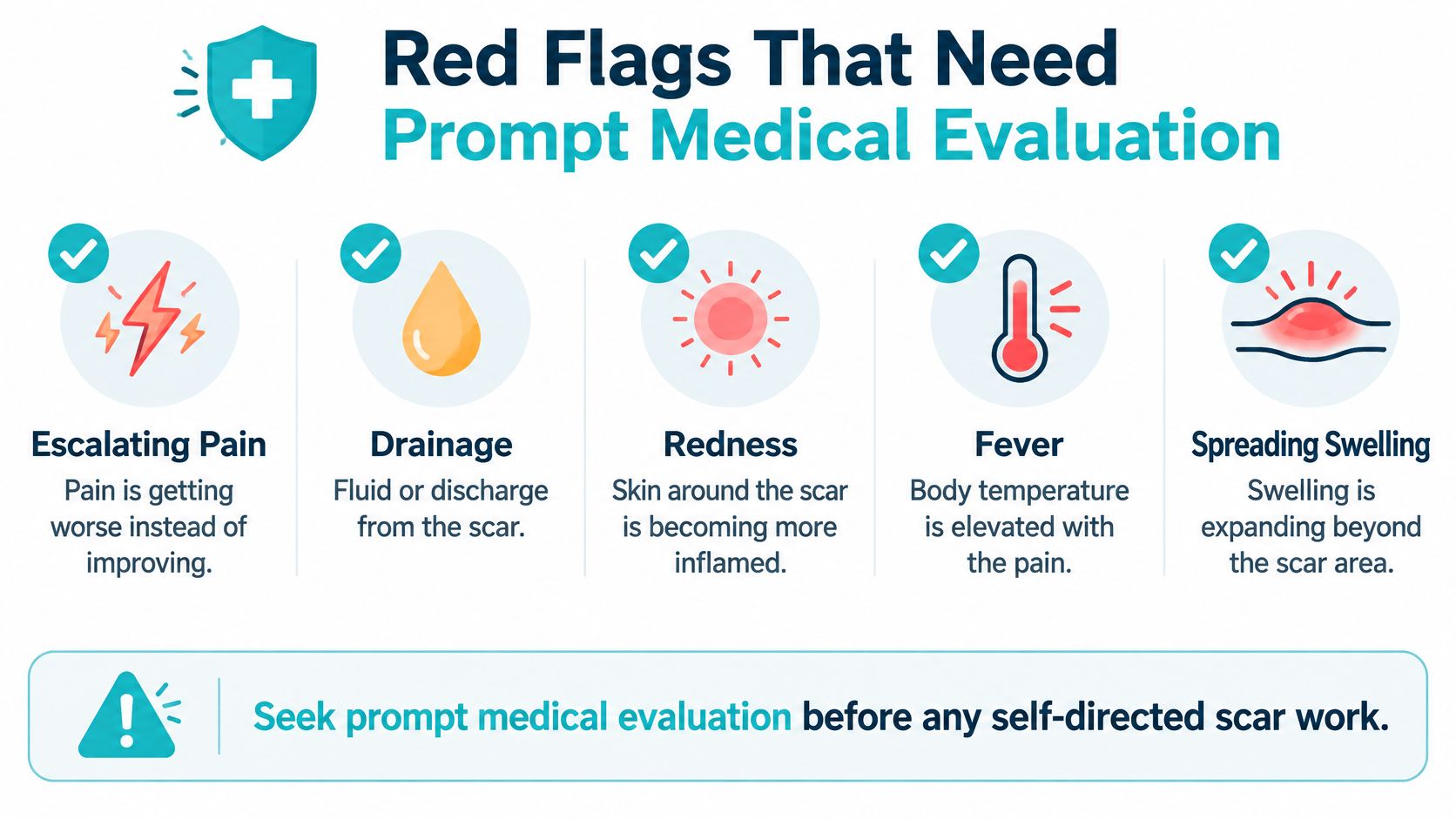
A scar that's painful and worsening, draining, or becoming increasingly red should be assessed before you try massage or stretching. Seek prompt medical advice if pain is escalating, fluid is coming from the incision, redness is spreading, you have a fever, or swelling is expanding around the area. These symptoms can signal a wound or other medical problem that needs a clinician's assessment, not home scar work.
Pelvic symptoms after cesarean delivery also deserve attention, even if the external incision looks fine. Pain with sex, menstruation, urination, or bowel movements, or a deep pulling sensation in the abdomen, can have causes beyond the skin. These may include a uterine scar niche, adhesions, nerve involvement, or pelvic-floor dysfunction. A gynecologist or other appropriate medical provider can assess whether further evaluation is needed.
A 2025 systematic review found that among patients with a confirmed cesarean scar niche, reported prevalence was 28.2% for painful sex and 26.8% for chronic pelvic pain (review of cesarean scar niches). The symptoms don't establish that a niche is present; they're a reason to discuss assessment rather than assume the pain is superficial or just part of healing.
Use this practical decision path:
- Contact a medical provider promptly if pain is worsening, the scar is draining or increasingly red, you have a fever, swelling is spreading, or you notice a new mass.
- Book a gynecologic assessment if pelvic pain accompanies sex, periods, urination, bowel movements, or deep abdominal movement after surgery.
- Ask before self-treating if you're unsure whether the wound has healed, symptoms are changing, or pain is significant.
Scar mobility work can support rehabilitation, but it can't diagnose a wound problem or a deeper pelvic cause. Get medical guidance first when warning signs or pelvic symptoms are present.
Comparing Conservative Treatment Options for Scar Pain
Once a medical provider has ruled out problems that need treatment first, conservative care can address mobility, sensitivity, strength, or a combination. The right choice depends on where the pain seems to come from, how the scar behaves during movement, and whether pelvic symptoms are present.
| Approach | Primary Target | Typical Focus | Best Fit When |
|---|---|---|---|
| Pelvic-floor physical therapy | Pelvic-floor and abdominal-wall function | Coordinated movement, relaxation, strength, and activity adaptations | Pelvic symptoms or difficulty with intimacy, bladder or bowel function, or daily tasks are part of the picture |
| Manual therapy | Restricted tissue movement | Gentle hands-on techniques to assess and support mobility | A clinician finds movement restrictions that may contribute to pulling or discomfort |
| Scar mobilization | Scar pliability and tethering | Graded contact and movement between the scar and nearby tissue | The wound is healed and assessment suggests local restriction or sensitivity is appropriate to address |
| Graded exercise | Strength and everyday function | Gradual return to lifting, walking, reaching, and other relevant movements | Pain is stable enough for progressive activity and the person needs to rebuild confidence and capacity |
Scar mobilization is intended to improve movement between tissue planes, which may lessen mechanical stress on irritated nerves. A systematic review and meta-analysis of physical scar-management techniques found a large overall reduction in pain compared with control interventions, reported as Hedges' g = −0.95, with a 95% confidence interval of −1.69 to −0.20 (review of physical scar-management approaches). The review combined different scar types and treatment methods, so the result doesn't guarantee an outcome for a particular person or mean forceful massage is suitable for every scar.
A clinician may begin by addressing sensitivity and gentle mobility, then add movement and strengthening as tolerated. If pelvic symptoms suggest a deeper source, medical assessment should guide care rather than treating the external scar alone. For general recovery context, Georgia Plastic & Reconstructive Surgery recovery tips offer another patient-facing resource. Any plan should be adjusted if treatment increases burning, swelling, or pain instead of settling comfortably.
Exercise Progressions for Scar Mobility at Home
Try scar mobility exercises only when a clinician has confirmed the wound is healed and the approach is appropriate for your symptoms. The starting point depends on how irritable the area is, whether touch causes sensitivity, and how the scar moves. Graded exposure means introducing small, manageable movements and repeating them, rather than trying to force a restriction to release all at once.
Start with comfortable contact. Rest your hand near the scar, or lightly touch the surrounding area. If even gentle contact causes sharp or spreading discomfort, pause and ask your clinician how to proceed.
Add small movements. If light contact is comfortable, move the skin gently from side to side or in a small circle. Keep pressure light. The goal is to explore comfortable movement, not to press hard enough to provoke pain.
Bring in nearby body movement. With your provider's guidance, try easy activities such as a comfortable reach, a gentle trunk turn, or an easy walk. Notice whether the scar moves without a strong pulling or burning response.
Build useful strength. As symptoms allow, progress toward tasks that matter to you, such as lifting, carrying, or returning to exercise. A physical therapist can help choose movements that build support through the core, hips, and pelvic floor without overloading a sensitive area.
Progress only when symptoms settle. If a movement causes a mild increase that returns to your usual level by the next day, your clinician may consider that an acceptable response. If burning, swelling, or pain stays elevated or grows, reduce the range, pressure, or activity and check in.
Healing and sensitivity aren't the same for everyone, so there's no need to reach a particular massage pressure or movement range on a schedule. Some scars respond best to gentle desensitization before mobility work; others need a medical check before exercise. Stop self-directed work and seek medical advice if new warning signs appear. A safe home plan should feel like a gradual return to movement, not a test of how much discomfort you can tolerate.
When to Refer and How to Start Pelvic Floor Therapy
A referral to women's health or pelvic-floor physical therapy can make sense when a scar is affecting intimacy, bladder or bowel function, lifting, exercise, or recovery after cesarean, pelvic, breast, or gynecologic cancer surgery. The therapist can assess how the scar moves, how the surrounding muscles respond, and which daily activities bring on symptoms. If pain suggests a wound issue or deeper pelvic cause, the medical provider remains part of the plan.
Care works best when the right people share information. Your primary care clinician, gynecologist, surgeon, or oncology team can evaluate medical concerns and coordinate with rehabilitation. A physical therapist can then tailor movement and scar care to the clinician's findings, your healing status, and your goals. If you're unsure what an appointment involves, what to expect at pelvic floor therapy offers a practical introduction.
Lake City Physical Therapy is a women's health practice led by Sheree Dibiase, PT, with clinics in Coeur d'Alene, Hayden, Post Falls, Rathdrum, Liberty Lake, Spokane South Hill, Eagle, and Boise, as well as telehealth options. Its care includes pelvic-floor and oncology physical therapy, including scar mobility and recovery support after breast and gynecologic surgery. To prepare for an evaluation, write down where the pain is, what brings it on, how it affects your routine, and any relevant medical notes. You can request a scar pain evaluation through the practice's website and discuss whether in-person or telehealth care is appropriate.
A clear assessment can help distinguish a sensitive external scar from a deeper source and provide a plan that builds toward daily activities with more confidence.
If scar pain is limiting movement, intimacy, or recovery, contact Lake City Physical Therapy to ask about a women's health or oncology physical therapy evaluation. Bring your symptom notes and medical information so your care team can help identify a safe next step and a plan designed to meet your needs.

