Scar Tissue After Mastectomy: Healing, Treatment
You reach for a glass on a high shelf and feel a sharp pull across the side of your chest. The incision has closed, the dressings are long gone, and yet your arm doesn't move as freely as it did before surgery. Maybe a shirt feels difficult to pull over your head, or twisting in bed creates a strange tugging sensation near the mastectomy scar.
That experience is common, but it shouldn't be dismissed as merely cosmetic. Scar tissue after mastectomy can affect how the skin, chest wall, shoulder, and arm move together. The right treatment depends on whether your main concern is restricted mobility, altered appearance, sensitivity, pain, or difficulty returning to normal activity. Your reconstruction choice can also shape the recovery process, so learning about surgical breast reconstruction choices may help you prepare more specific questions for your surgical team.
Why Scar Tissue After Mastectomy Deserves Your Attention
A mastectomy scar isn't just a line on the skin. It sits within a larger area of healing tissue that may include skin, connective tissue, chest-wall fascia, muscle, and, depending on the operation, reconstructed tissue. When those layers don't glide easily over one another, everyday movement can feel restricted even if the incision looks calm from the outside.
A patient may notice the problem while fastening a bra, washing her hair, reaching into a cupboard, or putting on a coat. The sensation isn't always pain. Some women describe tightness, pressure, pulling, numbness, or a feeling that the skin is being held in place. Others don't notice the restriction until they resume yoga, swimming, strength training, or a job that requires repeated reaching.
Practical rule: Treat a change in movement as useful information, not as a flaw you need to tolerate.
Scar management also requires judgment. A new lump, rapidly changing area, drainage, redness, or worsening swelling needs medical assessment rather than massage. At the same time, stable tightness and reduced flexibility often respond to carefully timed rehabilitation, especially when treatment addresses the entire movement system instead of focusing on the scar's appearance alone.
The most helpful approach is goal-based. Gentle skin care may support comfort and appearance. Scar mobilization may improve glide. Shoulder exercises restore range and coordination. Desensitization can reduce overreaction to clothing or touch. A specialist can determine which combination matches your healing stage, reconstruction, radiation history, and current function.
What Scar Tissue Is and How It Forms After Surgery
Scar tissue is the body's repair material. Think of it as a quickly applied patch rather than an exact replacement for the original woven fabric of skin and connective tissue. The patch closes a wound and provides strength, but it may be less flexible, less organized, and less capable of sliding across the layers beneath it.
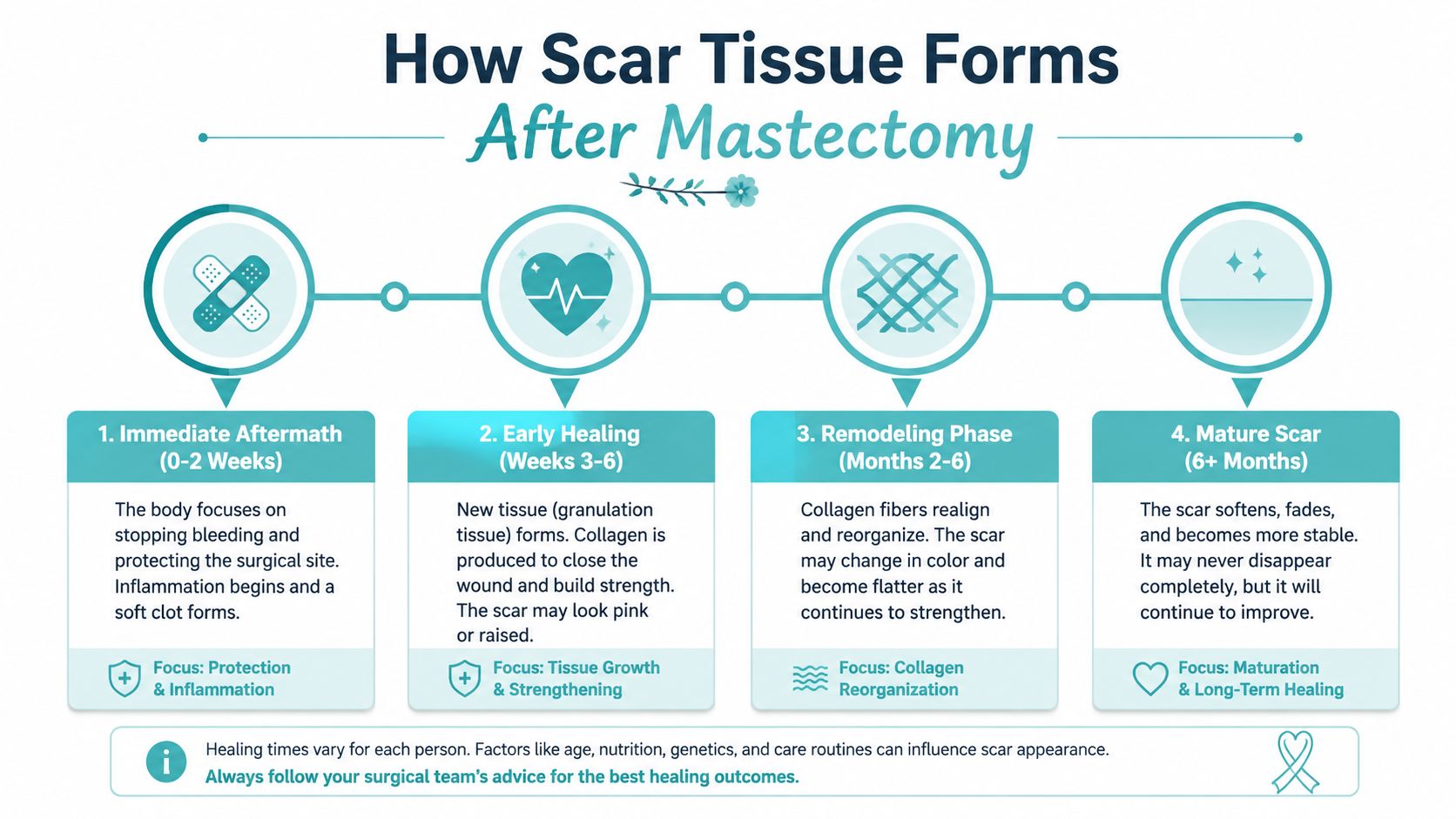
Healing generally moves through overlapping phases. First, inflammation protects the wound and clears damaged material. Next, new repair tissue fills the area. During remodeling, the body gradually reorganizes collagen and changes the scar's texture, thickness, color, and flexibility. This process can continue long after the incision has closed, and scar remodeling may remain active for 12 to 18 months.
Mastectomy scars can behave differently from smaller incisions because surgery may affect a broad section of the breast and chest wall. The resulting scar complex can connect with underlying fascia or other soft tissue, especially when healing is influenced by reconstruction, drains, infection, radiation, or limited movement.
Why symptoms vary
A scar can feel tight because it doesn't lengthen well when the arm rises. It can itch as nerve endings recover and the skin changes. Numbness may follow disruption of small cutaneous nerves, while hypersensitivity can develop when the nervous system becomes protective around the healing area. Pulling may reflect reduced tissue glide rather than a problem with the incision itself.
The surface appearance can also mislead you. A scar may look flat and pale while the tissue underneath remains tethered. Conversely, a visible, raised scar may be bothersome cosmetically without causing meaningful movement loss. That distinction matters because each problem calls for a different intervention.
When hands-on work is appropriate
The wound must be fully closed and healed before direct scar massage or mobilization. Rehabilitation guidance commonly places the start of scar mobilization around four to six weeks after surgery, but the appropriate date depends on your surgeon's examination and your individual healing course. Starting mechanical loading too soon can disturb wound closure, irritate fragile tissue, or worsen inflammation.
Early recovery is usually about protecting the incision, maintaining approved shoulder movement, and watching for signs that require review. Later care can address glide, flexibility, strength, sensitivity, and confidence with activity. A therapist should adjust pressure and exercise based on how the tissue responds during the session and afterward.
How Scar Adhesions Affect Movement and Daily Function
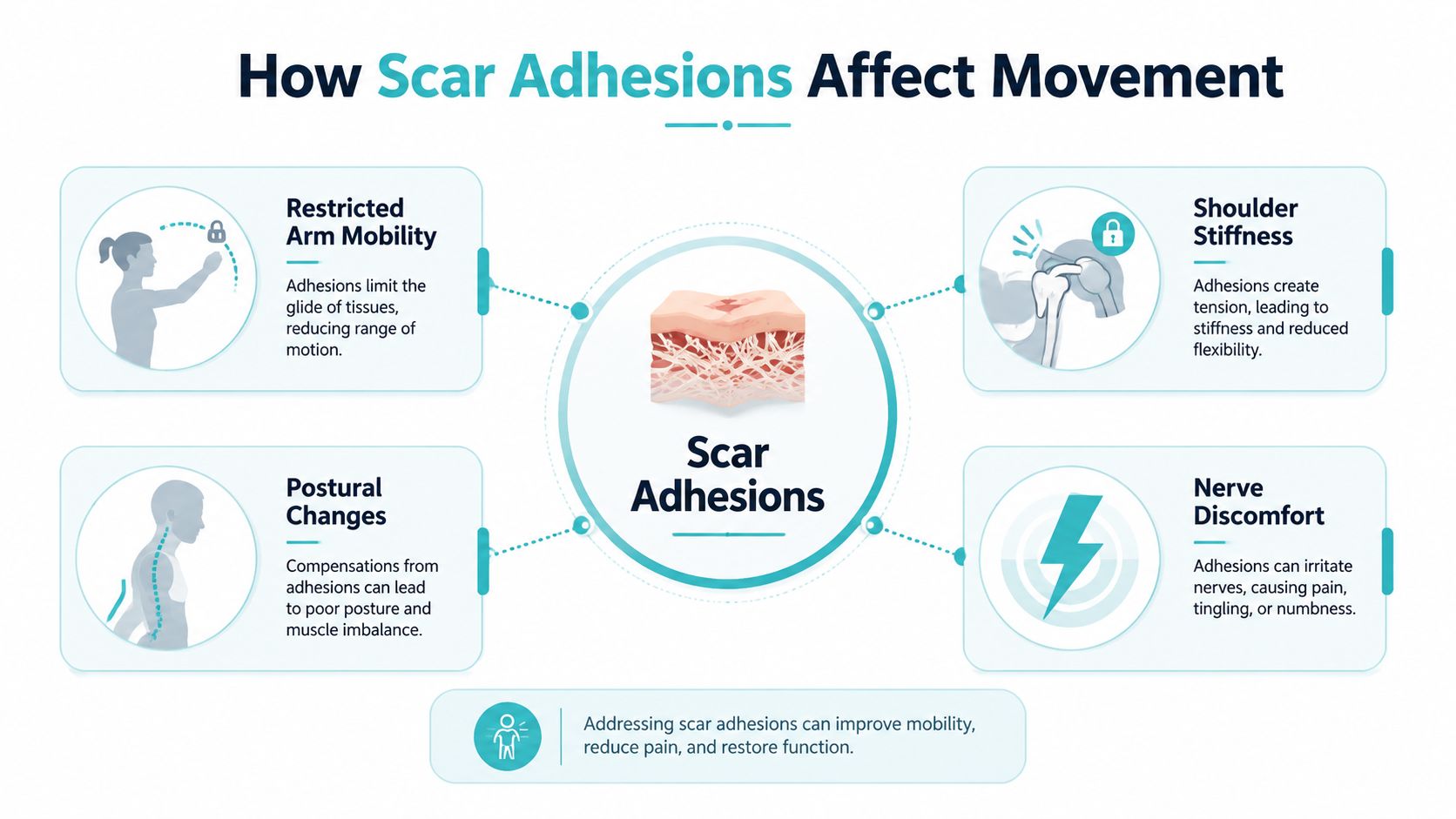
An adhesion forms when healing tissue binds where layers would normally slide. After mastectomy, scar tissue can create adhesions across the trunk and chest wall. A validation study measured scar anisotropy and viscoelasticity because those properties influence how scar tissue stretches and glides during shoulder and chest movement (Aurora Health Care research PDF).
That mechanical change can alter the way your body distributes force. When the scar complex doesn't lengthen as the arm rises, the shoulder may compensate by shrugging, rotating the trunk, or moving through a smaller range. The chest wall may also feel less mobile during deep breathing, reaching, or twisting.
The result often appears in ordinary tasks before it appears in formal exercise. You may pull your arm backward to put on a jacket, avoid lifting a pan with the surgical-side arm, or turn your whole body instead of reaching behind you. During yoga or overhead strengthening, the restriction may feel like a band across the front or side of the chest.
Pain isn't the only measure
A 2025 rehabilitation cohort found that scar adherence was the most common complication reported in that cohort, occurring in 20.6% of participants, and it was associated with shoulder range-of-motion restriction and axillary web syndrome. The same report found that rehabilitation didn't increase complication risk (2025 rehabilitation cohort).
That evidence supports a point I emphasize in practice: mobility and pain are separate outcomes. Pain may settle while the arm still can't reach comfortably overhead. A patient may report feeling better but continue to compensate during dressing, lifting, or exercise. Testing reach, rotation, chest-wall expansion, strength, and task performance gives a fuller picture than a pain score alone.
For practical education about discomfort and movement limitations around the surgical area, the guidance on chest-wall pain after mastectomy can help you identify questions to bring to a clinician. A therapist may observe your shoulder blade, rib cage, breathing pattern, and trunk rotation rather than examining the scar in isolation.
Treatment Options From Scar Massage to Surgical Revision
No single treatment improves every scar problem. The useful question is, what outcome are you trying to change? A scar that feels tethered needs a mobility strategy. A raised scar may need dermatologic or surgical input. Sensitive skin may respond better to graded touch than to forceful massage.
| Treatment | Primary Target | Typical Start Time | Evidence Support |
|---|---|---|---|
| Scar massage and mobilization | Mobility and tissue glide | After the incision is fully healed, often around 4 to 6 weeks | Commonly used in rehabilitation guidance; pressure must be individualized |
| Silicone gel or sheets | Appearance and scar surface characteristics | Once the skin is closed and the surgical team approves | Used for scar care, but not a substitute for mobility rehabilitation |
| Desensitization | Hypersensitivity and touch tolerance | Once contact is safe and approved | Graded textures, fabrics, and light touch can help the nervous system adapt |
| Myofascial-focused rehabilitation | Mobility and function | After wound healing, with clinician guidance | A 2024 randomized trial reported better results than conventional physiotherapy for post-surgical scar tissue |
| Mechanical stimulation | Pliability and selected appearance measures | During the early remodeling phase when medically cleared | A randomized trial reported improved vascularity and pliability scores at follow-up points |
| Corticosteroid injections | Raised hypertrophic or keloid scars | After assessment by an appropriate clinician | May be considered for selected raised scars, not ordinary tethering |
| Laser treatment | Appearance and selected scar characteristics | After specialist evaluation | May help specific surface concerns; results depend on scar type and skin factors |
| Surgical revision | Persistent structural or appearance concerns | After healing and oncology or surgical review | Removes or revises scar tissue, but creates a new surgical healing process |
Massage works best when it is gentle, progressive, and aimed at improving glide rather than “breaking up” tissue. Aggressive pressure can provoke soreness and guarding. Silicone products may support surface management, but they won't restore shoulder mechanics on their own.
Evidence is becoming more specific about mechanical treatment. One randomized trial found that adding mechanical stimulation after mastectomy improved scar appearance scores for vascularity and pliability at follow-up points, while both groups improved in pain and function without a between-group difference in pain (randomized trial on mechanical stimulation). That distinction matters. An intervention can improve scar quality without producing a noticeable pain advantage.
Myofascial work may be appropriate when the restriction involves a broader area than the visible scar. It can include skin rolling, soft-tissue techniques, breathing coordination, shoulder movement, and progressive loading. The therapist should stop or modify the technique if the skin becomes increasingly hot, swollen, irritated, or painful.
For a scar that remains raised, thick, or structurally troublesome, ask your surgeon or dermatologist about medical options. If revision becomes relevant, educational information about surgical scar revision in Beverly Hills may help you understand the type of procedure to discuss, though your own surgical and oncology teams must determine whether revision is appropriate.
The Role of Oncology Physical Therapy in Scar Recovery
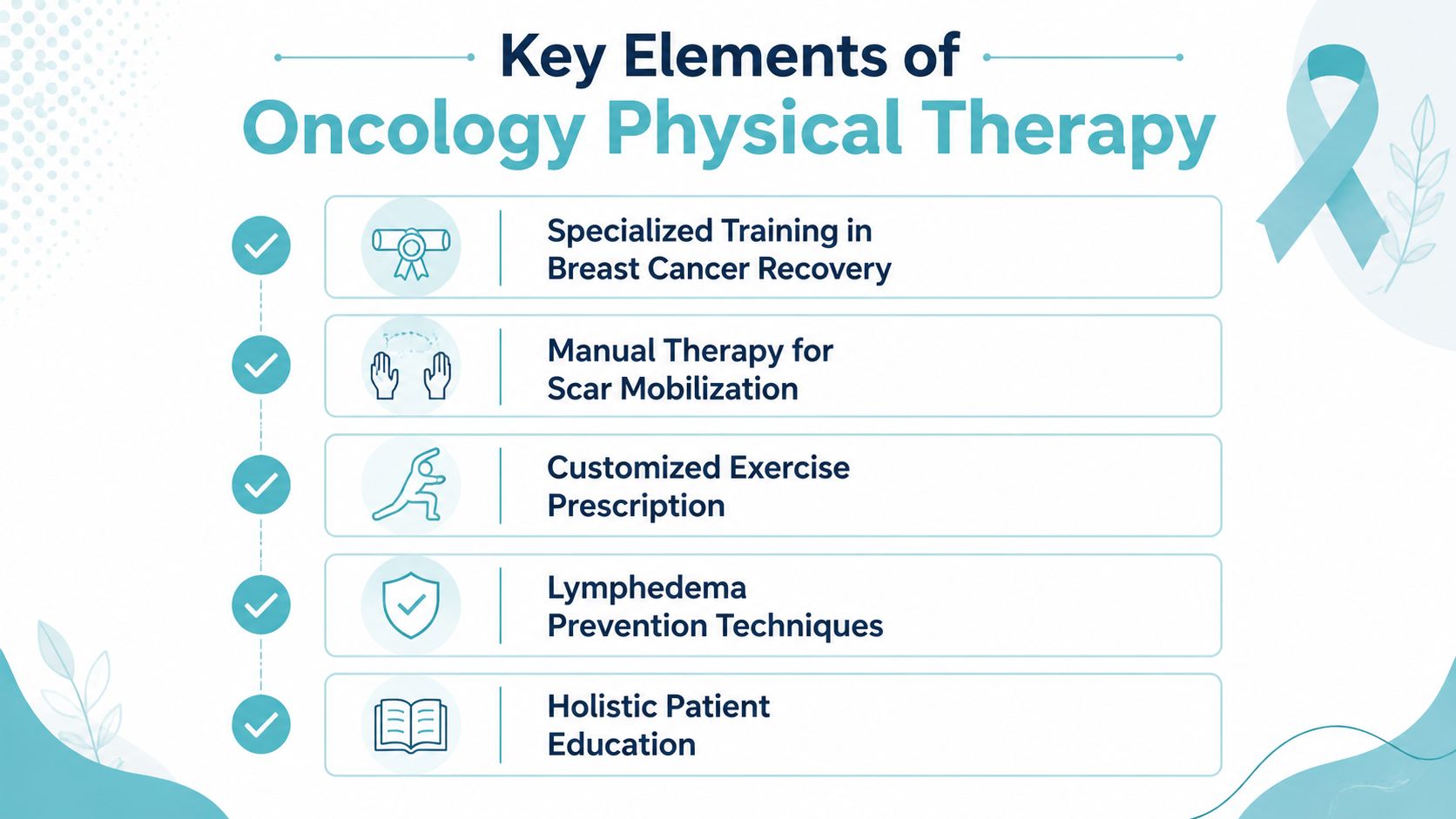
Oncology physical therapy combines surgical rehabilitation with awareness of cancer treatment, lymphatic changes, reconstruction, radiation effects, fatigue, and return-to-activity goals. A general exercise program may improve strength, but it may not address the way a scar interacts with the rib cage, shoulder blade, lymphatic system, and healing tissues.
Timing comes first. Direct scar work generally begins only after the incision is fully healed, commonly around four to six weeks after surgery, according to postoperative breast-surgery rehabilitation guidance from major cancer-care resources (Baclesse rehabilitation guidance). Your surgeon may delay that process if there are open areas, drainage, infection, delayed closure, or reconstruction-specific concerns.
What a session may include
A therapist may begin by observing how you breathe, raise the arm, rotate the trunk, and position the shoulder blade. They may then use light skin mobility, scar gliding, myofascial techniques, or desensitization, depending on the tissue response and your treatment history.
Movement is usually paired with manual work. Examples may include:
- Supported shoulder elevation: Slide the hand up a wall or towel while keeping the ribs relaxed, stopping before sharp pain or a strong pulling response.
- Chest-wall breathing: Expand the ribs gently in several directions rather than forcing a deep breath into a restricted area.
- Scapular control: Practice small shoulder-blade movements so the neck and upper trapezius don't do all the work.
- Progressive reaching: Reintroduce dressing, grooming, shelf-reaching, and light household tasks in a graded sequence.
- Strength restoration: Add resistance only when range, wound status, fatigue, and reconstruction considerations make loading appropriate.
Lymph-node surgery changes the assessment. A therapist may screen for swelling, heaviness, skin changes, and altered tissue texture, then coordinate scar work with lymphedema precautions. Scar mobilization should never be treated as a standard routine that ignores lymphatic symptoms or radiation-related tissue changes.
The plan also needs to reflect whether you had implant-based or autologous reconstruction, radiation, axillary surgery, drains, or complications. Guidance on physical therapy after mastectomy can help you prepare for a conversation about clearance, exercise progression, and scar mobility. Ask your therapist how they will measure progress. Useful measures include overhead reach, behind-the-back movement, trunk rotation, task tolerance, sensitivity, and confidence with activity, not pain alone.
Building a Practical Recovery Plan Week by Week
Recovery doesn't follow a perfectly straight line. A useful plan protects the wound early, introduces mobility when cleared, and keeps building capacity as the scar remodels.
The immediate postoperative phase
Focus on wound protection, approved breathing, hand and elbow movement, and gentle shoulder motion prescribed by your surgical team. Choose soft clothing that doesn't rub the incision, and use pillows to support the arm or torso in a position that reduces pulling during sleep. Don't apply oils, silicone, adhesive products, or direct pressure to an unhealed incision unless your care team approves them.
Around the scar-mobilization window
Once the incision is fully healed and your surgeon or therapist clears you, begin light scar contact rather than deep pressure. Start with noticing how the skin moves in different directions, then pair small gliding movements with comfortable shoulder elevation.
A useful test: The tissue may feel stretched, but it shouldn't feel sharply painful, increasingly hot, swollen, or irritated after the session.
Reintroduce overhead tasks in short, manageable doses. If reaching to a shelf triggers pulling, practice a lower target first, then gradually increase height. Swimming, weightlifting, and yoga each require individualized clearance because wound healing, reconstruction, radiation, drains, and shoulder control affect readiness.

During progressive remodeling
As months pass, the aim shifts from moving the arm to using it confidently. Combine scar mobility with shoulder strength, trunk rotation, breathing, posture changes, and the activities you need, such as carrying groceries, lifting a child, working at a computer, or returning to sport.
Radiation or changes in treatment can make tissue feel tighter again. That doesn't mean you failed or must force the scar. Reduce the intensity, reassess the area, and ask your oncology or rehabilitation team whether the change represents expected tissue behavior or needs examination.
Long-term maintenance can be simple. Continue the mobility exercises that address your restricted direction, vary positions throughout the day, and use strength training to support the shoulder and chest wall as tolerated. The best plan is one you can repeat without creating a flare.
When to Seek Specialist Care and What to Watch For
A new lump or nodule near the scar needs assessment, even though true recurrence within a mastectomy scar is uncommon. A histology review of mastectomy scars found no malignancy in clinically unremarkable scars, supporting the rarity of in-scar recurrence while reinforcing the need to evaluate new findings. A radiology review of mastectomy scar recurrence describes recurrence in the scar as occurring in less than 1% of mastectomies. Stay alert without assuming every firm area signals cancer.
Contact your surgical or oncology team if the scar changes quickly or develops increasing redness, warmth, drainage, fever, new swelling, persistent worsening pain, or a firm area unlike ordinary healing. Seek rehabilitation assessment when restricted shoulder motion continues, daily tasks become harder, or home care has not improved function.
Because scar mobilization must be coordinated with swelling precautions, reviewing lymphedema after mastectomy can help you understand what your therapist assesses alongside the scar. An oncology physical therapist, breast surgeon, plastic surgeon, dermatologist, or lymphedema specialist may contribute. Evaluation should consider mobility, appearance, pain, sensation, swelling, and function, not cosmetics alone.
Lake City Physical Therapy provides women's health and oncology physical therapy for scar mobility, lymphedema management, shoulder movement, and graded return to activity after mastectomy. Visit Lake City Physical Therapy to learn about available care and schedule an evaluation.