Symphysis Pubis Dysfunction Exercises for Safe Relief
You roll out of bed and feel a sharp catch at the front of your pelvis. Later, taking the stairs or stepping into the car brings it back. By evening, even turning over can feel like a task you need to plan around.
If that sounds familiar, you may be dealing with symphysis pubis dysfunction (SPD), often discussed as pregnancy-related pelvic girdle pain. The right exercise plan isn't about forcing the pelvis into place. It's about finding a level of movement your body can tolerate, then building strength and everyday function without repeatedly triggering a flare.
What Symphysis Pubis Dysfunction Actually Feels Like
Pain linked to symphysis pubis dysfunction (SPD) is often felt over the pubic bone at the front of the pelvis. It may also spread to the groin, inner thighs, hips, buttocks, or lower back. Some people notice clicking or grinding; others describe a sharp jab, deep ache, or difficulty feeling supported during movement.
Symptoms can build as the day goes on. Walking, stairs, getting dressed while standing on one leg, rolling in bed, and getting in or out of a car may bring them on. A person might feel comfortable in the morning, then have more pain after errands, repeated transfers, or a long time on their feet.
Why movement can hurt
The pubic symphysis is the joint at the front of the pelvis. During pregnancy, changes in joint mobility, body position, muscle coordination, and daily demands can affect how load moves through the pelvis. The sacroiliac joints at the back also share that load, so symptoms can occur in several areas.
Pain alone cannot show what the joint looks like or confirm that the pelvis is out of place. Pregnancy-related pelvic girdle pain is the broader clinical term for pain around the pubic symphysis and sacroiliac joints. The Royal College of Obstetricians and Gynaecologists' guidance on pelvic girdle pain reports that it affects about one in five pregnant women and can make walking, turning in bed, and climbing stairs difficult.
The useful target is function: easier walking, bed mobility, and daily tasks, rather than trying to squeeze or “realign” the pelvis.
For a plain-language explanation of pelvic girdle pain in pregnancy, see how symptoms can affect everyday movement. Exercise can be part of managing symptoms, but it should be dosed to the person's response. Exercise has not been shown to reliably prevent pelvic girdle pain, so a prevention claim should not be confused with symptom management. If movement repeatedly worsens pain or limits daily tasks, a pelvic health PT can assess what is contributing and guide the next steps.
Setting Your Baseline Before You Start Exercising
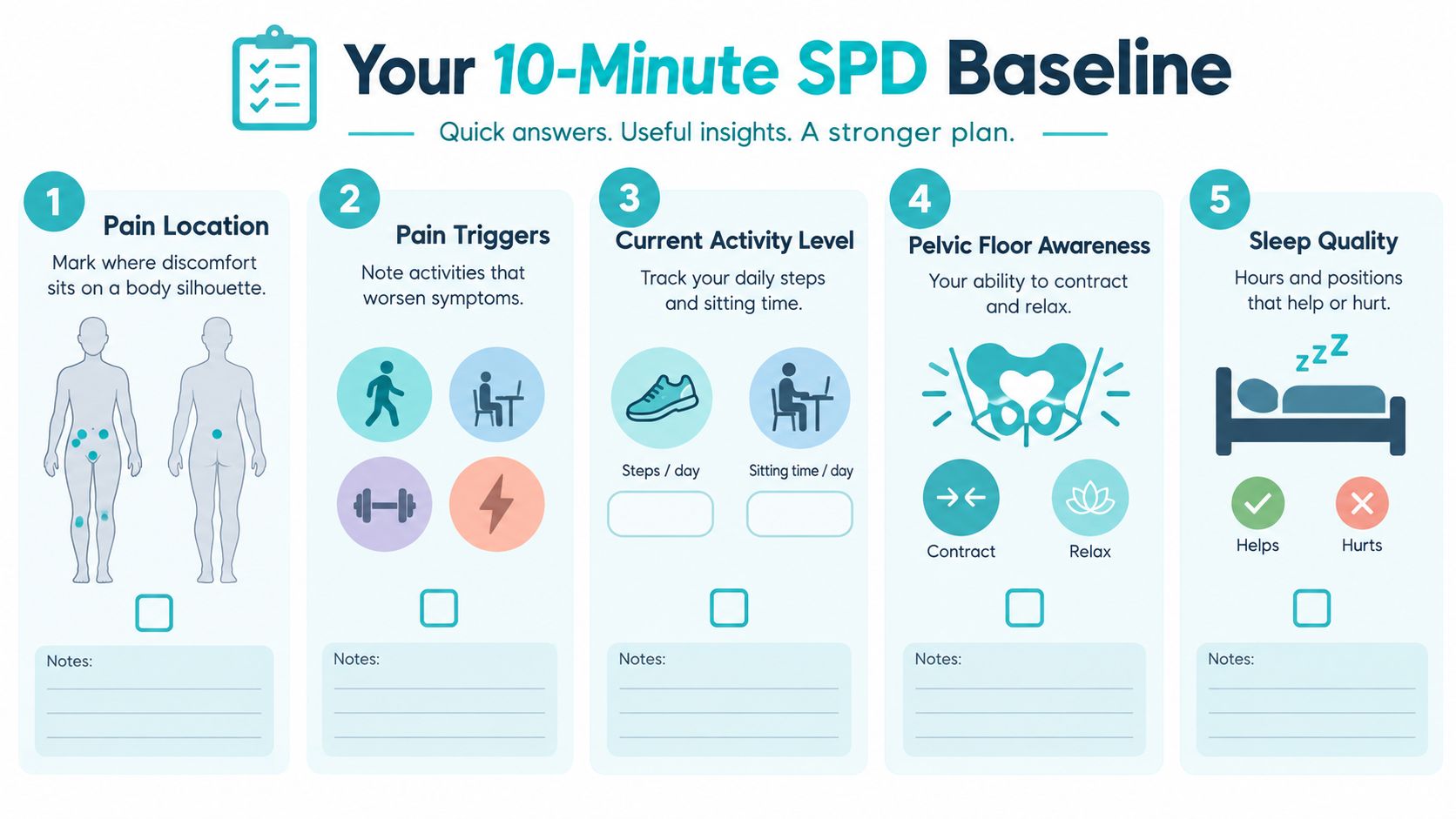
Before you choose exercises, take a short inventory of what feels difficult right now. A baseline helps you notice whether a change in your routine is helping, making no difference, or leaving you more irritable later. You don't need special equipment. A note on your phone or a paper checklist is enough.
Do a practical self-check
- Pain location and intensity: Note where you feel pain and rate it from zero to ten, where zero is no pain and ten is the worst you can imagine. Record the number at rest and during a movement that usually bothers you.
- Triggers: List the specific tasks that bring on symptoms. For example, note whether stairs, longer steps, rolling in bed, or putting on trousers are the main problem.
- Walking and standing: Walk across the room at your usual pace. Notice whether you limp, shorten one step, or feel pain with each stride. If it feels safe, briefly observe how standing on one leg feels, but don't push through pain to complete the check.
- Sleep and position: Write down whether pain wakes you or makes turning difficult, and which position or pillow setup feels most comfortable.
- Pelvic-floor awareness: Notice whether you can gently contract the pelvic floor and then fully let it soften. Don't hold a contraction continuously or strain to find one.
Repeat the check regularly, such as once a week, using the same movements and rating scale. That makes it easier to compare how daily function changes, rather than judging your plan by one unusually good or bad day. If you want help using a rating scale consistently, this guide to measuring pain and choosing an acceptable pain level offers a starting point.
A baseline is information, not a test you have to pass. If a movement feels unsafe, leave it out and record that it currently isn't comfortable.
The Foundational SPD Exercise Sequence
Start with control and a comfortable range. These symphysis pubis dysfunction exercises are options to discuss with your maternity provider or pelvic health physical therapist, especially if you're unsure which positions are appropriate for your pregnancy or postpartum recovery. Keep your breathing easy. Stop or make the movement smaller if it causes sharp pain, a worsening click, or a change in the way you walk.
Begin with breath and gentle support
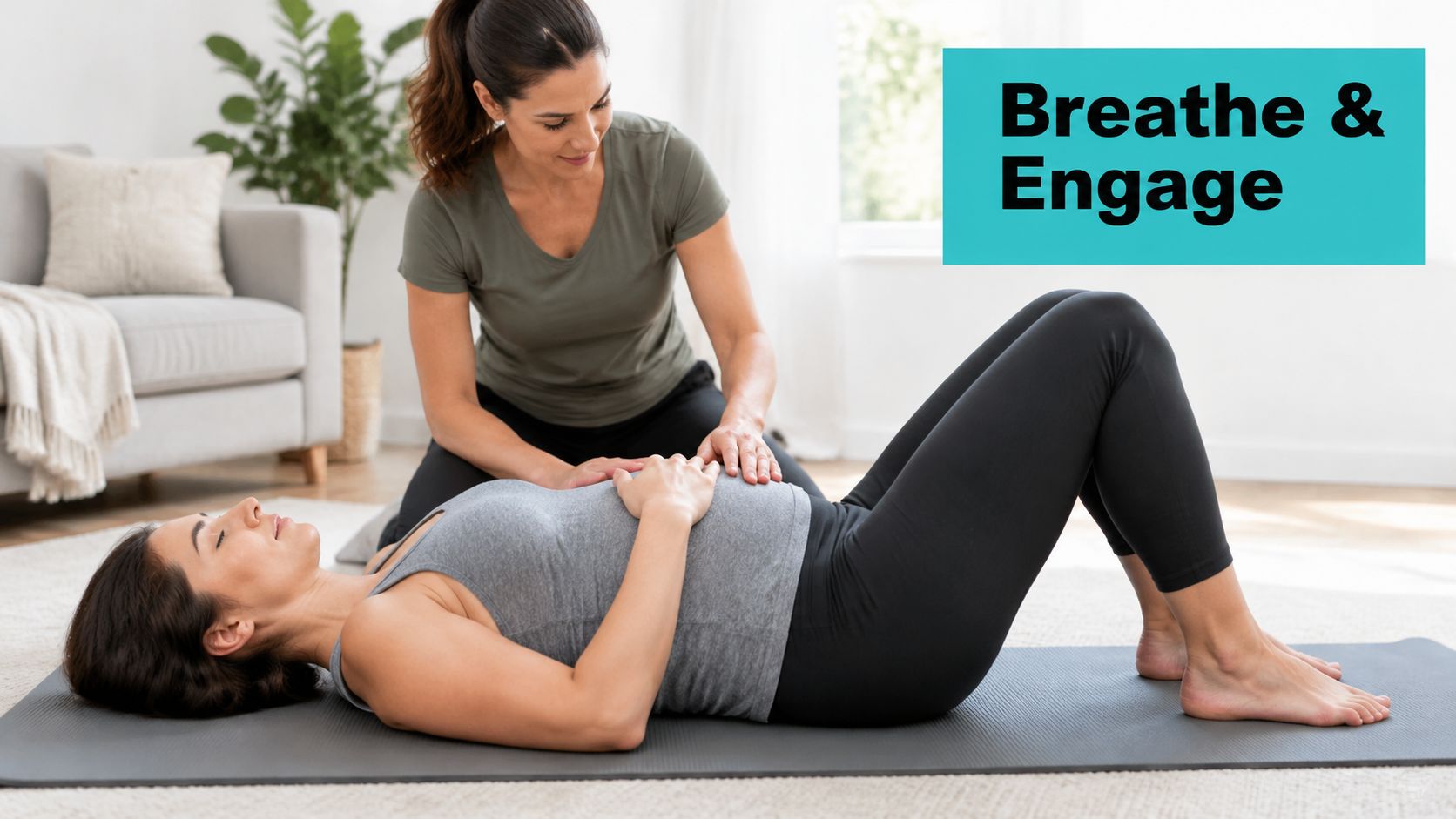
Lie on your side or sit comfortably, whichever feels better. Inhale gently into your ribs and abdomen. As you exhale, lightly engage the lower abdominal muscles and pelvic floor, as if you're giving the pelvis a small amount of support. Let the pelvic floor relax again as you inhale. Try a few slow breaths rather than maintaining a constant squeeze.
Next, if lying on your back feels comfortable and appropriate for you, bend your knees with your feet supported. Keep your knees close together and gently tilt your pelvis a small amount, then return to a comfortable neutral position. Move slowly with the exhale; stop if you feel pubic pain, pressure, or discomfort from the position.
Add small, controlled strength work
- Side-lying hip abduction: Lie on your side with your knees slightly bent and a pillow between them. Keep your pelvis steady and lift the top leg only a small distance, without rolling backward. Try a slow set of 5–10 repetitions if that range feels comfortable, then stop if you feel a sharp pull or increased pubic pain.
- Supported bridge: With knees bent and feet comfortably close, exhale and lift your hips only as far as you can keep the movement smooth and symmetrical. Pause briefly, then lower with control. Avoid thrusting the pelvis upward or pressing harder through one foot. If your pelvis clicks or pain increases, return to breathing work or leave bridges out for now.
- Sit-to-stand: Sit on a stable chair with feet under you and knees facing forward. Lean slightly from the hips, exhale as you stand, and keep your weight even through both feet. Sit back down slowly. Start with a few comfortable repetitions rather than repeating the movement until form breaks down.
A review of exercise therapy for pregnancy-related pelvic girdle pain found that treatment-focused exercise may reduce pain and improve function for some people, while also noting mixed results and substantial variation between studies. That's why an individual response matters more than completing every exercise on a list.
How to Progress (or Pull Back) Based on Symptoms
A movement can feel fine while you're doing it and still leave you more sore later. Use a two-point check: pay attention during the session, then check how you feel later that day and the next morning. If symptoms rise during exercise, your movement changes, or pain remains more heightened than usual afterward, the dose was likely too much for now.
Change one lever at a time
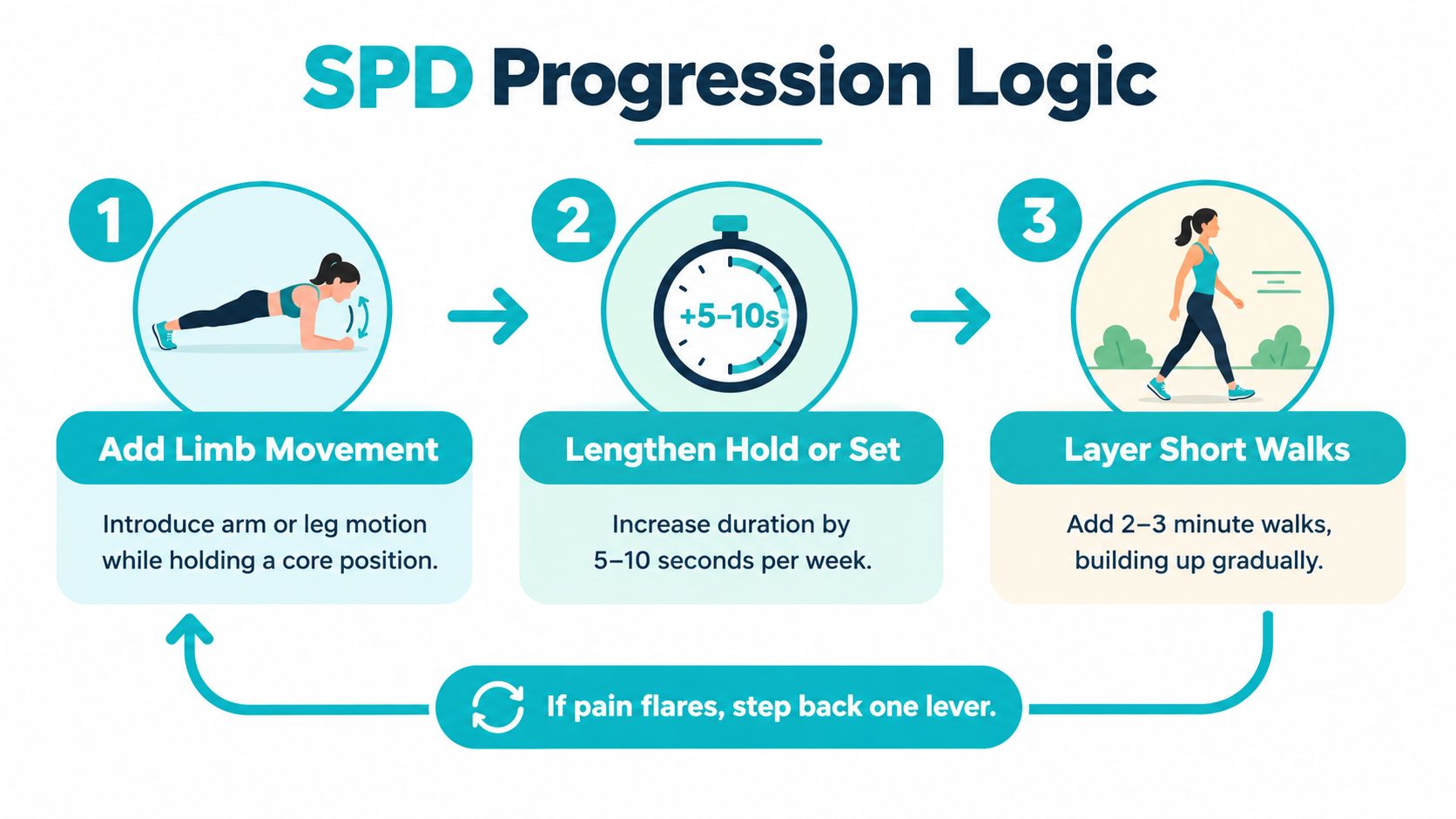
When a movement feels manageable and your symptoms return to their usual level by the next morning, you can test a small change. Don't add more repetitions, a longer hold, and a harder variation all at once. Changing one feature makes it easier to identify what your pelvis tolerates.
- First, add controlled movement: For example, after a supported bridge feels steady, you might try a small, controlled leg movement only if you can keep your pelvis level and symptoms remain settled. If your pelvis rocks or pain appears, return to the simpler version.
- Then, increase the work slightly: Add a little time to a hold or a few slow repetitions. A practical starting point is one set of about 5–10 repetitions or 5–10-second holds, then reassess before doing more. That's a dosing option, not a target you must reach.
- Finally, layer in walking: Try a short, comfortable walk at an easy pace. If your stride shortens or pain builds, reduce the pace or distance, or split the walk into smaller bouts.
The preloaded visual below summarizes a progression framework. Use its walk intervals as an illustration, not a prescription: the right starting point depends on your symptoms and daily capacity.
If symptoms flare, that isn't failure. Reduce the movement range, do fewer repetitions, use more support, shorten your walk, or return to breathing and gentle activation until your usual baseline returns. You can also note whether the flare followed exercise, stairs, a long period on your feet, or another daily demand. That context helps you adjust the total load rather than blaming one exercise automatically.
Exercises and Habits That Commonly Make SPD Worse
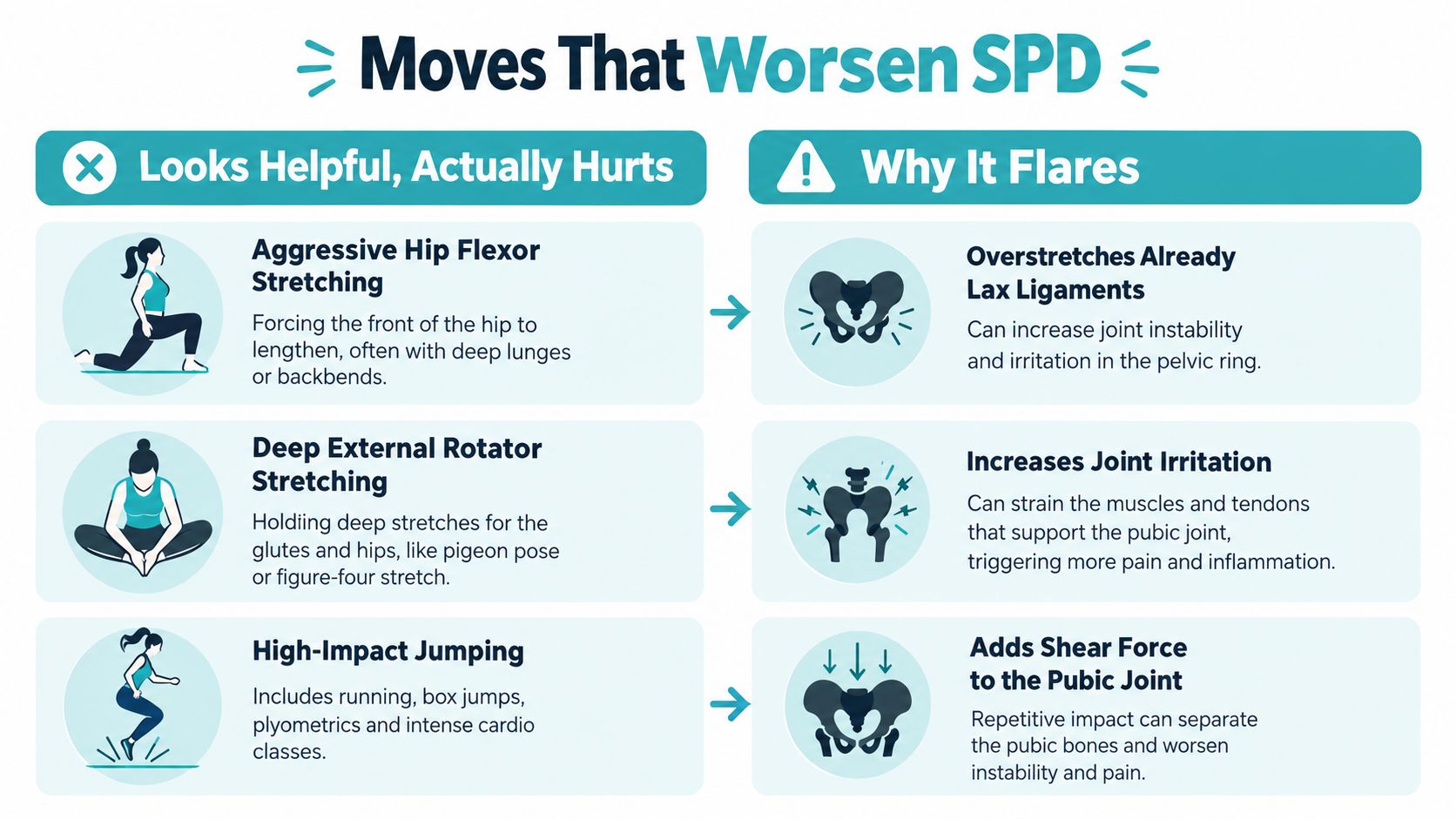
More stretching isn't always better. A wide-leg position or deep hip stretch may feel relieving at first, but if it pulls the legs far apart or reproduces pubic pain, it can ask an already sensitive pelvis to tolerate more movement than it can manage. Keep stretches gentle and within a range that doesn't provoke symptoms.
Watch for repeated uneven loading
Deep lunges, repeated step-ups, and standing on one leg for tasks such as dressing can load one side of the pelvis at a time. They aren't automatically wrong for everyone, but they're poor choices when they reproduce your symptoms or leave you more sore. Sit down to dress, shorten your stride, use a handrail on stairs, or choose a two-footed variation while symptoms are active.
High-impact exercise can also be too demanding during a flare. Running or jumping adds repeated impact, and continuing because you're determined to “stay fit” may cost you more comfortable walking and daily movement. Choose a lower-impact activity only if it feels manageable during the activity and afterward.
Don't hold your breath or keep your pelvic floor clenched. Coordinated support includes being able to release, not just contract.
Endless pelvic-floor squeezing isn't a substitute for an individual plan. If you can't relax between contractions, or exercise makes you brace harder, reduce the effort and return to easy breathing. Likewise, a long walk isn't automatically safer than a short one. The useful dose is the amount you can complete without a clear rise in symptoms that persists after you stop.
A systematic review of stabilizing exercises for pregnancy-related pelvic pain reported conflicting findings, with limited evidence for any single program. That supports choosing movements by response rather than treating one popular routine as a universal fix.
Modifying the Plan for Pregnancy and Postpartum Phases
Your position, energy, and capacity change across pregnancy and after birth, so the same exercise setup may not suit every phase. During pregnancy, side-lying, sitting, or an incline may be more comfortable than lying flat, especially if a position makes you feel unwell. Keep everyday tasks symmetrical when possible, use support for stairs, and choose short, easy walking bouts if they don't aggravate symptoms.
In early postpartum recovery, gentle movement and comfortable walking can be useful starting points, but birth, sleep disruption, and caring for a newborn all affect what feels manageable. Reconnect with breathing and pelvic-floor coordination without assuming that stronger contractions are always the next step. For practical context on comfort measures, this resource on safe pain relief for expectant mothers can sit alongside advice from your maternity clinician.
Let function guide the rebuild
Later postpartum, progress according to what you can do comfortably, not a date on the calendar. Bed mobility, stairs, walking, controlled weight transfer, and the ability to contract and relax the pelvic floor can help guide the next stage. Return to running, heavy lifting, or sport gradually, increasing demand only when simpler tasks are going well.
| Phase | Primary Goal | Preferred Positions | What to Avoid | Milestone to Progress |
|---|---|---|---|---|
| Pregnancy | Maintain tolerable movement and daily function | Side-lying, supported sitting, incline, comfortable standing | Positions or tasks that provoke symptoms, forced wide-leg movement | Daily tasks feel more manageable without a lingering increase in symptoms |
| Early postpartum | Reconnect with breath, gentle support, and comfortable walking | Side-lying, supported sitting, relaxed standing | Rushing into strenuous or high-impact exercise | Bed mobility and short walks are comfortable and controlled |
| Later postpartum rebuild | Restore strength and return to valued activities | Positions suited to the task, progressing toward functional loading | Advancing by calendar alone or ignoring a symptom flare | Stairs, weight transfer, and pelvic-floor coordination are manageable before adding higher impact |
An individualized postpartum assessment can help match exercise to your recovery and goals. Learn more about postpartum pelvic floor physical therapy if pain continues or you're unsure how to rebuild.
When to Stop Self-Managing and See a Pelvic Health PT
Home exercise is useful when you can find a tolerable dose and see how your body responds. It isn't the right next step if symptoms are rapidly worsening, you can't bear weight, or a new symptom suggests you need medical assessment. Contact your maternity provider or seek prompt clinical advice for concerning symptoms rather than trying a harder routine.
Arrange assessment if you have:
- Escalating pain or a sudden limp: A clear worsening trend or a new change in how you walk deserves attention.
- Difficulty bearing weight: Don't keep testing stairs or single-leg exercises if standing or walking has become substantially limited.
- Numbness, tingling, or bladder or bowel changes: These symptoms need medical assessment rather than exercise progression.
- New or worsening pain during sex: A pelvic health clinician can help assess contributing factors and discuss appropriate care.
- Persistent night pain or disrupted sleep: Seek help when position changes and reasonable adjustments aren't making rest manageable.
- Postpartum pain that isn't improving: If symptoms remain limiting or aren't trending better over time, ask your provider about an evaluation.
A pelvic health physical therapy visit should be specific to your situation. The clinician will ask about pregnancy or birth history, the movements that trigger symptoms, sleep, daily activities, and what you need to get back to. They may assess how you walk, transfer, load each leg, coordinate your trunk and hips, and contract and relax the pelvic floor. Any internal pelvic-floor examination should be discussed with you first, and you can ask questions or decline.
The result should be a plan that fits your symptoms, not a generic handout. A pelvic health PT can help you adjust exercise, movement habits, and daily tasks, and coordinate with your obstetric clinician or midwife when medical input is needed. If you're being assessed, explain which activities matter most to you, such as walking the dog, getting through a workday, lifting your baby, or returning to sport.
Keep a simple daily and weekly check
Two small habits can make it easier to notice what your pelvis tolerates. Try a brief breathing and pelvic-floor release practice in the morning or evening, and break up a long walk or workout into shorter bouts when that feels better. At night, experiment with a pillow between your knees or one supporting your abdomen if those positions improve comfort.
Once a week, review your baseline notes. Ask: Where was the pain? Which activities brought it on? How did walking and stairs feel? Did sleep improve or worsen? Did symptoms return to their usual level after exercise? Those answers can help you and your clinician spot a pattern before a small flare becomes a reason to stop moving altogether.
The aim isn't to “cure” SPD with one perfect exercise. It's to manage the dose, preserve useful movement, and gradually rebuild capacity. When self-management isn't enough, a pelvic health PT can help you find a safer next step.
Lake City Physical Therapy offers women's health pelvic floor care and prenatal and postpartum rehabilitation adapted to your symptoms and goals. If pubic pain is limiting your movement, sleep, or return to exercise, visit Lake City Physical Therapy to explore care options.

