Symptoms of Vaginal Prolapse: Signs, Red Flags and Care
If you only watch for a lump you can see, you can miss most of the symptoms of vaginal prolapse. Many women wait for tissue at the opening, then brush off pressure, a slow urine stream, or a bowel movement that never feels finished. Those quieter changes often arrive first, and they rise and fall with standing, lifting, and the end of a long day.
A pelvic exam can find descent when you feel fine, and it can look mild on a short visit when your afternoon is already hard. That mismatch is the gap most checklists skip. What matters is function: how you empty, how you move, how sex feels, and whether the pelvis feels heavy by evening.
This guide starts with daily life, not a stage number. You'll see which symptom groups travel together, why a small finding can still disrupt a run or a work shift, which signs need same-day care, and what a careful visit checks before anyone talks about surgery.
Vaginal Prolapse Symptoms at a Glance
Symptoms of vaginal prolapse usually announce themselves as a bulge or a sense of pressure, but they also show up as bladder, bowel, sexual, and low-back changes. Most women report several groups together. The bulge is often the first thing people name. It is rarely the only sign.
| Symptom group | What it feels like | When it tends to appear |
|---|---|---|
| Vaginal bulge or lump | Tissue seen or felt at the vaginal opening | After standing, lifting, coughing or straining; eases when lying down |
| Pelvic pressure or heaviness | Fullness, dragging or a sense of sitting on something | Late in the day or after prolonged standing |
| Urinary symptoms | Leakage, urgency, frequency, weak or incomplete stream | With coughing, running or as the bladder fills |
| Bowel symptoms | Constipation, straining, feeling of incomplete emptying | During bowel movements |
| Sexual symptoms | Pressure, pain or reduced sensation | During or after intercourse |
| Low back or pelvic ache | Dull ache in the lower back or pelvis | Later in the day or with activity |
Read the table as a daily map, not a diagnosis. One row after a single hard workout is different from the same row that returns for weeks. Pair what it feels like with when it tends to appear. That pairing tells you more than asking whether the tissue looks large.
How the groups tend to cluster
Say you feel a small lump after a grocery shift, leak a little when you cough, and need to strain on the toilet that evening. Those three rows are one pattern, not three separate problems. Sexual pressure can join them even when the morning check in the mirror looks normal.
Common triggers that raise load on the pelvic floor:
- Prolonged standing: A retail, teaching, or clinic shift often brings heaviness by late afternoon.
- Heavy lifting: Childcare, boxes, and gym loads can make a bulge easier to feel.
- Running or jumping: Impact can trigger leakage and a dragging sensation.
- Chronic constipation: Hard stool and long sits on the toilet add repeated downward pressure.
- Repeated straining: Coughing, bearing down, and breath-holding during lifts do the same.
- Childbirth and menopause: These change support and tissue in the background. They are not a reason to ignore a new pattern.
Practical rule: If two or more symptom groups have lasted several weeks, write them down and arrange a pelvic health assessment.
You don't need a dramatic protrusion to justify that step. Persistent pressure plus a bladder or bowel change is enough to start a proper check.
Why a Small Bulge Can Still Cause Big Symptoms
A finding on exam and a problem in daily life are not the same thing. A 2020 epidemiology review reported that examination-based studies identify pelvic organ prolapse in as many as 50% of women, while questionnaires focused on bothersome symptoms generally estimate prevalence between 3% and 8.3%. Telephone surveys that rely on a woman reporting a vaginal bulge or lump land at about 2.9% to 8.3%. A separate analysis of U.S. National Health and Nutrition Examination Survey data estimated that 2.9% of women aged 20 years and older report symptomatic prolapse, typically defined as seeing or feeling a vaginal bulge.
Think of a dented fender. The dent is a fact about the car. It matters when it stops the door from opening, leaks in rain, or makes the wheel rub. Descent on an exam is the dent. Symptomatic prolapse is the point where pressure, bulging, or function starts to shape the day.
What stage actually measures
Clinicians describe stage by where the leading edge sits relative to the hymen. That number describes anatomy. It does not score how much your bladder, bowel, sleep, or sex life is affected.
| Stage | Position of the leading edge |
|---|---|
| 0 | No prolapse detected |
| I | More than 1 cm above the hymen |
| II | Between 1 cm above and 1 cm below the hymen |
| III | More than 1 cm below the hymen, not complete |
| IV | Complete protrusion, near full vaginal length |
Three situations come up constantly. A large bulge with no symptoms can be watched if emptying, comfort, and tissue health stay fine. A small bulge with heavy symptoms can still limit a job, a run, or intercourse. Symptoms with no visible bulge are real too. Pressure, leakage, or incomplete emptying can show up before tissue reaches the opening, and they can ease when you lie down after standing, lifting, coughing, straining, or exercise.
Judge the problem by its effect on daily life, sleep, bladder and bowel function, and sex. Bring that picture to a clinician. Don't treat every anatomical finding as an emergency, and don't ignore a pattern that is already changing how you live.
Bladder, Bowel and Sexual Symptoms People Overlook
A vaginal or pelvic-organ pattern is not limited to a lump. Clinical descriptions of prolapse symptoms include pelvic heaviness, a sense that tissue is descending, urinary urgency and frequency, stress leakage, trouble starting or finishing urination, constipation, incomplete bowel evacuation, fecal or flatus incontinence, and pain or difficulty with sex. Symptoms do not reliably scale with stage. Mild prolapse can be highly symptomatic, while more advanced prolapse can be barely noticed.
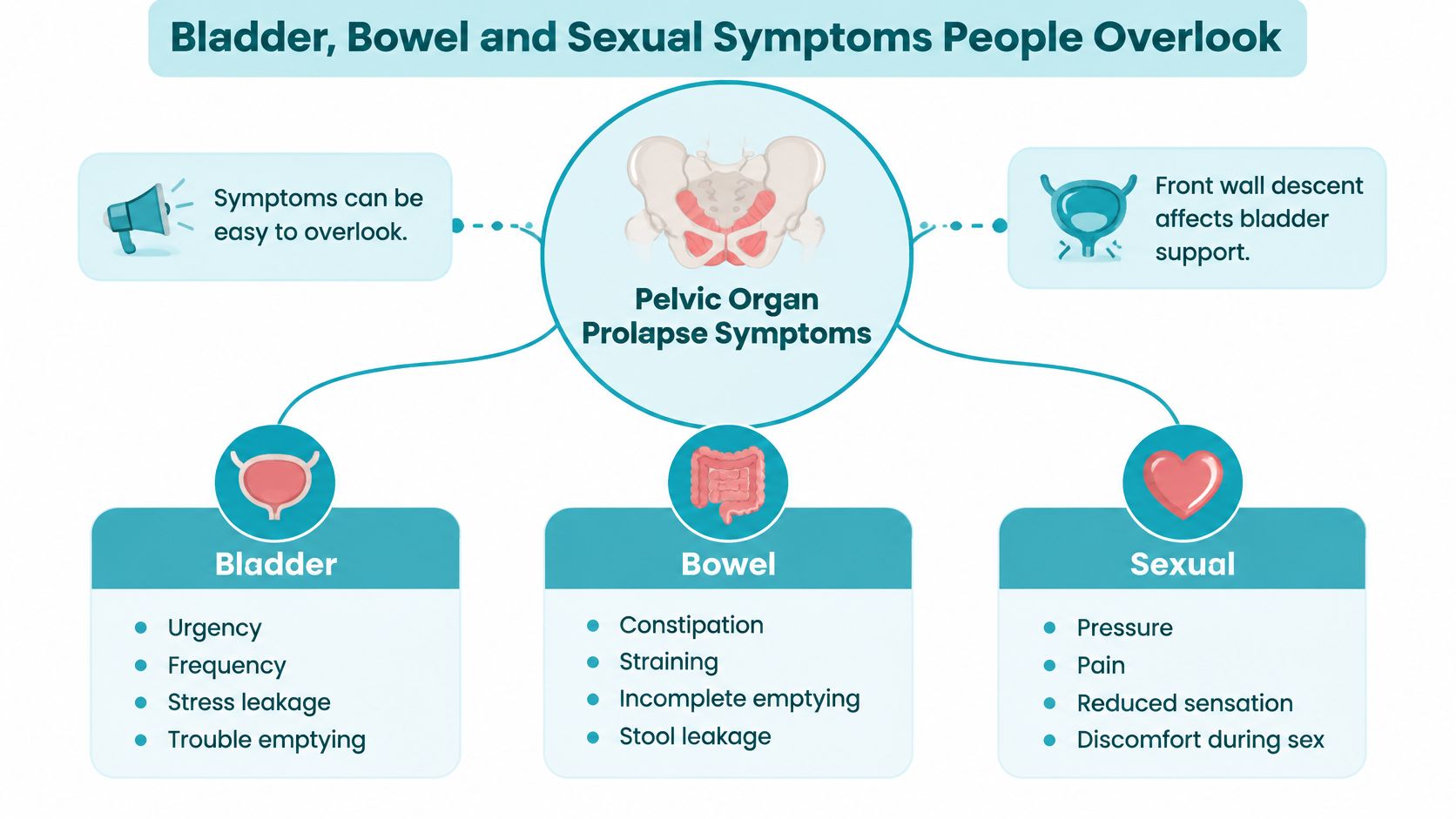
The wall that has dropped explains a lot of the confusion. Front-wall descent changes bladder support. Back-wall descent changes how the rectum empties. The top of the vagina is often the source of heaviness rather than a obvious lump at the opening. Our page on cystocele and rectocele walks through those two walls in more detail.
| Compartment | Common name | Main symptoms |
|---|---|---|
| Anterior (front wall) | Cystocele | Urgency, frequency, stress leakage, slow or hesitant stream, feeling the bladder never fully empties |
| Posterior (back wall) | Rectocele | Constipation, straining, incomplete evacuation, pressing on the vagina or perineum to pass stool |
| Apical (top) | Uterine or vaginal vault prolapse | Pelvic heaviness, pressure, dragging, bulge at the top of the vagina |
Sex, sleep, and look-alike conditions
Sexual symptoms are easy to leave off a short checklist, and they are often the most distressing. Pressure, pain, friction, altered sensation, and difficulty reaching orgasm can all appear. Fear of making the descent worse adds its own distress, even when the physical obstruction is small.
Nighttime urgency and repeated urinary infections disturb sleep in the same way a bulge does not. You wake, you worry about leakage, and you start planning the day around bathrooms.
These bladder, bowel, and sexual changes overlap with infections, irritable bowel patterns, and other gynecologic conditions. A list like this is a map for the visit, not a self-diagnosis.
NICE-style assessment looks at prolapse symptoms together with urinary, bowel, and sexual function, and it checks for other pelvic causes. Note what happens during intercourse, bowel movements, coughing, running, lifting, and long standing, including any need to splint the vagina to pass stool.
How Symptoms Change Through the Day

Many women feel ordinary at 8 a.m. and worn out by 6 p.m. A short clinic visit can land in the easy window, so the exam and your memory don't match the week you lived. Standing and gravity raise the load. A cough or a strain adds a sudden spike. Lying down takes that load off, so bulge and heaviness often ease.
Clinical guidance on pelvic organ prolapse is clear that care should follow how bothersome symptoms are, not anatomy alone. Symptoms often worsen with standing, coughing, or straining and ease when you lie down. That is why you can feel normal in the office and see no bulge at every check.
Can symptoms come and go? Yes. Can you have significant symptoms without seeing tissue? Yes. A changing bulge does not, by itself, mean the support is failing fast.
A two-week diary you can copy
Take Maya, four months postpartum and back to short runs. Heaviness shows up after a 45-minute run, eases if she lies down for twenty minutes, and feels sharper in the days around her period. She had been calling it "just fitness" and "just hormones."
For two weeks she writes one line after the activities that matter, then brings the pages to her appointment:
- Time of day and how long she was on her feet.
- Lifting or exercise, including the run, jumps, and any breath-holding.
- Bowel movements, straining, and whether emptying felt complete.
- Bladder emptying, leakage, and urgency.
- Intercourse and menstrual timing.
A new bleed, a sore on exposed tissue, discharge, severe pain, or inability to pass urine needs prompt medical care, not another week of notes.
Red Flags That Need Prompt Medical Care
Most fluctuating pressure can wait for a planned visit. A few signs should not. Scan the two tiers below if you are deciding tonight versus next month.

Seek urgent care the same day
- Can't pass urine or stool: Nothing is coming out, or only drops come with rising pain.
- Severe pain: Intense pelvic or lower abdominal pain, not the familiar end-of-day ache.
- Bleeding: Blood from the vagina or from prolapsed tissue.
- Exposed or sore tissue: A protrusion that looks raw, ulcerated, or increasingly irritated.
- Infection signs: Discharge with fever, or you are clearly getting sicker.
- Can't push it back: A protrusion that will not reduce, especially if emptying has stopped.
A bulge that swells after a long day and tucks back in when you lie down is common. It is not an emergency by itself. A bulge that is getting harder to return, or that is paired with retention, is a different problem and needs prompt review.
Book a clinician within a few weeks
- A new or fast-growing bulge that is changing week to week.
- Worsening emptying of the bladder or bowel, including more straining or more residual feeling.
- Recurrent urinary infections after a stretch of bladder symptoms.
- New leakage that is already changing work, exercise, or sleep.
- Sexual pain that is getting worse rather than staying stable.
Before the visit, write when symptoms started, what makes them worse, and any bleeding or pain. These tiers are general guides. A clinician has to make the final judgment for your body, your tissue, and your other conditions.
If you are unsure whether tonight's symptom is urgent, call. Waiting on a retention or a bleeding protrusion is the riskier choice.
How Clinicians Confirm Prolapse and Symptoms
A useful visit has two halves, and neither half replaces the other. The exam describes where tissue sits. Your history describes what that tissue is doing to your day.
What happens in the room
First comes a pelvic examination of each compartment: front wall, back wall, and top. The clinician notes where the leading edge sits, often while you strain, and often while you stand. A bulge that hides when you are lying on the table can appear once gravity is in the picture. Our overview of a pelvic floor exam covers what that assessment involves.
Second comes a symptom history. Expect questions about leakage, urgency, hesitancy, constipation, incomplete emptying, sexual pain or reduced sensation, and which activities you have dropped. The visit also looks for other causes, including urinary infection and bowel disorders, so prolapse is not blamed for every pelvic complaint.
Stage alone is a weak predictor of how you feel. In a study of 388 women assessed with the Pelvic Organ Prolapse Quantification system, stage correlated only weakly with urinary distress, including irritative, stress, and obstructive symptoms, with correlation coefficients of about 0.146 to 0.198. Quality-of-life domains were also weak, about 0.120 to 0.223. POP-Q measurements describe anatomy. They can't, by themselves, predict pressure, urinary trouble, bowel difficulty, or sexual impact.
Questionnaires that carry the symptom side
- UDI-6 asks about urinary symptoms.
- PISQ-12 asks about sexual function.
- IIQ-7 asks how symptoms affect activity and quality of life.
A new bulge, worsening emptying, recurrent urinary symptoms, bleeding, or a protrusion you can't reduce deserves that combined assessment rather than a guess that "the pelvic floor is just weak."
Leave with three questions: which compartments are affected, which of your symptoms the clinician thinks prolapse is causing, and which options fit your goals.
Conservative Options Compared Before Surgery
For many women the first aim is fewer symptoms, not a different stage on paper. Pelvic floor physical therapy, a pessary, local estrogen, habit changes, and activity tweaks are compared before surgery for that reason.

| Option | How it helps | Best suited for | Practical note |
|---|---|---|---|
| Pelvic floor physical therapy | Strengthens or relaxes pelvic floor muscles and improves coordination | Bulge, pressure, leakage and pain with intercourse | Usually the first step; progress is tracked over several weeks |
| Vaginal pessary | Supports the prolapsed organ with a removable device | Symptomatic bulge or pressure when surgery is not wanted or is delayed | Needs professional fitting and periodic checks |
| Vaginal estrogen | Improves the health of the vaginal lining | Postmenopausal women with bulge, urinary symptoms or irritation | Prescription; a clinician confirms suitability |
| Bladder and bowel habit changes | Timed voiding, fluid and fibre routine, avoiding straining | Urgency, constipation and incomplete emptying | Works alongside other options |
| Activity and lifting changes | Reduces load on the pelvic floor during heavy lifting or high-impact exercise | Symptoms triggered by running, lifting or standing | Adjust activity rather than stopping everything unless advised |
| Surgery | Repairs or supports the prolapse surgically | Advanced or persistent symptoms not controlled by conservative care | Discuss risks and alternatives with a specialist |
How a choice looks in real weeks
A woman whose bulge worsens on a standing shift may do well with a vaginal pessary, a removable support that is fitted and then checked on a schedule. If you want the mechanics first, see how a pessary works. A runner whose leakage and heaviness spike with impact often starts with pelvic floor physical therapy, including coordination work, not only squeezes, with progress checked over several weeks. Vaginal estrogen is a prescription option when postmenopausal tissue is thin, dry, or irritated. A bowel routine of fluid, fibre, and less straining helps the woman who braces on the toilet every morning. Activity changes might mean fewer double-unders or a different lifting brace, not quitting movement. Surgery stays for advanced or persistent symptoms that conservative care has not controlled, after a specialist has walked through risks and alternatives.
A 2025 patient-perspective study of 158 people with pelvic organ prolapse found the greatest improvements after treatment in bulging, with mean severity falling from 6.62 to 3.48, back pain from 5.49 to 3.51, and constipation from 5.56 to 3.91. Those shifts track symptoms people experience, which is the right scoreboard.
Confirm Your Next Step With a Pelvic Floor Specialist
You don't need a perfect label before you act. You need a record, the right clinician, and a short list of questions.
- Keep the two-week diary. Use time of day, standing time, lifting or exercise, bowel movements and straining, bladder emptying, intercourse, and menstrual timing. Star any red flag the day it appears.
- Book a pelvis-focused visit. A primary care clinician, an OB/GYN, or a pelvic floor physical therapist can start the assessment. Pelvic floor physical therapy is a common first step for prolapse, endometriosis-related pain, incontinence, and painful sex. Lake City Physical Therapy, a women's health practice led by Sheree Dibiase, PT, offers pelvic floor physical therapy with in-person clinics in North Idaho and Spokane, plus telehealth.
- Bring the diary and three questions. Which compartments are affected? Is prolapse the likely cause of these symptoms? Which conservative option fits your goals for work, exercise, and sex?
Symptoms that are new, worsening, or paired with a red flag should be seen promptly. A planned therapy visit is for the pattern you can track. Same-day care is for retention, severe pain, bleeding, infection signs, or tissue you can't reduce.
Lake City Physical Therapy provides pelvic floor physical therapy for prolapse-related pressure, bladder and bowel changes, and painful sex, with plans built around how your symptoms behave in daily life. If a bulge, leakage, or heaviness is already shaping your day, a private evaluation can sort compartments, habits, and next steps before surgery is even on the table. Visit Lake City Physical Therapy to schedule in North Idaho, Spokane, or by telehealth.

