Urinary Incontinence Running: What to Change
Urinary incontinence showed up in 39% of women athletes in a broad review, and that rate did not differ significantly by sport discipline, impact category, or modality. Match the leak pattern and change the training load before you quit running.
You're allowed to feel awkward about this and still want the next long run. Leakage during urinary incontinence running is usually a load-matching problem. The pelvic floor, the bladder, and the way your foot hits the ground have to agree on timing. A strong squeeze in a chair doesn't settle that argument by itself.
Start with when the leak shows up. Then change volume, cadence, or bladder timing to fit that pattern. A supervised trial comes after the pattern is clear, not before you've named it.
How Common Running Leakage Is and Your First Move
Sport choice alone is a poor reason to stop. A 2026 umbrella review of 14 systematic reviews and 32 primary studies involving 4,649 women athletes found an overall urinary-incontinence prevalence of 39%, and prevalence did not differ significantly by sport discipline, impact category, or sport modality. The evidence was highly heterogeneous, with an I² of 94.3%. One analysis estimated 6% higher odds of incontinence for each additional training hour per week, with the caution that hours are not a direct measure of pelvic-floor loading.
Older benchmarks belong next to that finding, not in place of it. A 2015 study of 511 non-professional female marathon runners found that 157 participants, or 30.7%, reported urinary-incontinence symptoms in at least one circumstance, and urgency-related incontinence was reported by 63 runners, 12.0% of the sample. That 30.7% figure is not a during-run rate, because symptoms were counted in any circumstance, and the authors described it as broadly comparable to rates in the general female population. An International Continence Society 2023 abstract stated that 19 of 39 female runners experienced running-induced stress urinary incontinence, while 20 did not.
Sort the leak before you change the week
| When it happens | Likely pattern | First change |
|---|---|---|
| Cough, sneeze, or laugh off the run | Stress | Start supervised pelvic floor training rather than unsupervised squeezes |
| Hills, sprints, or hard landings | Impact stress with timing trouble | Shorten the session and check landing and breath timing |
| Only late in a long run | Fatigue and coordination loss | Cut duration before adding strength work |
| Sudden urge and a race to the bathroom | Urgency | Begin bladder training and review fluids and caffeine |
| Both urge and impact leaks | Mixed | Use both bladder training and pelvic floor training |
| Little during the run, leaks or urgency afterward | Post-run irritation or urge | Adjust hydration and bathroom timing before adding more squeezes |
Say you leak only on the last hill of a Tuesday workout and stay dry on easy flats. That's a different job from a sudden urge at mile two with a nearly empty bladder. The first runner needs less impact and better timing. The second needs bladder habits, not another set of squeezes.
Much of this evidence is cross-sectional, sport labels are poor stand-alone screening tools, and prospective work with standardized pelvic-floor exposure is still needed. The practical question is narrower. Do you modify mileage, step timing, bladder habits, or all three?
Why Impact Beats a Strong Pelvic Floor Squeeze

The pelvic floor works like a trampoline under a bouncing load. The fabric has to be there, and it has to tighten at the right instant and spring back rather than stay rigid or arrive late. Running asks for that sequence on every step, mostly while you're on one leg.
A strong maximal squeeze doesn't prove the fabric will meet the bounce. In a 2023 comparison of female runners with and without running-induced stress urinary incontinence, the symptomatic group developed pelvic-floor force faster during a maximal voluntary contraction, yet produced lower force when tissue was lengthened passively. They also showed greater bladder-neck elevation from rest to a maximal contraction. That pattern points to altered control and tissue behavior. Weakness alone doesn't explain it.
What fails at footstrike
On one leg, several jobs stack in a fraction of a second.
- Contraction timing: The pelvic floor has to meet impact before the pressure wave reaches the bladder.
- Load transfer: The trunk and hip share the landing so the pelvic floor isn't the only brake.
- Passive support: Bladder-neck tissues have to hold position while lengthened, which a deliberate hard squeeze never tests.
- Breathing strategy: A held breath pushes pressure downward at the same moment the foot hits.
- Shock absorption: A stiff knee and a loud landing send more bounce into the pelvis.
A runner who wins a squeeze test in a clinic chair can still leak when the contraction arrives late. That's the confusion that keeps people doing more of the same exercise. The chair test asks for a voluntary max. The run asks for an automatic, brief response under speed.
Assessment has to include timing, relaxation, passive stiffness, bladder-neck support, breathing, and landing, not repeated maximal squeezes alone.
Motor control training builds that response inside the movement itself rather than in a lying-down hold. An exam should check whether you can tighten and fully let go, then whether that timing survives a single-leg stance. Once the pattern is named, the plan can match it instead of piling more squeezes onto a timing problem.
Mileage Cadence and Body Factors That Add Load
Running can strain support tissues for a while even when the muscle still contracts well. Laboratory work tied running to a larger levator hiatus, a lower bladder-neck position, and a longer levator plate afterward, while intravaginal dynamometry did not show a concurrent drop in active muscle function, according to the review behind a half-marathon loading paper. The same paper describes pelvic-floor loading from ground reaction forces of about 2.4 to 3.9 times body weight. In parous female runners, prolonged ground-contact time and slower cadence were associated with worse urinary-incontinence symptom scores.
That split matters. The muscle can still squeeze while the passive tissues sit lower after the run. Adding max holds on top of a swollen training week doesn't undo the bounce you just absorbed.
Match the factor to one change
| Factor | What the evidence suggests | Change to try |
|---|---|---|
| Extra weekly training hours | Odds rise with each added hour, and hours aren't a direct pelvic-floor load measure | Avoid stacking hours; add recovery before intensity |
| Ground reaction force | About 2.4 to 3.9 times body weight in a half-marathon context | Reduce speed or volume when leaks rise |
| Slow cadence and long contact | Worse symptom scores in parous runners | Try a slightly quicker, quieter cadence |
| Sudden mileage jump | Symptoms often escalate with load, not with a single run | Hold volume steady until leaks settle |
| Constipation, cycle stage, fluids, birth history | These change bladder and pelvic load around the run | Treat them alongside training, not after it fails |
A few body factors never make the generic tip list, and they change the same week.
Constipation fills the rectum, which sits against the pelvic floor, so a strained bowel movement before a run steals the very support you're asking for at mile four. Cycle stage can shift urge and tissue feel without any change in your plan, so a leaky luteal-phase long run isn't proof you "lost" fitness. Birth history changes how much passive support you start with, which is why contact time showed up in parous runners. Race-day drinking that fills the bladder with no planned stop is a load choice, same as adding a hill.
Practical rule: Progress by symptoms. A stronger squeeze is not a permit to absorb more impact.
If leaks climb after a mileage jump, cap the hours and quiet the landing before you add intensity. How to prevent running injuries uses the same idea for bones and tendons: small changes in cadence and contact time, not a heroic week. Prospective studies that standardize pelvic-floor exposure are still needed, so treat these as load experiments you can reverse, not as a permanent label.
How Clinicians Sort Stress Urgency and Timing
Four questions sort most running leaks before anyone writes a program.
- Does leakage follow a cough or a landing with no warning? That's stress. The bladder wasn't asking. The pressure arrived faster than support.
- Is there a strong urge with little urine? That's urgency. More squeezes won't teach the bladder to wait.
- Can you both tighten and fully let go, or does the pelvic floor stay clenched? A floor that never releases fatigues, then misses the step that matters.
- Do leaks appear only after fatigue, hills, or a mileage jump? That's timing under load. The tissue may pass a rested test and fail at minute 40.
Map those answers to four needs: strength and support, bladder retraining, relaxation, or timing under impact. Many runners have two at once. A cough leak on easy days plus a sprint to the bathroom on long runs is mixed, and it won't yield to one generic drill.

Bother can be measured instead of guessed. An International Continence Society 2023 abstract reported an ICIQ-FLUTS urinary-incontinence subscale mean of 5.8 out of 20 among runners with running-induced stress urinary incontinence, compared with 1.7 out of 20 among controls. A number like that keeps "it's only a little" from becoming the whole plan.
What a visit adds
A pelvic floor visit checks contraction and lift, then relaxation, then whether you hold your breath to create the squeeze. Single-leg control and cadence come next, because that's the pose running uses. If it's safe, a short cough or small hop shows whether support arrives on time. What causes urinary incontinence is a useful primer on stress versus urge before that visit, so you can describe the pattern in plain words.
See a clinician before you self-program if you have blood in the urine, pain, recurrent infection, a bulge or pressure that suggests prolapse, leakage that is new after birth or surgery, or symptoms that stop training. The pattern you leave with chooses how long the next trial should run.
Treatment That Matches the Leakage Pattern
NICE guidance recommends supervised pelvic-floor muscle training for at least three months for stress or mixed urinary incontinence, while bladder training for at least six weeks is first-line for urgency or mixed symptoms, as summarized in this Medscape review of pelvic floor care. Those clocks are the point. A weekend of squeezes isn't a trial.
Pelvic floor training is coached contraction and relaxation that later has to show up in breathing, landing, hills, and fatigue. Bladder training is scheduled voids and urge suppression, not more squeezes. If vaginal estrogen is already on the table for tissue comfort, a plain look at estriol cream uses and safety helps you separate a local hormone option from the training trial. Cream doesn't replace either clock.

A 2025 randomized study, covered in that same review, reported clinically meaningful 12-week improvement with both isolated and coordinated pelvic-floor muscle training. A hypopressive approach produced a smaller change and was inferior to both pelvic-floor programs. Treat hypopressives as a lesser option, not as the main plan.
Pick the trial that fits the leak
| Pattern | First-line approach | Minimum trial | Do not substitute |
|---|---|---|---|
| Stress leakage | Supervised pelvic floor muscle training with relaxation | At least 3 months | Unsupervised daily Kegels only |
| Urgency | Bladder training | At least 6 weeks | More squeeze practice |
| Mixed stress and urge | Both pelvic floor training and bladder training | 6 weeks for bladder habits and 3 months for muscle training | A single generic exercise |
| Poor timing or late-run fatigue | Coordination under breath, landing, and fatigue | Individualized, retest on the run | Max-effort holds in lying only |
| Inability to relax | Down-training before loading strength | Until release is reliable | Hard strengthening first |
| Hypopressive exercise as the main plan | Not first-line | 12-week study showed a smaller change | A replacement for pelvic floor training |
Skip aggressive strengthening if you can't relax, if you bear down instead of lifting, or if the main problem is urge with a small void. Loading a clenched floor makes the miss at footstrike more likely, not less. Athlete trials are still limited and uneven in quality, so a three-month supervised trial is a fair test, not a promise of a dry race. Exercises count only when they transfer into the run you do.
Managing Leaks on the Run While You Rehab
Rehab takes weeks. You still need a way to run this week without turning every outing into a test of willpower.
- Plan the route around a known restroom. On races and long runs, note the nearest option before you leave the house, not at mile six.
- Void just before you start. Skip large fluid volumes in the final hour. A full bladder at the gun is a load you chose.
- Sip on long efforts. Gulping at aid stations spikes urgency. On days when urge shows up, cut back caffeine and other irritants rather than cutting all fluid.
- Exhale before hard strides. A few slow breaths out in the warm-up keep the pelvic floor from bracing through the first impacts.
- Use a well-fitted liner or pad while symptoms last. Carry a dry change for longer sessions. Protection manages the leak. It doesn't fix the load.
- Walk or shorten the session when a leak starts. Repeated leaks are a load signal. Pushing through teaches the bladder that this pace is too much today.
- Log leaks by run type, distance, and the next day. Bring that log to the assessment so the pattern isn't a vague memory.
Avoid bearing down on the toilet and during heavy lifts. Those habits reuse the same downward pressure the run already asks you to manage. Pads and route planning sit beside the training changes. They don't replace them.
Sample Weeks for Getting Back to Running
Three runners, three different first weeks.
A nulliparous club runner leaks only on the last hill repeat. She keeps easy flats, drops the hill day for two weeks, and adds one short hill only after two clean easy runs. A postpartum runner leaks on every easy mile. She uses walk-run intervals on flat ground and doesn't add pace until the next morning is no worse. A marathoner with late-race urge leaks after long runs. She schedules a bathroom stop, trims the long run, and doesn't chase a personal best that month.
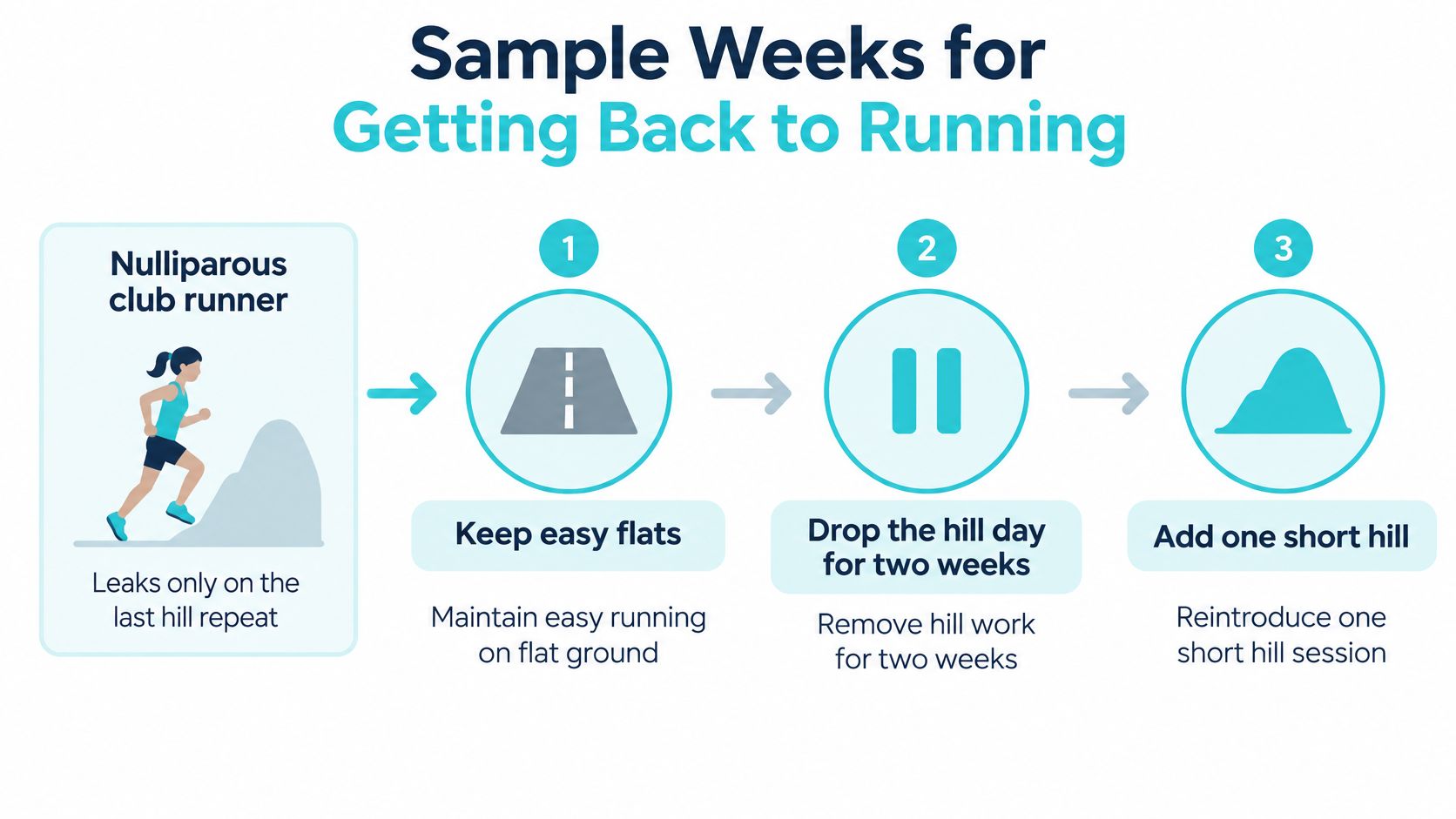
The phases below follow that same logic. One new stress at a time.
| Phase | Running allowed | Move on when | Step back if |
|---|---|---|---|
| Settle | Walks and strength, no running impact | Daily leaks have stopped for about a week | Cough leaks or pressure increase |
| Reintroduce | Short flat walk-run intervals | Two sessions with no leak and a quiet next day | Leak during an easy interval |
| Continuous easy | Flat easy running, cadence slightly quicker | Volume feels stable and leaks stay absent or rare | Next-day urgency or new leaks |
| Build | Add about 10 percent only after easy running is comfortable | A longer easy run stays clean | Symptoms rise with the extra distance |
| One hard variable | Hills or speed, not both in the same week | That session and the next day stay clean | Leak returns on the new stress |
| Race or goal run | Event only after a clean long run near goal effort | Plan fluids and bathrooms in advance | Any escalation in the final build |
Move on only when leaks are absent or no worse than a rare mild episode and the next day is quiet. Step back a phase if leakage returns or spreads to coughing. Once continuous easy running is comfortable, keep volume jumps to about 10 percent. A race comes after a clean long run at goal effort, not after a perfect squeeze test.
The short video below walks through a simple exhale-and-land drill you can pair with the easy-flat phase, before hills come back.
Never-pregnant athletes leak too, so birth history isn't the entry ticket. A 2014 study of 112 elite female athletes, 55 runners and 57 cross-country skiers, found that 45.54% reported urine leakage with sneezing or coughing. 76% were nulliparous. Among symptomatic athletes, 42.86% were only slightly bothered, which is how leakage gets normalized and left off the training log. The same paper cites historical work in which 35% of female Olympic track-and-field participants leaked while competing at the 1996 Olympic Games. Slight bother is still a signal. Log it, then use the phase table instead of waiting for a heavy week.
Book an Assessment Before the Next Build
Book the visit if leaks happen on most runs, if cutting weekly volume hasn't settled symptoms within a few weeks, or if urgency and stress leakage show up together. Book it for pain, a bulge, or pressure. Book it if leakage began after birth or surgery, or if a race build is about to add weekly hours.
The visit should hand you four things, not a generic sheet of squeezes.
- A pattern label: stress, urgency, mixed, or timing.
- A check of contraction and relaxation, including whether you bear down.
- A load plan that covers cadence and weekly mileage, not pace slogans.
- A matched trial: three months of supervised pelvic floor training for stress, or six weeks of bladder training for urgency.
For runners in North Idaho and Eastern Washington, Lake City Physical Therapy offers pelvic floor physical therapy for incontinence and related pelvic conditions. Women's sports physical therapy on our schedule is built for running, CrossFit, triathlon, dance, and volleyball. The Lake City PT mobile app can hold a personalized pelvic floor exercise program between visits so the trial isn't a memory of what you did in the clinic.
Until that appointment, pause the mileage jump. Keep the easy movement that stays dry. Put the assessment on the calendar before the next hard block, not after the race week has already raised the load.
Lake City Physical Therapy provides pelvic floor physical therapy and women's sports physical therapy for runners dealing with leaks on hills, long runs, and speed work. We pair a clear pattern check with a return-to-running plan you can follow. Visit Lake City Physical Therapy to schedule an assessment before your next build.

