Your 30 Minute Core Workout: A PT-Approved Guide
Most advice about a 30 minute core workout gets one thing backward. It treats the core like a surface muscle problem. Tighten your abs, do more crunches, feel the burn, and assume stronger means harder.
That approach misses how the core works in a woman's body.
Your core is a pressure system. The diaphragm at the top, the abdominal wall around the middle, the deep spinal stabilizers in back, and the pelvic floor at the bottom all coordinate with each other. If one part overworks or stops syncing well, you might feel it as back strain, abdominal doming, leaking, pelvic heaviness, or an exercise that just never feels right no matter how “strong” you are.
A good 30 minute core workout should build control before intensity. It should help you manage pressure while breathing, lifting, rotating, reaching, and moving through fatigue. That matters whether you're newly postpartum, navigating prolapse symptoms, training during pregnancy, or returning to running and strength work.
Rethinking the 30 Minute Core Workout
The popular version of a core workout is fast, flexion-heavy, and breathless. A pile of crunches, bicycles, and long planks gets labeled “effective” because it creates fatigue.
Fatigue alone doesn't tell you much.
A more useful question is this. Can you keep your ribs, abdomen, breath, and pelvic floor working together while you move? If the answer is no, more repetitions usually make the pattern worse, not better. That's why many women feel their neck gripping, hip flexors taking over, or pelvic floor symptoms increasing during generic ab routines.
Your core is more than your abs
In women's health physical therapy, the core is often better understood as a canister. The diaphragm forms the top, the pelvic floor forms the base, and the abdominal wall and spinal muscles create the sides. When you inhale well, pressure expands through the torso. When you exhale well, the system recoils and supports effort.
That changes the goal of training. Instead of flattening your stomach or forcing a brace at all costs, you're learning to create support without bearing down.
A strong core isn't the one that feels the hardest. It's the one that can manage load, motion, and pressure without symptoms.
Thirty minutes is enough when the work is organized well
You don't need marathon ab sessions to improve function. A 2023 systematic review on core training found that interventions lasting 30 minutes or less per session still had a large and significant effect (ES = 1.05) on athletic performance markers such as balance and jumping ability.
That finding matters far beyond sports. Balance, force transfer, and trunk control show up in daily life too. They matter when you carry a toddler, push a stroller uphill, pick up a laundry basket, or return to higher-impact exercise.
A pelvic-floor-safe 30 minute core workout should leave you feeling worked, but not compressed. Challenged, but not symptom-provoked. The difference is in the setup, the breathing, and the exercise choices.## Your Foundation Proper Breathing and Core Engagement
Before any circuit, the foundation is breath. Not “take a deep breath” in the vague sense. A 360-degree breath that lets your rib cage and trunk expand in all directions.

If you skip this and jump straight to tightening, you often end up with a hard belly, lifted ribs, clenched glutes, and a pelvic floor that can't respond well. That isn't deep core control. It's gripping.
What 360-degree breathing should feel like
Lie on your back with knees bent and feet on the floor. Put one hand on your lower ribs and one hand on the lower abdomen. As you inhale through your nose, think about filling your torso like a balloon. You want expansion in the front, sides, and back of the rib cage, not just a push up into the chest.
On the exhale, breathe out slowly through the mouth. Let the ribs soften down. Feel a gentle narrowing through the lower abdomen, as if the waistband area is drawing inward without force. At the same time, imagine the pelvic floor responding with a subtle lift, not a squeeze from the glutes or inner thighs.
If that feels unfamiliar, that's normal. Many women have been taught to “pull the belly button to the spine,” which often creates a rigid, hollowed posture. A better cue is softer and more functional.
- Inhale wide: Let the ribs expand sideways and back into the floor.
- Exhale gently: Feel the lower abdomen firm slightly below the belly button.
- Keep the throat relaxed: If your jaw, neck, or shoulders tense up, back off.
- Allow the pelvic floor to respond: Think lift and support, not clench and hold.
For a deeper walkthrough of how breath and activation work together, these core and pelvic floor exercises are a helpful next step.
How to engage without bearing down
The deep core doesn't need maximal tension in most rehab and return-to-exercise settings. It needs timing and coordination. A useful effort level is gentle to moderate. Enough to create support, not so much that you lose breath flow.
Here's the sequence I teach most often:
-
Set your position
Find a neutral starting point. Your ribs aren't flared up, and your pelvis isn't aggressively tucked. -
Inhale first
Let the breath spread through the trunk. -
Exhale on effort
As you move or prepare to lift, exhale and feel the lower abdominal wall respond. -
Check for pressure signs
If your belly domes, you feel downward pressure, or you have to hold your breath, the exercise is too hard in its current form.
Practical rule: If you can't exhale through the hardest part of the movement, you probably don't own that movement yet.
This visual guide can help you connect the pieces before you start the workout.
Cues that usually work better than crunch harder
Some cues improve activation quickly because they reduce over-bracing.
| Cue | What you're trying to feel |
|---|---|
| Melt the ribs down | Less chest lift, better rib-pelvis stacking |
| Exhale through effort | Controlled abdominal support without bearing down |
| Widen on inhale | Better pressure distribution through the trunk |
| Zip up gently from below | Pelvic floor support without gripping |
If you only remember one thing, remember this. Your breath should stay available. A core strategy that requires straining usually isn't the one you want.## The Complete 30 Minute Pelvic-Safe Core Circuit
This routine uses a timed interval structure because that format helps people keep form cleaner as fatigue builds. Evidence-based core workouts are often organized as 45 seconds of work followed by 15 seconds of rest, repeated over multiple rounds, which supports movement quality and pressure control under load, as described in this 30-minute core workout interval format.
The sequence below starts with standing stability, moves into mat-based control, and finishes with dynamic core work that still respects pressure management. If symptoms show up, reduce the range, shorten the lever, slow the tempo, or rest longer.
30-minute core workout summary
| Phase | Time | Exercises (Example) |
|---|---|---|
| Warm-up | 5 minutes | Rib breathing, pelvic tilts, marching, hip hinge reach, wall support rotation |
| Circuit 1 | 7 minutes | Single-leg deadlift to knee drive, front-rack march, windmill, repeat |
| Circuit 2 | 7 minutes | Dead bug, side plank rotation, plank drag, repeat |
| Circuit 3 | 7 minutes | Standing knee drive with reach, bear hover hold or incline climber, suitcase march, repeat |
| Cooldown | 4 minutes | Child's pose breathing, adductor rock-back, open book, supported exhale |
Warm-up for pressure and mobility
The warm-up should make breathing easier, not just raise your heart rate.
Use these movements in a steady flow:
- 360 breathing in hook-lying: Reconnect ribs, diaphragm, and pelvic floor.
- Pelvic clock or gentle pelvic tilts: Find movement without forcing a tuck.
- Marching with exhale: Lift one foot at a time while keeping the trunk quiet.
- Hip hinge reach: Practice trunk control as the hips move back.
- Standing thoracic rotation with support: Add upper-body motion without yanking through the low back.
During this phase, watch for early warning signs. If you already feel abdominal gripping, downward pressure, or breath holding here, the workout needs to stay conservative.
Use the warm-up as a screen. Symptoms that appear early rarely improve when the workout gets harder.
Circuit 1 with standing stability
These drills teach the core to manage gravity in positions that look more like daily life.
Single-leg deadlift to knee drive
Stand tall near a wall or countertop if balance is limited. Hinge from the hips as one leg reaches back, then return to standing and drive the knee up. Exhale as you come up. Keep the ribs stacked over the pelvis.
Pelvic-floor-safe modification: Keep the back toes on the floor in a kickstand stance.
Progression: Hold a dumbbell on one side to add anti-rotation demand.
Front-rack march
Hold light weights at the shoulders or use bodyweight only. Alternate lifting one knee without leaning back. Think tall spine, soft ribs, steady breath.
What works: Slow, controlled marching with a full exhale on each lift.
What doesn't: Snapping the knee up, arching the back, or using momentum.
Windmill
Take a wide stance and reach one arm overhead. Hinge and side-bend only as far as you can keep length through the waist. This is not a race to touch the floor.
Modification: Use no weight and slide the lower hand only partway down the leg.
Progression: Add a light dumbbell overhead if shoulder control is solid.
If you're dealing with changing hormones, stiffness, or exercise-related pelvic discomfort in midlife, this guide on managing midlife fitness and pelvic health offers useful context for adjusting training load.
Circuit 2 with mat-based deep core control
Now the body has to manage limb movement with more trunk demand.
Dead bug
Lie on your back with knees over hips and arms up. Inhale to prepare. Exhale as one leg reaches away and the opposite arm lowers. Return before your ribs pop or your abdomen domes.
Best cue: Keep the front of the ribs heavy and the low back naturally supported, not smashed flat.
Regression: Tap one heel down instead of straightening the leg.
Progression: Hold a light dumbbell or extend both arms farther overhead.
Side plank rotation
Start on the forearm with knees bent if needed. Lift into side support, then rotate through the upper back, not by collapsing the waist.
Pelvic-safe version: Knees down, shorter hold, slower rotation.
Progression: Full side plank with top-leg support removed if you can breathe steadily there.
Plank drag
Set up in a high plank or plank on a bench. Drag a light dumbbell or yoga block across the floor with minimal trunk shifting.
This is an excellent anti-rotation drill when it's scaled correctly. It's a poor choice if your belly cones, your breath disappears, or your low back sags.
If the plank changes your breathing pattern, elevate it. Incline work often trains the same concept with much better form.
For more guided progressions that emphasize deep support rather than surface tension, this deep abs workout is a useful companion resource.
Circuit 3 with dynamic but symptom-aware effort
The final circuit raises the challenge without turning the session into a pressure contest.
Try this sequence:
-
Standing knee drive with cross-body reach
Reach across the body as the opposite knee lifts. Control the twist through the ribs and trunk, not by yanking the pelvis around. -
Bear hover hold or incline climber
A hover hold is often better than fast mountain climbers for women who lose pressure control easily. If you choose climbers, raise the hands and slow them down. -
Suitcase march
Hold one dumbbell or kettlebell at one side and march in place. The goal is to resist side-bending and keep the trunk organized.
This phase should feel athletic, but still coordinated. If you notice pelvic heaviness, leaking, or strong abdominal doming, go back to a standing variation. Dynamic doesn't have to mean reckless.
Cooldown that restores breathing
A good cooldown helps the trunk come back down from effort.
Use:
- Child's pose or supported rest position with wide back breathing
- Adductor rock-back
- Open book rotation
- Long exhale in hook-lying
Many women skip this because it seems optional. It isn't. If you finish a session still gripping through your abdomen or chest, your body may carry that strategy into the rest of your day.## Common Mistakes That Weaken Your Core
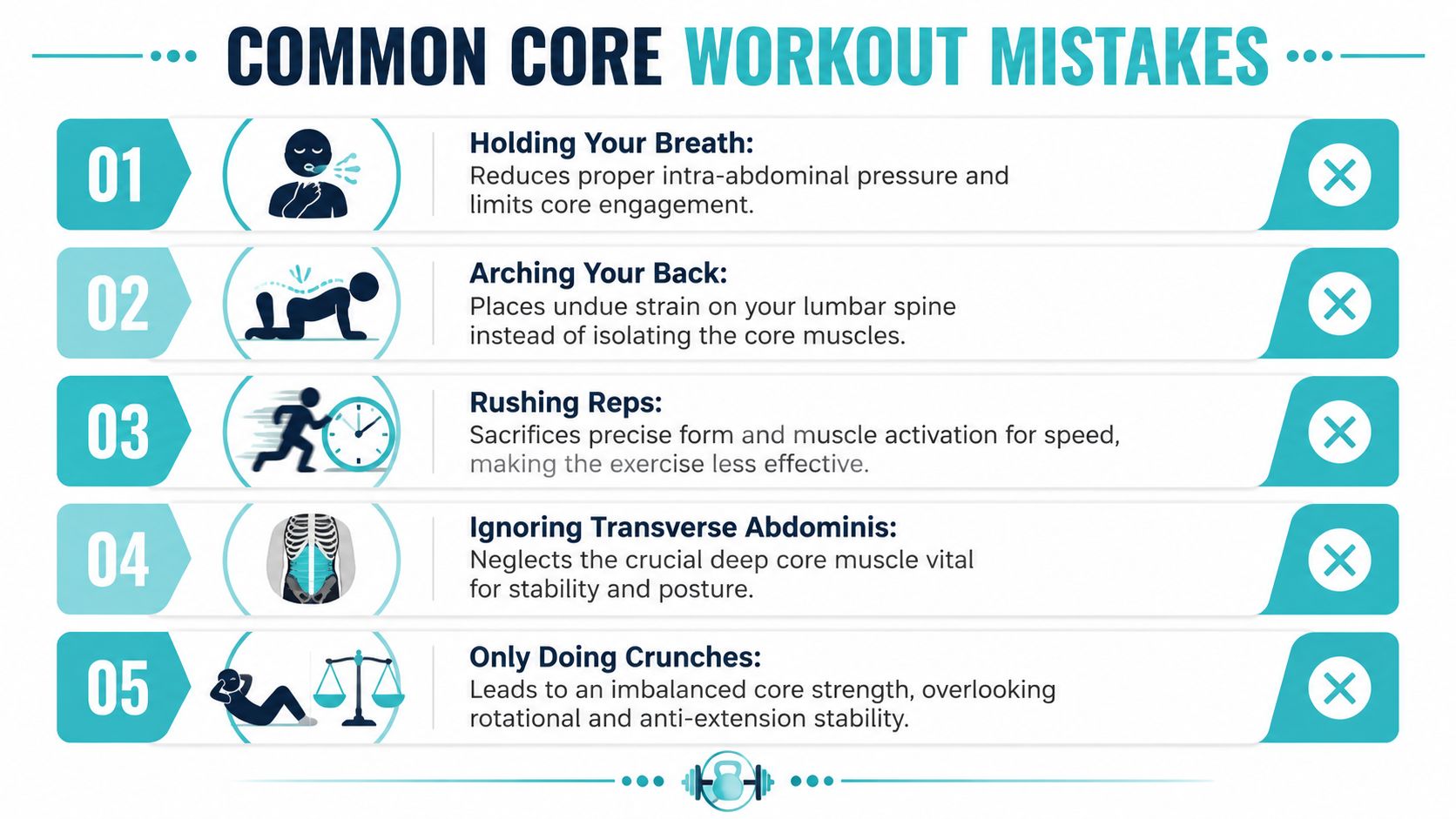
Most core mistakes don't look dramatic. They show up as subtle compensation. A rib flare, a held breath, a hard abdomen, a rushed rep. Those patterns matter because they change where force goes.
When pressure isn't managed well, the body has to put it somewhere. Sometimes that's the low back. Sometimes it's the abdominal wall. Sometimes it's downward into the pelvic floor.
Doming is a feedback sign, not a badge of effort
If you see a ridge or cone through the midline of the abdomen during effort, the solution isn't to push harder. Doming usually means the system can't manage the current load well.
That can happen in sit-ups, planks, leg lowers, and even seemingly simple moves if the lever is too long or the breath disappears.
Fix it by changing one variable at a time:
- Shorten the lever: Bend the knees or reduce arm reach.
- Reduce the load: Bodyweight is often the better choice.
- Exhale sooner: Don't wait until you're straining.
- Use a different position: Incline and side-lying options are often cleaner.
Breath holding creates the wrong kind of pressure
Many women unintentionally use a bearing-down strategy when an exercise gets hard. They brace, close the throat, and push. It can make the movement feel stronger for a moment, but it often increases pelvic pressure and reduces useful core coordination.
You'll notice this in planks, carries, and transitions from the floor.
A quick reset helps. Inhale before the rep. Start the exhale as the effort begins. If you can't keep that pattern, scale the exercise.
Don't use intensity to test your core. Use your breathing to assess whether the exercise belongs in your program.
Pelvic tucking and back flattening can backfire
A common instruction in fitness is to flatten the low back into the floor at all costs. That cue can help in some exercises, but many people overdo it and lose normal rib and pelvic movement.
When the pelvis is aggressively tucked, the deep system often turns into a gripping strategy. Glutes clench. Hamstrings dominate. Breath gets shallow.
Instead, look for stacking, not force. The ribs rest over the pelvis, and the trunk stays organized as you move. Neutral doesn't mean rigid.
Rushing reps hides weakness
Speed can make a shaky movement feel powerful. It also hides the exact point where pressure control breaks down.
If the last third of the work interval turns into flinging, twisting, or collapsing, the exercise is too advanced in its current form. Slow reps expose the truth. That's a good thing.
A simple self-check works well:
| Mistake | What to do instead |
|---|---|
| Holding your breath | Start the exhale with effort |
| Doming through the midline | Shorten the lever or reduce load |
| Aggressive pelvic tuck | Restack ribs over pelvis |
| Rushing the interval | Slow the tempo and own each rep |
| Pushing through symptoms | Stop and modify immediately |
Pain, heaviness, leakage, or a sense that something is “dropping” are not signs to tough it out. They're useful information.## How to Adapt This Workout for Your Body
A pelvic-safe program should feel adjustable from the start. Not because you're fragile, but because bodies move through different seasons. Pregnancy changes load distribution and breathing mechanics. Postpartum recovery changes tissue tolerance and coordination. Athletic goals change how much speed and resistance make sense.
That's why the same 30 minute core workout can work well for different women when the principles stay the same and the dosage changes.

During pregnancy
As your abdomen and rib cage change shape, exercises that once felt easy may start to create doming, breath holding, or pulling sensations. That doesn't mean core training stops. It means the strategy shifts.
Standing work often becomes more comfortable than long floor-based positions. Side-lying, tall kneeling, wall planks, and loaded carries usually give better feedback than high-tension front-body work.
Useful adjustments include:
- Choose more upright positions: They often make pressure easier to manage.
- Shorten ranges of motion: Especially during twisting and leg-lowering patterns.
- Lower the effort if you're straining: A smaller exhale-supported rep is often more productive.
- Use support freely: Walls, benches, and counters are training tools, not crutches.
Early postpartum
Early postpartum core work should rebuild connection before chasing challenge. Many women are told to “start with kegels and walk,” but the underlying issue is usually coordination. Can the diaphragm, abdominals, and pelvic floor work together again? Can you exhale with effort while lifting, rolling, carrying, and standing up?
Start with breath work, marching, heel slides, supported bridges if tolerated, and modified anti-rotation work. Progress only when symptoms stay calm and the abdominal wall handles load cleanly.
A few signs you need a gentler version:
- You feel heaviness after the session
- You notice leakage with exertion
- Your abdomen domes during simple drills
- You feel more sore in the back or neck than through the trunk
Those signs don't mean you failed. They mean the current version is ahead of your present capacity.
With pelvic pain or prolapse symptoms
This group often gets bad advice from both sides. Either “avoid all core work” or “just strengthen more.” Neither is precise enough.
When symptoms involve pain, pressure, or prolapse, the first target is usually symptom-free loading. That means finding versions of exercises you can do without flaring symptoms during or after the workout. Often that involves reducing impact, choosing supported positions, and avoiding exercises that trigger bearing down.
What tends to help:
- Longer exhales
- Smaller ranges
- Fewer high-pressure transitions
- More rest between efforts
- More standing or side-lying choices
For the female athlete
Athletes often need a reminder that pelvic-floor-safe doesn't mean easy. It means your progressions are earned.
Once breath, pressure management, and base strength are solid, you can advance with load, speed, asymmetry, and more complex planes of motion. Carries, chops, rotational control, deceleration work, and higher-demand plank variations all fit here when the basics stay intact.
Athletes do best when they treat pelvic floor symptoms the same way they'd treat any other performance limiter. Assess it, scale it, train it, and don't ignore it.
If you're training hard and symptoms only show up at higher loads or impact, that's often where individualized programming matters most.## When to See a Women's Health Physical Therapist
Some workouts need modification. Some need a trained set of eyes.
If you have pain during core work, urinary or fecal leakage, a persistent feeling of pelvic heaviness, visible abdominal doming that doesn't improve with scaling, or discomfort with intercourse alongside exercise-related symptoms, it's time to get assessed. Those issues usually don't improve from pushing harder through generic online routines.
A personalized plan matters because the same 30-minute session can land very differently depending on the person. The calorie cost alone can vary widely. Harvard Health's activity table shows that in 30 minutes, calorie burn can range from about 120 to over 400 calories depending on body weight and exercise intensity, which is one reason workout dosage needs to fit the individual rather than the trend, as shown in this Harvard Health calorie-burn comparison.
Signs that deserve evaluation
- Leakage during exercise
- Pelvic pressure or heaviness
- Pain in the abdomen, pelvis, hips, or back
- Bulging or doming through the midline
- Fear of returning to movement after pregnancy or symptoms
- A plateau where every ab exercise feels wrong
A women's health physical therapist can assess breathing mechanics, abdominal wall function, pelvic floor coordination, movement strategy, and the way symptoms change under load. That's much more useful than guessing.
If you're unsure whether your symptoms are worth evaluating, these signs you need pelvic floor therapy give a clear starting point. A clinic such as Lake City Physical Therapy can use that assessment to build an exercise plan around your symptoms, life stage, and goals rather than asking you to fit yourself into a generic workout.
If you want help turning this 30 minute core workout into a plan that fits your body, your symptoms, and your goals, connect with Lake City Physical Therapy. Their women's health physical therapists work with prenatal and postpartum patients, women with pelvic floor symptoms, and active women returning to sport who need more than generic ab advice.