Stomach After Pregnancy Loose Skin: A PT’s Guide
You catch your reflection while pulling on leggings or stepping out of the shower. The belly that carried your baby doesn't look or feel like it used to. Maybe the skin seems softer and looser. Maybe there's a rounded bulge that doesn't match the effort you're putting into walking, eating well, and trying to “get your core back.” Maybe you've tried creams, wraps, or random ab videos and nothing seems to match what your body needs.
That moment can feel discouraging. It can also feel confusing, because postpartum abdominal changes are rarely just one thing.
As a women's health physical therapist, I want to start with this. Your postpartum body is not failing. It's adapting after a major physical event. If you're dealing with stomach after pregnancy loose skin, the first step isn't finding the most aggressive fix. It's figuring out what you're looking at: loose skin, diastasis recti, body composition changes, or a mix of all three. That answer changes everything about what will help and what won't.
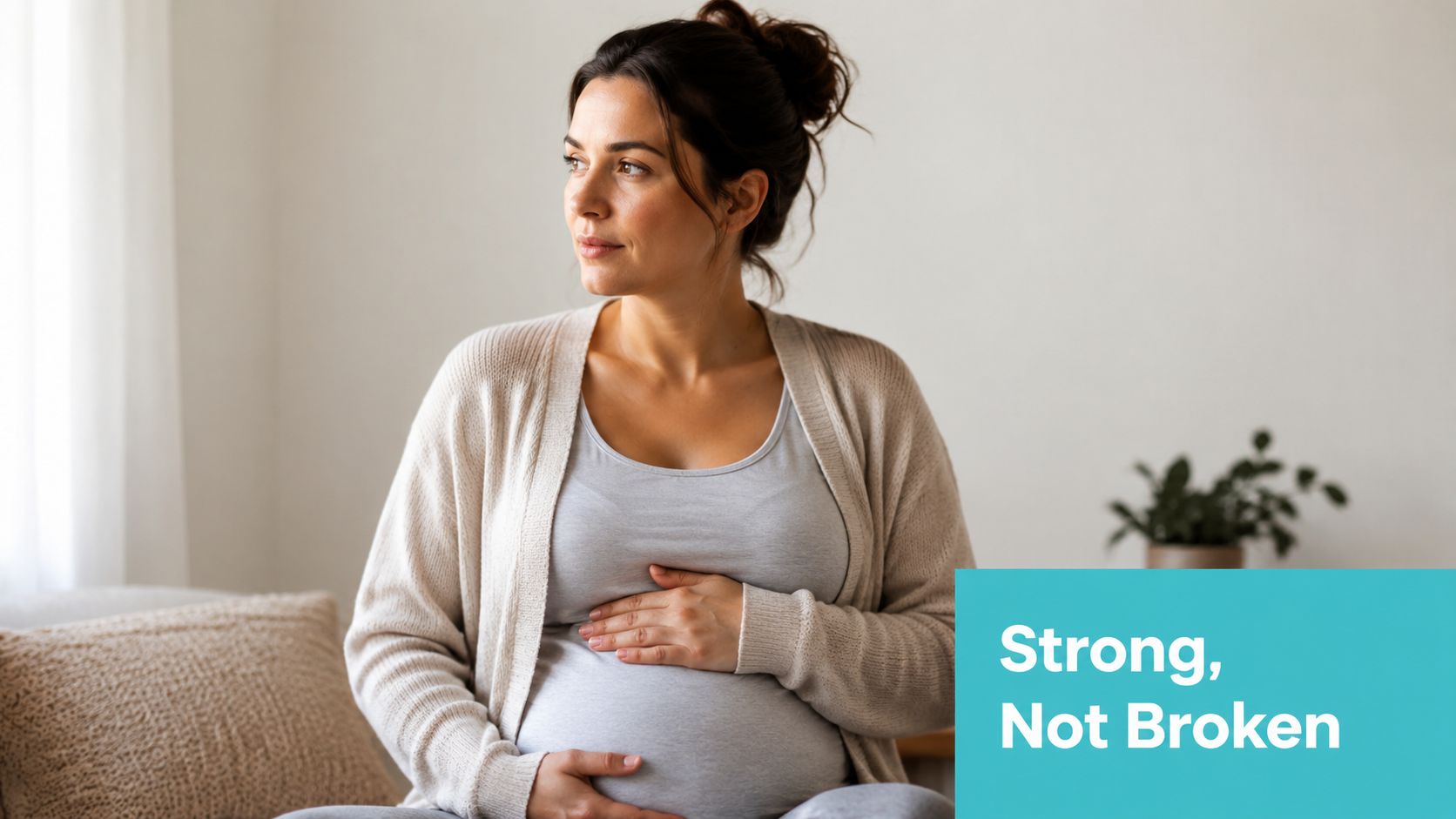
Your Postpartum Body Is Strong Not Broken
Many new mothers do the same quiet check. They stand sideways in the mirror, lift the lower belly with their hands, tighten their abs, then let go. They wonder whether what they see is skin, fat, weakness, or something they caused by not “bouncing back” fast enough.
That thought process is common. It's also unfair to you.
Pregnancy, birth, feeding, sleep disruption, carrying a baby, and healing at the same time ask a lot from the abdominal wall and the pelvic floor. Your body has done skilled, demanding work. The changes you see now are not proof that you're broken. They're signs that tissues were stretched, muscles were challenged, and recovery takes time.
What most women need first
Most women don't need more pressure. They need better information.
That means asking practical questions:
- What changes are normal: Softness, altered shape, reduced abdominal tension, and slower recovery can all happen postpartum.
- What deserves assessment: Doming through the midline, ongoing back pain, pelvic heaviness, scar restriction, or trouble returning to exercise deserve more than social media advice.
- What recovery should target: Function first. Breathing, pressure control, posture, strength, and symptom reduction usually matter more than chasing a flatter stomach.
Your goal doesn't have to be loving every visual change right away. A better first goal is feeling informed, supported, and physically stronger.
A more useful way to think about recovery
Instead of asking, “How do I tighten my stomach fast?” ask, “What is my abdomen asking for right now?”
For one woman, the answer is patience and gradual strengthening. For another, it's pelvic floor rehab and scar mobility. For someone else, it's accepting that true excess skin may improve only partially without a medical procedure.
That's the approach I want you to take through the rest of this guide. Reassuring, but honest. Supportive, but specific.
The Science Behind Postpartum Abdominal Skin
Loose skin after pregnancy is not a motivation problem. It's a tissue problem.
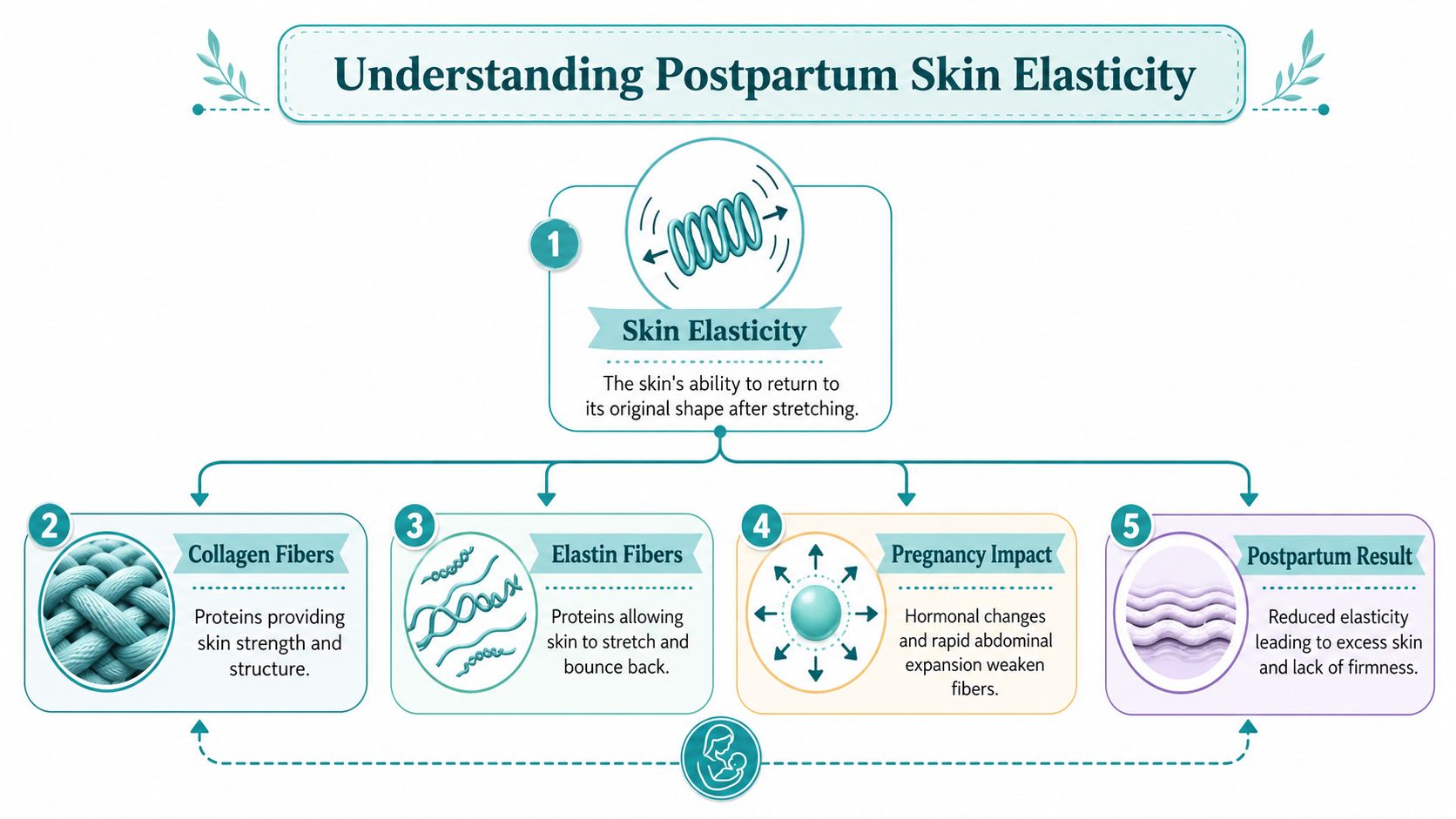
During pregnancy, the abdomen has to expand quickly. In biomechanical modeling, that expansion corresponds to about a 40% area increase before delivery according to postpartum skin stretching research. That kind of rapid stretch can damage or overstretch collagen and elastin fibers, which are the structures that help skin stay firm and spring back.
Think of collagen as the woven threads that give fabric strength, and elastin as the stretch built into the material. If you pull a favorite sweater far past its normal shape for long enough, it may never sit the same way again. Skin behaves similarly. It can recover to a point, but it doesn't always return to its pre-pregnancy tension.
Why weight loss doesn't solve everything
Many women get frustrated. They lose some pregnancy weight, their clothes fit better, but the lower abdomen still looks wrinkled, deflated, or folded.
That happens because fat and skin are not the same problem.
If there's extra body fat, nutrition and exercise can help reduce it. But if the skin itself has lost recoil because collagen and elastin were overstretched, shrinking fat cells won't fully restore the skin's previous firmness. You can become fitter and still see skin laxity.
Why time helps, but not always completely
Early postpartum healing matters. Swelling changes, hormone shifts settle, posture improves, and muscle tone comes back. All of that can improve how the abdomen looks.
But skin laxity exists on a spectrum.
- Mild laxity: Skin may look softer or less taut, especially when bending or sitting.
- Moderate laxity: The lower abdomen may appear loose even with improved fitness.
- Severe laxity: There may be a visible overhang or skin that doesn't retract much when the core engages.
Clinical takeaway: If your abdomen changes shape with better posture and muscle engagement, weakness may be playing a larger role. If there's a persistent drape of skin regardless of position, true laxity is more likely part of the picture.
What this means for treatment decisions
Understanding the science changes expectations. Lotions may help skin feel better. Exercise can improve support underneath. Time can improve healing. But none of those act like a magic reset button for significantly stretched tissue.
That isn't bad news. It's useful news. It helps you stop blaming yourself for not fixing a structural issue with discipline alone.
Is It Loose Skin Diastasis Recti or Fat
This is the question that matters most. Many women think they have one problem when they in fact have two or three layered together.
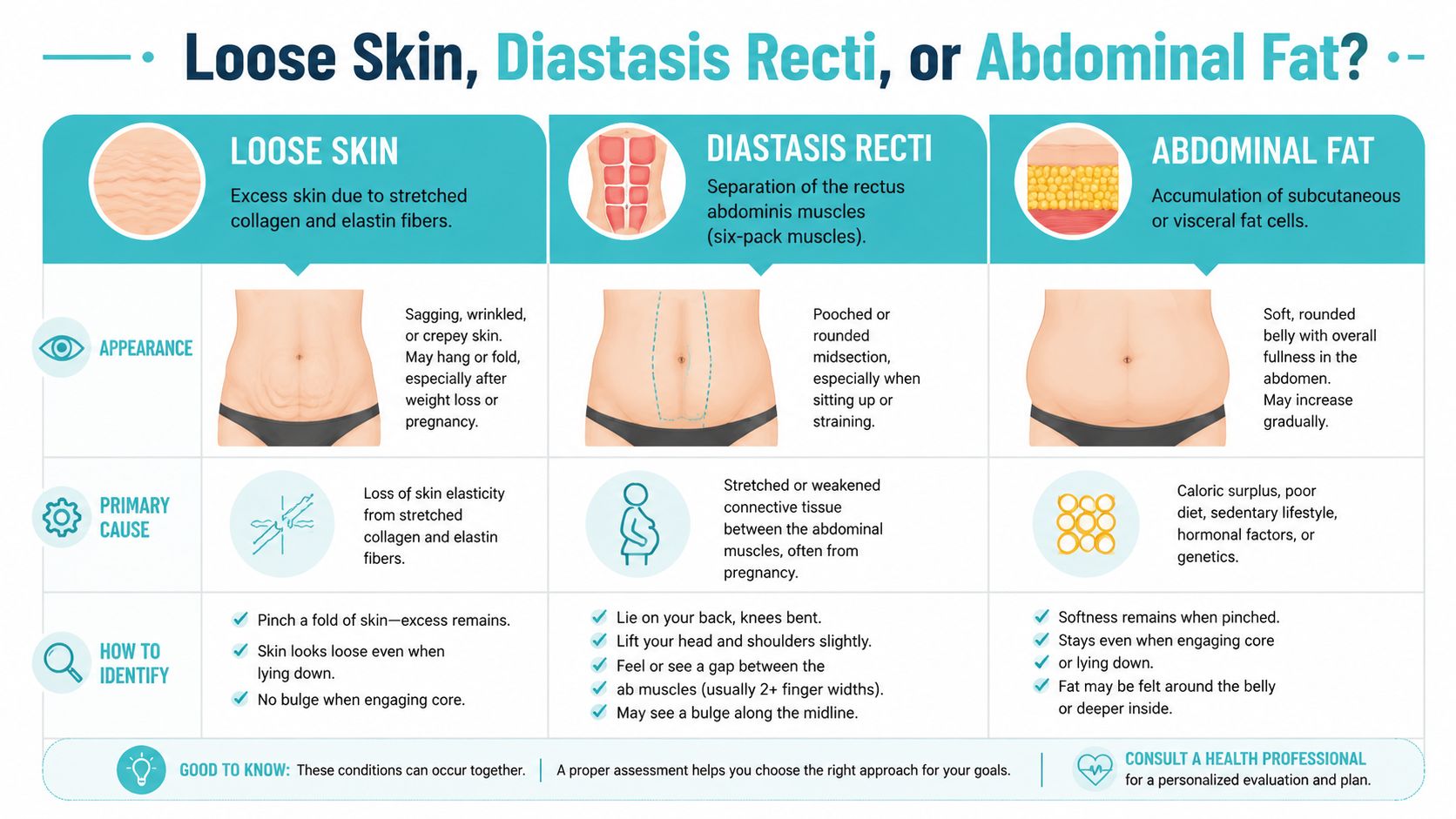
A soft postpartum belly can come from true loose skin, diastasis recti, abdominal fat, or a combination. According to guidance on postpartum abdominal changes and diastasis recti, symptoms like a persistent belly bulge, lower back pain, or visible doming during exercise often point to diastasis recti, and core rehab exercises such as planks, dead bugs, and glute bridges are more relevant than skin-tightening creams.
What each one tends to look like
Here's a simple comparison:
| Concern | Common appearance | What often changes it |
|---|---|---|
| Loose skin | Wrinkled, crepey, or draped tissue, especially when bending forward | Position changes it a little, but skin still looks excess |
| Diastasis recti | Midline bulge, doming, lack of tension through the front of the abdomen | Breathing, pressure control, and core training can change it |
| Abdominal fat | Softer fullness through the abdomen, often more uniform | Nutrition, strength work, sleep, and overall activity affect it |
A simple self-check for diastasis recti
A proper assessment is best done by a trained clinician, but there are useful signs you can notice at home.
Watch for these during movements like getting out of bed, sitting up, lifting the baby carrier, or trying an ab exercise:
- Doming or coning: A ridge rises along the middle of the abdomen.
- Persistent bulging: The belly pushes outward when effort increases.
- Back discomfort: The trunk feels unsupported during daily tasks.
- Poor tension: The abdominal wall feels soft or hard to coordinate rather than “weak.”
A deeper exercise guide on diastasis recti rehabilitation strategies can help you understand what movement patterns are usually introduced first and which ones may need modification.
Later in this section, this short visual can help you see what doming may look like during movement:
Why mislabeling the problem wastes time
If the main issue is diastasis recti, skin creams won't close the gap or improve pressure management.
If the main issue is body composition, endless ab bracing won't create the visual change you want by itself.
If the main issue is actual skin laxity, more cardio won't make excess skin disappear.
Most postpartum bellies are mixed presentations. That's why one-size-fits-all advice feels so disappointing.
When to get evaluated
Seek a women's health PT or qualified postpartum clinician if you notice:
- Visible doming with effort
- Lower back pain during lifting or carrying
- Pelvic pressure, heaviness, or leaking
- A c-section scar that feels tight or pulls your posture forward
- Uncertainty about which issue you're dealing with
A personalized assessment saves time and frustration. It also helps you avoid jumping into workouts that increase pressure faster than your core can manage.
Building Your Foundation with Core Rehabilitation
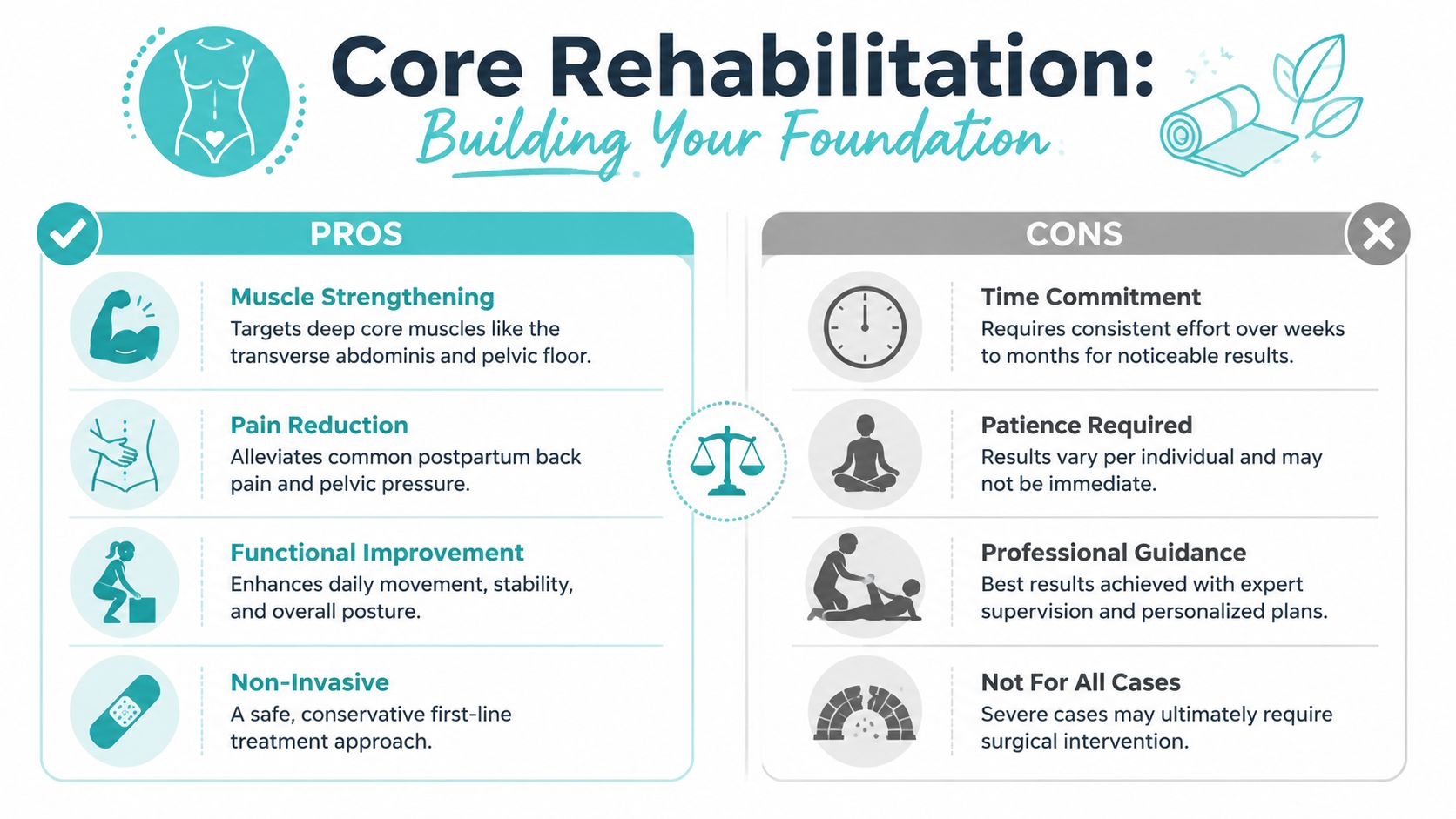
Once you know that weakness or diastasis recti is part of the picture, the most useful first treatment is usually core rehabilitation.
This doesn't mean punishing ab workouts. It means retraining the system that manages pressure, supports your spine, and gives the abdomen better tension from the inside out. I often describe it as rebuilding an internal corset. When the deep core and pelvic floor coordinate well, the front of the abdomen usually looks and feels more supported.
The American College of Obstetricians and Gynecologists recommends that postpartum women gradually work up to 150 minutes of moderate-intensity activity per week, and guidance for postpartum exercise also emphasizes beginning with simple movement and gradually increasing intensity, as noted in this summary of ACOG postpartum exercise recommendations. That progression matters. Early postpartum tissue doesn't respond well to rushing.
What core rehab actually aims to improve
Good rehab changes more than appearance. It can help with:
- Pressure control: Less outward pushing through the abdomen during effort.
- Posture support: Better rib cage and pelvis alignment.
- Back comfort: More support with lifting, feeding, carrying, and walking.
- Movement confidence: Safer return to strength training, running, or higher-impact exercise.
At Lake City Physical Therapy, postpartum core strengthening exercises are part of a broader rehab approach that can also include pelvic floor assessment, breathing mechanics, scar mobility, and return-to-activity planning.
Four early exercises that usually make sense
These aren't one-size-fits-all prescriptions, but they're common starting points because they teach control without excessive strain.
-
Diaphragmatic breathing
Lie on your back with knees bent or rest in side-lying. Inhale into the rib cage and lower belly without forcing the abdomen upward. Exhale slowly and feel the lower ribs soften. This helps restore pressure management and reconnect breathing with the deep core. -
Pelvic tilts
In a comfortable back-lying position, gently rock the pelvis so the low back alternates between a small arch and a gentle flattening. This improves awareness and can reduce gripping through the upper abs or glutes. -
Heel slides
Start in a neutral, supported position. Exhale as one heel slides away, then return without letting the abdomen dome or the rib cage flare. This is a quiet but useful way to train trunk control. -
Bird-dog, modified as needed
Begin on hands and knees if that position feels good. Lift one arm or one leg first, then build toward opposite arm and leg only if you can keep the trunk steady and avoid doming.
What to hold off on early
Some exercises create more pressure than your healing abdomen can manage well in the early phase.
Consider pausing or modifying:
- Crunches and sit-ups: These often push pressure forward through the midline.
- Aggressive planks: Helpful later for some people, but not automatically the best starting point.
- Double-leg lowering: This often overmatches early core control.
- High-impact classes: Jumping and fast transitions can expose weakness quickly.
Practical rule: If an exercise creates doming, breath-holding, pelvic heaviness, or leakage, it's not the right level yet.
How to know rehab is working
The first signs are often functional, not cosmetic.
You may notice that standing feels easier. Lifting the car seat may strain your back less. The belly may feel more supported by the end of the day. Over time, mild laxity can also look less prominent because the muscles underneath are creating better tension.
That said, core rehab has limits. It can improve support, shape, and function. It cannot remove substantial excess skin. Knowing that boundary helps you use exercise for what it does well instead of expecting it to do a surgeon's job.
Exploring Treatments Beyond Exercise
Once the foundation is in place, some women still want to address the skin itself. That's reasonable. The key is choosing options based on the actual problem and keeping expectations realistic.
Topicals and at-home products
Moisturizers, retinoid-based skincare, body oils, and collagen-focused products may improve texture, comfort, and the way skin looks in certain lighting. They can be worth trying if your concerns are mild and you enjoy a skincare routine.
But these products don't remove hanging skin or repair a significant loss of tissue recoil. They're best viewed as appearance support, not structural correction.
For women comparing postpartum skin changes to what happens after major weight shifts, this piece on addressing dramatic weight loss skin concerns offers a useful parallel. The skin question is often about tissue quality, not effort.
Non-surgical procedures
Clinic-based options like radiofrequency are often marketed as skin tightening. Some women do see improvement, especially with mild laxity.
Still, expectations matter. For moderate-to-severe cases, Medical News Today's overview of postpartum loose skin treatment options notes that radiofrequency typically yields only 10-20% improvement, while abdominoplasty provides 80-100% correction by removing excess tissue. That's a very different category of result.
A short comparison helps:
| Option | Best fit | Main limitation |
|---|---|---|
| Topicals | Mild texture concerns | Don't correct structural laxity |
| Radiofrequency and similar treatments | Mild to moderate laxity, realistic goals | Improvement is often modest |
| Abdominoplasty | Significant excess skin or overhang | Surgery involves recovery and scarring |
Surgery and support tools
For women with a clear pannus, major overhang, or skin that remains functionally bothersome, surgery is the most definitive way to remove excess tissue. It's not the right choice for everyone, and timing matters. Many women want to finish childbearing, feel medically stable, and rebuild baseline strength first.
Some women also ask about support garments. A postpartum recovery belt can offer temporary support and comfort for certain activities, but it doesn't restore the deep core on its own. Think of it as a tool, not a treatment plan.
The right question isn't “What's the most effective option overall?” It's “What fits my body, goals, symptoms, and tolerance for recovery?” For one woman, that answer is exercise and time. For another, it's non-surgical treatment with modest expectations. For someone with severe laxity, surgery may be the only option that exactly matches the anatomy.
FAQ Your Realistic Postpartum Recovery Path
Recovery after pregnancy rarely follows a straight line. Skin, muscle, scar mobility, posture, sleep, feeding demands, and stress all affect what you see and feel. The most grounded approach is to stop chasing a generic “bounce back” and start matching treatment to the actual issue.
How long should I wait before deciding what's permanent
Give your body time for natural recovery first. In the first postpartum months, swelling changes, muscle control improves, and daily movement becomes easier. If you're still unsure later on, a women's health PT or medical provider can help separate what may keep improving from what is more likely to persist.
Does breastfeeding affect loose skin
Breastfeeding changes hormones, energy demands, and sometimes weight stability. That can influence how recovery feels, but it doesn't create a universal timeline for abdominal appearance. It's one factor among many.
What if I had a c-section
A c-section scar can change abdominal tension, breathing mechanics, and the way the lower belly moves. If the scar feels stuck, numb, tender, or pulls when you stand upright, scar mobility work and guided rehab often help.
Can nutrition improve the look of my abdomen
Yes, to a point. According to this discussion of nutrition and postpartum skin support, adequate Vitamin C, Vitamin E, and healthy fats support skin building blocks, but they can't reverse severe structural damage on their own. Nutrition matters. It just isn't a standalone fix for major laxity.
What if I feel tight in my ribs and upper abdomen
Breathing patterns affect core pressure more than most women realize. If pregnancy left you with shallow breathing or rib tension, gentle mobility and breath practice can help. Some women also like practical breathing tips for pregnant women because the same rib cage awareness often carries into postpartum recovery.
The big picture is simple. Your abdomen may need healing, retraining, acceptance, treatment, or some mix of all four. Every body is different. Real progress starts when you identify the right problem.
If you want help figuring out whether you're dealing with loose skin, diastasis recti, pelvic floor dysfunction, or a combination, Lake City Physical Therapy offers women's health and postpartum rehabilitation focused on breathing, core recovery, pelvic floor function, scar mobility, and safe return to activity. A personalized assessment can help you stop guessing and start working on the right plan.