Breast Cancer Operation Recovery: A Practical Guide
You're home after breast cancer surgery, trying to work out whether the pulling across your chest is normal, whether your arm should be moving more, and how much activity is too much. You may have a drain, bruising, fatigue, numb skin, or a shoulder that suddenly feels unfamiliar. Well-meaning advice often conflicts: rest completely, move as much as possible, protect the arm, use it normally.
Good breast cancer operation recovery isn't measured only by a closed incision or the absence of lymphedema. It's measured by whether you can raise your arm, sleep comfortably, dress, carry necessary items, return to work, and resume meaningful activities without a worsening symptom pattern. The plan needs to protect healing tissue while preventing avoidable loss of movement and strength.
What Recovery Looks Like After Breast Cancer Surgery
A patient I'll call Maria arrived at her first postoperative appointment with a clean incision but limited function. She could not comfortably reach a cupboard, lift her arm to wash her hair, or lie on the surgical side. After being told to “take it easy,” she had spent much of the day guarding the arm and worrying that shoulder movement might harm the operation.
That uncertainty is common. Early recovery may involve drains, chest tightness, bruising, shoulder stiffness, fatigue, altered sensation, and soreness around the breast or armpit. These symptoms do not automatically signal a complication, but they can change how you move. Recovery works best as a controlled progression that respects the surgical team's restrictions while preserving useful function.
Three overlapping phases
Protection starts with wound care, comfortable breathing, short walks, safe transfers, medication management, and the gentle shoulder movements your surgeon permits. Reconstruction may mean living with drains for longer, while flap procedures can add soreness because tissue has been taken from another body site. The American Cancer Society describes procedure-specific recovery. Some patients also discuss hyperbaric recovery support options with their medical team.
Restoration begins as irritability settles and movement becomes easier. Treatment focuses on shoulder range of motion, posture, walking tolerance, and ordinary tasks such as dressing or reaching. The goal is useful movement, not an impressive exercise score. If activity triggers a flare that lasts into the next day, the load may need to be reduced and reviewed.
Return means gradually preparing for work, caregiving, exercise, and recreation. A healed incision does not guarantee normal strength, sensation, or confidence. Scar restriction, nerve symptoms, weakness, and fear of movement may still require targeted treatment.
Practical rule: Track what you can do, not only what you can see. Arm elevation, dressing, sleep, walking, lifting, and work tasks can reveal functional problems before a visible complication does.
Timelines vary substantially by procedure. After breast-conserving surgery such as a lumpectomy, many patients can generally return to regular activities within about 2 weeks. Mastectomy recovery is often closer to 4 weeks, while reconstruction can extend the return to usual activities to roughly 6–8 weeks. These are guideposts, not deadlines. The operation, reconstruction method, node treatment, symptoms, and overall health all influence the pace.
Timelines From Lumpectomy to Reconstruction
Recovery is easier to plan when you track function alongside wound healing. Your surgeon's instructions take priority, especially if you have drains, wound concerns, reconstruction, or additional procedures.
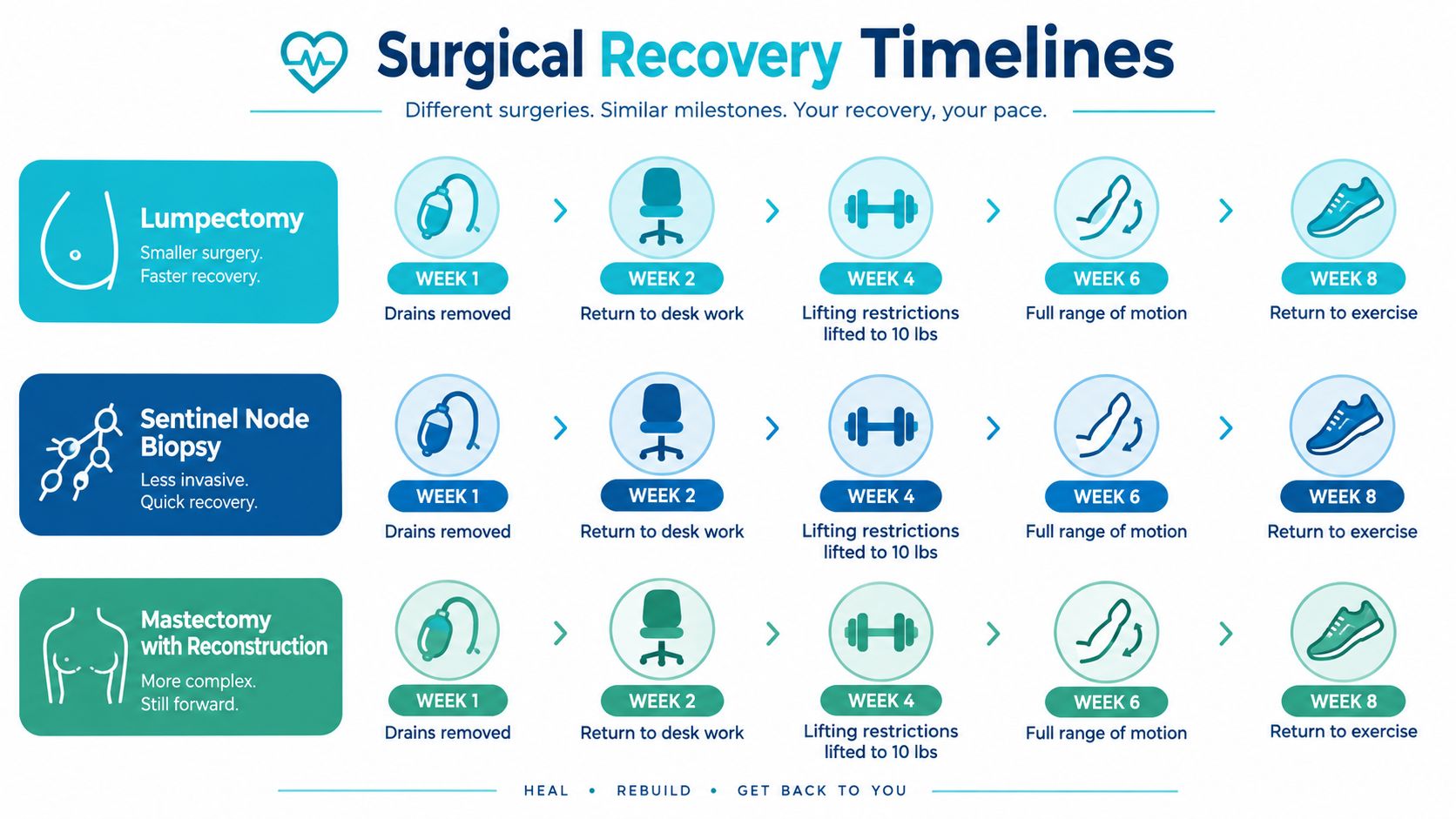
Lumpectomy and sentinel node procedures
After breast-conserving surgery, early recovery usually centers on protecting the incision, walking comfortably, breathing fully, and completing prescribed gentle movement. A lumpectomy often permits a faster return to regular activities than a mastectomy, although discomfort may be substantial when lymph nodes were sampled or removed. Reaching overhead, pushing, pulling, and sleeping may remain difficult even when the breast incision looks small.
Sentinel node surgery generally disrupts the armpit less than an axillary dissection. The shoulder and chest can still become guarded, however. Check whether you can raise the arm and reach behind your head without increasing pain or tightness. A gradual loss of movement, worsening symptoms, or difficulty with dressing and other daily tasks warrants assessment by your surgical team or an oncology physical therapist.
Mastectomy and reconstruction
Mastectomy often requires a longer recovery because more tissue has been removed, and the chest wall may feel tight or numb. Reconstruction adds another healing site and may bring implant-related or tissue-transfer restrictions. The American Cancer Society explains that reconstruction may involve several days in the hospital, drains, and a slower return to usual activity. Many patients resume most daily activities in approximately 4 weeks after mastectomy, while reconstruction may extend recovery to roughly 6–8 weeks.
Surgeons commonly restrict heavy lifting, strenuous exercise, and some overhead movements for about 4–6 weeks, but the timing depends on the operation, wound status, drains, and clinical clearance. Swelling and bruising may take as long as 8 weeks to settle. Scar maturation and altered sensation can continue for 1–2 years, so early tightness or numbness may change gradually rather than follow a fixed schedule.
| Recovery question | What to use as your guide |
|---|---|
| When can I lift? | Follow the surgeon's weight and movement restrictions instead of a generic calendar. |
| When can I exercise? | Resume in stages after wound review and clinical clearance. |
| When should swelling improve? | Expect gradual change, but report rapidly increasing or asymmetric swelling. |
| When is healing complete? | Function and sensation may continue changing long after the incision closes. |
A slower week is not automatically a setback. Sudden increases in pain, drainage, redness, fever, or swelling need medical review before you progress activity.
Lymphedema Risk and What the Numbers Really Mean
Lymphedema is persistent swelling caused by impaired lymph transport. It can affect the arm, hand, breast, chest, or trunk, and it isn't the same as ordinary postoperative fluid that steadily settles as tissues heal. The risk is particularly relevant when axillary lymph nodes are removed or treated.
A systematic review summarized by the U.S. National Cancer Institute found an overall breast-cancer-related lymphedema prevalence of 21.4%, with a reported range of 14.9%–29.8%. Incidence can continue increasing for up to 2 years after diagnosis or surgery (American College of Surgeons). The surgical technique changes the risk. Axillary lymph-node dissection is associated with more lymphedema than sentinel lymph-node biopsy, so your operation type matters when deciding how closely to monitor symptoms.

Symptoms worth reporting
Don't wait for dramatic swelling. Mention a new or persistent pattern of:
- Heaviness or fullness: The arm, breast, or chest feels weighted or congested.
- Tightness: Sleeves, rings, watches, or a bra feel different on one side.
- Reduced elevation: The arm no longer reaches as high or moves as freely.
- Tissue changes: The skin or underlying tissue feels firmer, thicker, or unusually tense.
Objective monitoring can identify change before symptoms become disabling. The American College of Surgeons describes tape measurements, three-dimensional surface-volume scanning, and bioimpedance spectroscopy as assessment options. Ask your team whether a baseline measurement is appropriate, especially after axillary surgery, and ask how often follow-up should occur.
A useful resource for understanding symptoms and treatment is this guide to lymphedema after breast cancer. Early referral doesn't mean you definitely have lymphedema. It means a clinician can distinguish normal healing, movement-related swelling, infection, and lymphatic dysfunction before the problem becomes harder to manage.
A Staged Rehabilitation Plan You Can Follow
Recovery should follow wound healing, symptoms, surgical restrictions, and medical clearance. The Oncology Nursing Society guideline suggests delaying programmed, supervised exercise for at least 7 days after cancer surgery. Resistance and strengthening work can follow after a favorable assessment by the surgeon and lymphedema therapist.
Phase one protects healing while limiting deconditioning
Start with short walks, comfortable breathing, regular position changes, and the gentle shoulder movements prescribed by your team. Keep the range easy. A mild stretch may be acceptable, but sharp pain, pulling at the wound, or symptoms that remain worse later that day means the dose is too high.
Focus on practical movement:
- Walking: Build frequent, manageable activity instead of one exhausting session.
- Shoulder motion: Stay within the permitted range and avoid forcing overhead reach.
- Daily tasks: Use the arm for light, comfortable activities without lifting beyond restrictions.
- Observation: Note swelling, drainage, redness, fever, and changes in arm use.
Phase two restores range and control
As the wound settles, rehabilitation may include progressive shoulder elevation, wall-assisted movement, posture work, and gentle reaching. The clinician may adjust the program for reconstruction, radiation, a skin graft, drains, or nerve symptoms. The goal is comfortable movement while tissues adapt, not aggressive scar stretching.
A 2025 systematic review and meta-analysis of 22 randomized controlled trials involving 2,305 patients found that postoperative exercise reduced lymphedema incidence, with an odds ratio of 0.34 and a 95% confidence interval of 0.19–0.61, while improving several shoulder movements (PubMed). The finding supports graded exercise, not indiscriminate exercise.
Phase three adds load and function
Begin resistance training only after appropriate assessment and clearance. Use controlled loading that matches your goals, such as lifting a child, carrying groceries, reaching at work, or returning to a sport. Scar mobility can begin once the incision is fully closed and the surgical team approves it. If lymphedema develops, complete decongestive therapy may combine compression, exercise, skin care, and selected manual techniques.
An exercise log or an adaptive workout planning app can record symptoms, activity, and recovery between visits. It should not replace surgical or oncology guidance. Use it to identify patterns when fatigue or treatment schedules change.
Pause progression and contact the medical team for increasing pain, rapidly expanding swelling, wound drainage, redness, fever, or new neurologic symptoms. A physical therapist can help when movement remains limited, symptoms affect sleep or work, or you are unsure how to progress safely.
Beyond Lymphedema: The Functional Problems Most Patients Miss
An arm can look normal while the shoulder, chest, or nerves remain impaired. After axillary surgery, patients may struggle with reaching, lifting, dressing, sleeping, or carrying objects without visible swelling. Recovery should therefore be judged by what you can do, not by arm circumference alone.
A 2026 study of 71 patients after axillary surgery reported painful shoulder-movement limitation in 56.34%, motor deficits in 54.93%, and sensory deficits in 46.48%. Lymphedema occurred in 4.23% of the sample (study of functional outcomes after axillary surgery). The results do not represent every surgical population, but they highlight an important clinical pattern: functional problems can be more prominent than lymphedema.
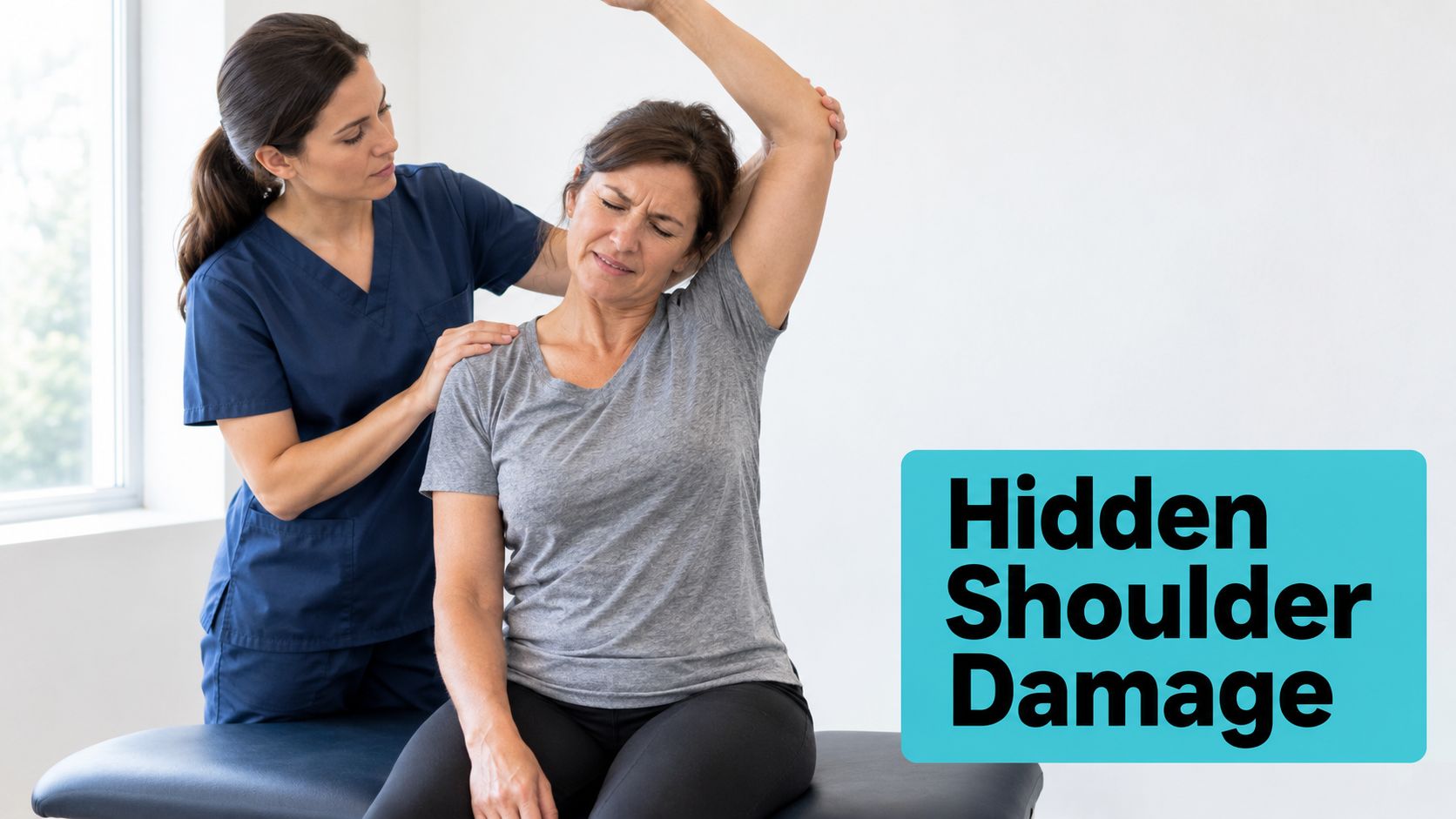
What patients often normalize
A tight band across the chest, numbness near the armpit, weakness while reaching, pain at the end of shoulder motion, or pulling when turning in bed can all affect daily function. Guarding the surgical arm may reinforce poor posture and weakness. The opposite problem is also common: pushing through pain because the incision looks healed.
Ask for an assessment if you notice:
- Persistent weakness: You cannot carry ordinary objects or use the arm at work as before.
- Movement loss: Reaching overhead, behind your back, or across your body remains restricted.
- Nerve symptoms: Numbness, tingling, burning, or altered sensation disrupts sleep or function.
- Scar restriction: Skin or tissue feels tethered during arm movement. Guidance on scar tissue after mastectomy can explain how this may limit motion.
- Activity avoidance: Fear, pain, or fatigue prevents dressing, driving, exercising, or self-care.
Rehabilitation needs are also missed at the system level. In a 2025 Quebec survey of 404 women after breast surgery, 78.4% reported rehabilitation needs, while 47.2% used rehabilitation services. Reported barriers included not knowing services existed, rehabilitation not being prescribed or recommended, and financial constraints (Quebec rehabilitation survey).
A normal-looking arm is not the same as a recovered arm. Tell your clinician what you cannot do, how long symptoms last, and which tasks you want to resume.
Returning to Exercise, Work, and the Activities You Love
A comfortable walk may be possible before you can manage a full workout. Return to activity by changing one demand at a time: duration, range, load, or speed. Adjusting several at once makes it difficult to identify what caused a flare.
Walking is often a practical starting point once your surgical team permits it. Choose a pace that allows comfortable conversation, then use the following day as feedback. If fatigue, pain, or swelling is clearly worse afterward, shorten the next session rather than stopping movement altogether.
Use function as your progression test
Driving requires enough comfortable shoulder and arm control to turn the wheel, check surroundings, and react safely. Your surgeon must also clear you, and pain medication or other treatment effects may affect alertness. Work planning should reflect your actual duties, including lifting, repetitive reaching, prolonged computer use, or unpredictable physical demands.
For gym sessions and sport, controlled movements should come before speed or heavier resistance. A therapist may progress from supported range of motion to light resistance and then to task-specific loading. The right sequence depends on the operation, reconstruction, radiation plan, symptoms, and conditioning before surgery.
Programmed exercise should wait until your surgical team considers it appropriate. Begin with supervised activity when advised, then add resistance and strengthening after the surgeon and rehabilitation clinician have assessed your healing, symptoms, and movement. The aim is measured loading, not prolonged immobilization.
Recovery also includes the activities that give your week structure. Break household tasks into shorter blocks, alternate demanding jobs with easier ones, and schedule rest before fatigue becomes overwhelming. Resume hobbies by practicing the specific movement they require, such as reaching, carrying, gripping, or sustained arm position.
Pause exercise and contact your surgical or oncology team for:
- Increasing pain instead of steady improvement.
- Rapidly expanding swelling in the arm, breast, chest, or trunk.
- Wound drainage, redness, or fever.
- New neurologic symptoms, including sudden weakness or major sensory change.
Radiation and chemotherapy can affect fatigue, skin tolerance, strength, and scheduling. Build activity around treatment and recovery days, and share your exercise plan with the clinicians coordinating your cancer care.
How to Get the Rehabilitation You Need
Recovery becomes easier to address when you describe the task you cannot do, not only the symptom you feel. At a postoperative visit, say, “I cannot raise my arm this far,” “I wake when I roll onto the surgical side,” “My hand feels heavy,” or “I need to lift equipment at work.” These examples give the team a clear reason to refer you and help a therapist set useful goals.
Start with a direct request
Ask your surgeon, oncologist, nurse navigator, or primary care clinician:
- Do I need an oncology physical therapy assessment after my surgery and node treatment?
- Should I have baseline arm or trunk measurements?
- What restrictions apply to lifting, overhead movement, driving, and exercise?
- Who should I contact if swelling, pain, drainage, or reduced motion changes?
- Can you refer me to a therapist experienced in breast cancer rehabilitation and lymphedema?
Choose a clinician who can examine shoulder motion, strength, scar mobility, posture, sensation, swelling, and the activities you need to resume. Lymphedema training matters when swelling or lymphatic risk is part of your situation. It should sit alongside functional assessment, not replace it.
As the Quebec survey showed, rehabilitation needs often go unmet. If no referral is offered, ask again and name the limitation that affects your daily life. If cost or travel makes visits difficult, ask about telehealth, community oncology programs, group education, sliding-scale care, or a home program reviewed by a qualified therapist.
Family members may need practical guidance about drains, household tasks, transportation, and appointment coordination. This guide pour proches aidants can help caregivers organize home support without placing every logistical task on the patient.
Lake City Physical Therapy provides oncology rehabilitation options that may include scar mobility, lymphatic care, shoulder and arm exercises, skin-care education, compression guidance, and return-to-activity planning. Its physical therapy after mastectomy service is one option to discuss with your medical team, alongside other qualified local or telehealth providers.
Needing rehabilitation does not mean recovery has gone badly. It is a practical response to a major operation, changing treatment demands, and the goal of returning to daily life with less pain and more confidence.
If surgery has left you with shoulder stiffness, scar restriction, swelling, weakness, or uncertainty about activity, Lake City Physical Therapy offers individualized oncology rehabilitation and lymphedema-focused care. Review available services and request support for your next recovery step.

