Deep Dyspareunia Treatment: A Step-by-Step Roadmap
The most common advice for painful sex, use more lubricant, relax, or do Kegels, can miss the central question: where does the pain start, and what brings it on? Deep pain during penetration may involve pelvic-floor muscles, but it can also signal a gynecologic, bowel, bladder, or postsurgical condition. Treatment should begin by sorting out the likely source, then address the pelvic floor and a comfortable return to intimacy when those are appropriate.
Deep dyspareunia treatment isn't one exercise program or a test of how much discomfort you can tolerate. It's a coordinated process involving you, a pelvic floor physical therapist, and, when indicated, your gynecologist. The plan should change with your symptoms and progress, not force your body to meet a calendar.
Treatment Roadmap at a Glance
The order of treatment matters more than a fixed schedule. First identify what may be driving the deep pain, then decide whether pelvic-floor therapy, gynecologic care, or both should lead. The phases below can overlap, and their pace depends on the diagnostic findings and your symptoms.
| Phase | Typical timing | Main goal | Move on when |
|---|---|---|---|
| 1. Diagnose and rule out causes | Weeks 0–4 | Clarify the likely source and arrange referrals | The pain pattern and possible causes are documented, and needed referrals are underway |
| 2. Calm pain and educate | Weeks 1–6 | Reduce guarding and understand pain responses | Pain at rest and with gentle touch is lower, and you can identify your triggers |
| 3. Retrain and release the pelvic floor | Weeks 4–12 | Improve relaxation, coordination, and tolerance | Tenderness and resting tone improve, and tampon or dilator insertion is comfortable |
| 4. Graded return to intercourse | Weeks 8–20 | Resume sexual activity at a controlled depth | You reach the agreed depth with pain at or below your agreed score across three sessions |
| 5. Maintain and reassess | Month 4 onward | Maintain gains and identify setbacks early | Scheduled reassessments show stable progress |
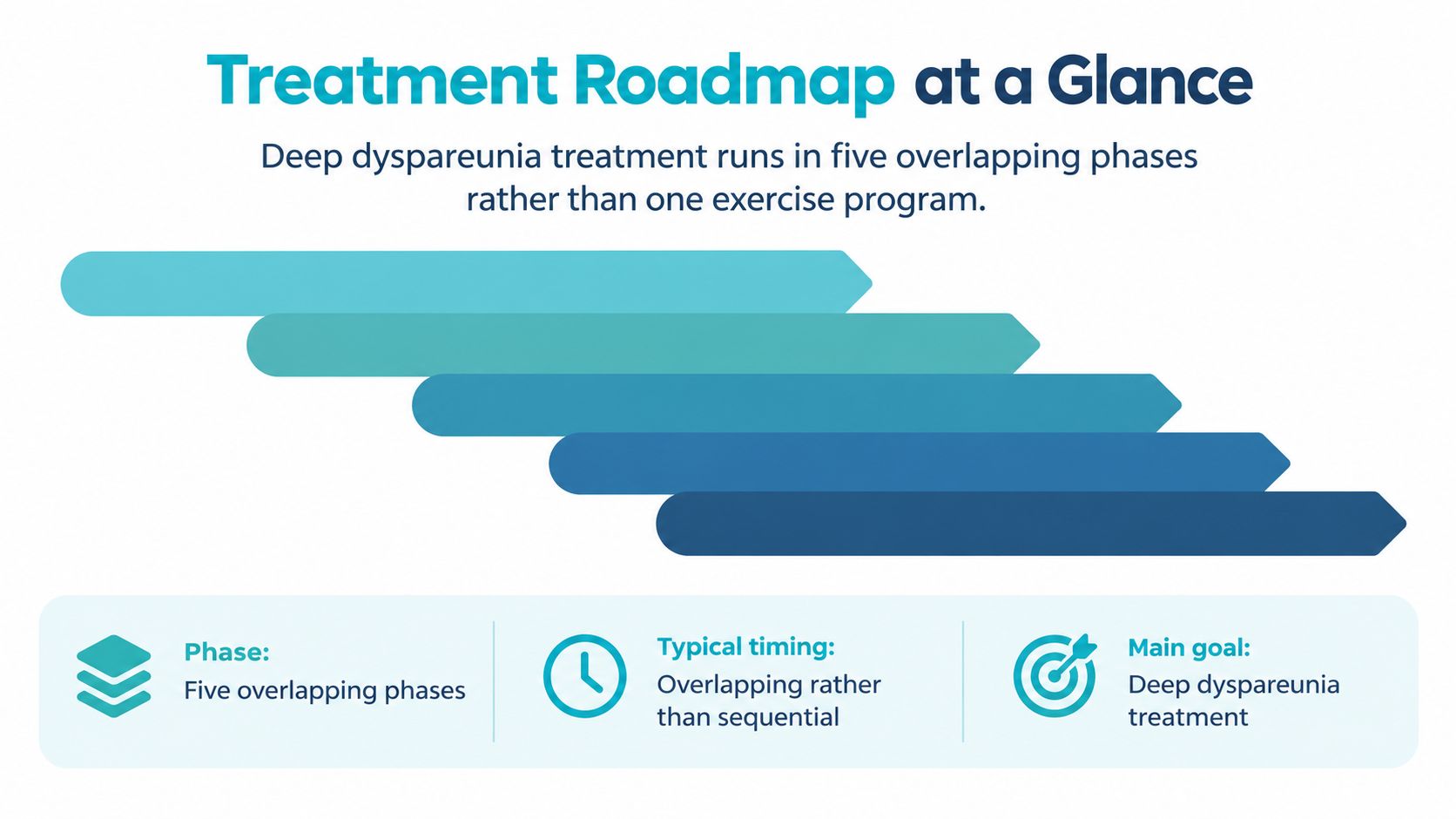
These phases are guides, not deadlines. Pain education and relaxation practice may continue while you begin non-penetrative intimacy. A randomized trial used 10 pelvic-floor therapy sessions over 10 weeks, a study schedule that does not set the required pace for every patient (trial of multimodal pelvic-floor therapy).
Use the table to track the phase you are in and the finding that would support moving on. If progress stalls, ask whether the treatment needs adjustment or the diagnostic picture needs another look. At your next appointment, agree with your therapist and gynecologist on what progress marker to review. If you remain stuck across two treatment blocks, revisit the cause assessment rather than pushing through more pain.
Sort Deep Pain Causes Before Treating the Floor
The location and trigger of deep pain help determine which pathway should lead. Deep dyspareunia means pain during deeper penetration, often felt in the pelvis or abdomen. Pain that appears at one depth or in one position may have a different explanation from pain that tracks with your cycle or bowel symptoms.
Possible causes include endometriosis, adenomyosis, fibroids, ovarian cysts, pelvic inflammatory disease, bowel or bladder disorders, prolapse, a retroverted uterus, adhesions, and changes after surgery or radiation. Major clinical sources describe these as possible contributors to painful intercourse, which is why pelvic-floor treatment shouldn't stand in for an assessment of structural, inflammatory, gynecologic, gastrointestinal, or urinary causes (Cleveland Clinic's overview of dyspareunia).
| Pain pattern | Possible source | First action |
|---|---|---|
| Changes with position, hits at a fixed depth | Mechanical contact, retroverted uterus, or cervix contact | Try positions where you control depth; request gynecology review if it persists |
| Cyclical, worse before or during periods | Endometriosis or adenomyosis | Arrange gynecology evaluation before relying on pelvic-floor work alone |
| Pain with bowel movements or urinary pain | Endometriosis, bowel disorder, or bladder disorder | Assess bowel and bladder symptoms; seek GI or urology input as needed |
| Pain after pelvic surgery or radiation | Adhesions, scar tissue, or radiation-related tissue change | Request surgical or oncology review, then consider scar and tissue mobility work |
| Persistent pain with infertility concerns | Endometriosis or adhesions | Discuss gynecology evaluation and fertility concerns |
| Pain on entry, guarding, tender floor, no structural findings | Pelvic-floor muscle overactivity | Consider pelvic-floor PT focused on down-training and manual therapy |
| Fever, discharge, or sudden severe pelvic pain | Infection, such as pelvic inflammatory disease | Seek same-day medical assessment before therapy |
For the next three weeks, keep a simple log of cycle day, sexual position, penetration depth, bowel movements, and whether pain lingers afterward. Bring it to your clinician. It can turn “sex hurts” into a clearer account of timing and triggers, helping the team decide whether to investigate a medical cause, assess the pelvic floor, or do both. For vaginal dryness that may accompany hormonal changes, this overview of understanding hot flashes and vaginal dryness may help you prepare questions about symptoms to discuss with your clinician. You can also review endometriosis and physical therapy as you consider how rehabilitation may fit alongside medical care.
Fever, unusual discharge, or sudden severe pelvic pain needs same-day medical assessment. Don't wait for a physical therapy appointment.
Manual Therapy and Pain Education Calm the Tissue
Deep pain should be located before hands-on treatment begins. If assessment links symptoms to tender, overactive pelvic-floor muscles, a therapist may use manual techniques to reduce guarding and improve tissue mobility. Options include internal or external myofascial release, Thiele massage, and trigger-point work on the levator ani or obturator internus. Abdominal or hip mobility may also be addressed when it affects pelvic movement.
Pressure or a deep ache can occur during treatment, but sharp or escalating pain is a reason to pause or change the approach. Tell the therapist where the sensation travels and whether it eases when pressure changes. This week, note which touch or movement feels tolerable, and bring questions about pelvic-floor release techniques to your appointment.
Evidence for manual therapy alone is limited, so treatment should be individualized rather than presented as a guaranteed solution. A systematic review and meta-analysis of physiotherapy for dyspareunia examined physiotherapy approaches, but its findings do not establish that one hands-on technique works for every person or cause of deep pain. Manual work may be one part of care when muscle sensitivity is involved.
Put pain sensations in context
Pain education can explain how a sensitive nervous system may interpret movement or touch as painful. That response is real, but it does not by itself identify the source of deep pain or prove new tissue damage. The aim is to understand symptom patterns and build tolerance gradually, without asking you to ignore pain. For more on approaches to chronic pain, see Be Your Best Self & Thrive insights.
A clinician can acknowledge your pain while using your symptoms to guide treatment and watching for signs that need medical investigation. Manual therapy and education may help when muscle-related pain contributes, but they cannot treat a deep lesion or replace a gynecologic workup. The location and pattern of pain still determine whether your gynecologist, pelvic-floor therapist, or both should lead care.
How to Assess and Retrain the Pelvic Floor
Deep pain does not automatically mean the pelvic floor is the source. Its depth, position, and triggers help determine whether the pelvic floor therapist, gynecologist, or both should guide care. A pelvic-floor assessment can identify muscle tenderness and coordination problems, but it does not replace a medical workup for other causes.
-
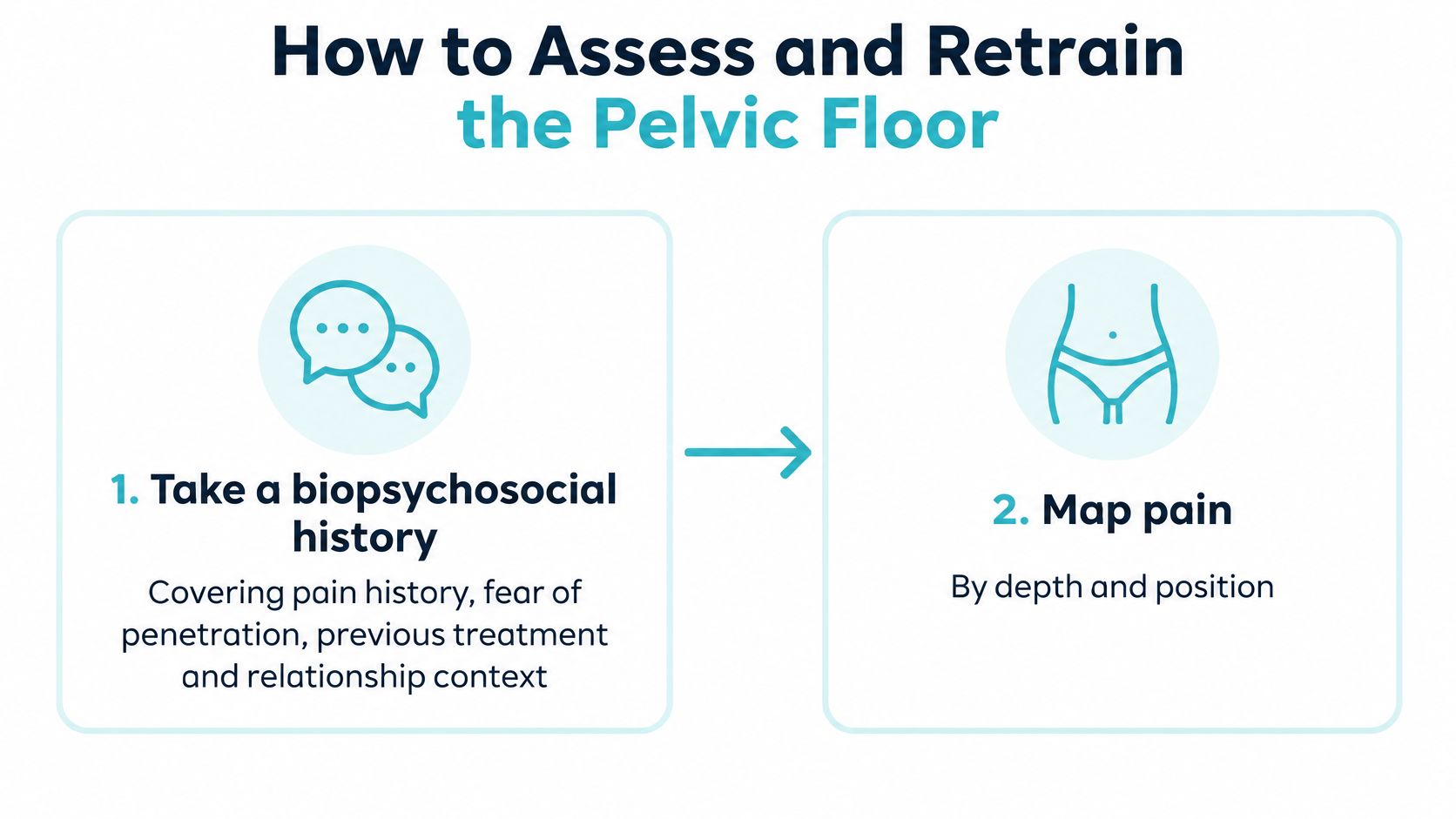
Start with your history. Discuss when the pain began, how it feels, what treatment you have tried, and whether fear of penetration affects you. Share relationship context only if you are comfortable. These details help the therapist understand how symptoms affect daily life and intimacy. You should feel heard, not rushed into an examination.
-
Map pain by depth and position. Explain which positions and penetration depths trigger symptoms, and whether the pain is sharp, aching, or pressure-like. Your therapist may record a 0-to-10 pain score to compare symptoms over time. Correct the record if it does not reflect your experience.
-
Assess the pelvic floor. With your consent, the therapist may check tenderness, trigger points, resting tone, coordination, and your ability to release the muscles on cue. Tell the therapist if pressure becomes sharp or hard to tolerate. A muscle examination cannot rule out conditions such as endometriosis, so discuss concerning symptoms with your gynecologist.
-
Learn pain-free breathing and down-training. Practice breathing that allows your abdomen and pelvic floor to soften instead of brace. The exercise should feel manageable and should not reproduce your pain.
-
Add therapist-directed myofascial work. If the assessment supports it, your therapist may use manual techniques on specific tender areas. Describe what you feel, and ask for lighter pressure or a pause if symptoms increase.
-
Practice coordination and movement. Once you can release the muscles more comfortably, practice contracting and letting go in sequence. Then apply that control to movements such as standing from a chair or squatting. The goal is coordinated muscle response, not constant clenching.
-
Consider patient-controlled exposure. When appropriate, discuss whether a dilator or gradual penetration practice fits your symptoms and medical picture. Keep control of the pace and stop if pain rises beyond the agreed comfort range.
A randomized trial evaluated a program combining electrotherapy, manual therapy, and pelvic-floor exercises over 10 sessions in 10 weeks. The reported results favored treatment over a wait-list control for pain, pelvic-floor strength, endurance, and sexual function. The findings come from one trial, and its sexual-function result should not be treated as a predictable outcome. A broader review found no significant pooled benefit for sexual function, so track your own symptoms and function rather than expecting one specific result.
A common pitfall: Repeated Kegels can aggravate symptoms when deep pain is linked to guarding or high resting tone. In that case, prioritize release and coordination before adding strengthening.
Track pain, function, quality of life, and sexual function, not strength alone. Lake City Physical Therapy provides pelvic-floor therapy for painful sex, with evaluation and individualized care that may include education, relaxation, manual therapy, and graded movement.
Graded Exposure and Sex While Treatment Works
Deep pain is not a cue to push harder or to avoid all intimacy indefinitely. First, use the pain's depth, position, and pattern to guide the medical workup: pelvic-floor treatment may help with muscle guarding, but it does not rule out gynecologic causes or replace assessment by a gynecologist. Once you and your clinicians have agreed on a safe approach, graded exposure can help you test manageable activities without treating pain as something to overcome.

Set a stopping rule with your clinician before trying an activity. One example is to keep discomfort around 3 out of 10 or lower, but the right ceiling depends on your symptoms and medical picture. Advance only when the current stage stays manageable; if pain rises or lingers, stop and return to an earlier stage.
| Stage | Activity | Who controls depth | Stop rule |
|---|---|---|---|
| 1. Non-penetrative intimacy | Touch, massage, and mutual pleasure without deep contact | Both, with pace set by you | Stop if pain rises above the agreed ceiling |
| 2. Shallow insertion | Tampon or finger to the first comfortable point, for 1–2 minutes | You | Pain stays at or below the ceiling after 10 minutes |
| 3. Low-depth dilator | Smallest dilator, inserted only to the first comfortable point | You | Pain stays at or below the ceiling for three consecutive sessions |
| 4. Target-depth dilator | Dilator advanced to the depth where deep pain is triggered | You | Pain doesn't climb across three sessions |
| 5. Position-controlled intercourse | Shallow angles, partner paces, you set depth | You | Stop before pain escalates; step back a rung if it recurs |
| 6. Full return | Usual positions, with lubrication as needed | Shared | Review with your clinician if deep pain returns |
During partnered sex, choose a position that lets you control depth. A pillow may change the angle. Agree on a clear signal to pause, and stop before pain escalates. Non-penetrative intimacy can be a satisfying goal in its own right while treatment continues.
Lubricant can reduce friction, and a vaginal moisturizer may help with dryness. These options may be relevant during menopause, breastfeeding, or cancer-related hormonal suppression. If tissue changes may be contributing, ask your clinician whether local hormonal treatment is appropriate. Research on exercise, education, and manual therapy for endometriosis-associated dyspareunia remains limited, so findings from pilot research should not yet be generalized (pilot trial information).
Choose the next step by consent and comfort, not pressure. You can pause, change the activity, or return to an earlier rung at any time.
The video below offers another way to reflect on shared comfort and communication while you decide what feels manageable.
Coordinate Gynecology, Sex Therapy and Your Team
Deep pain that changes with the menstrual cycle, comes with bowel symptoms, or is getting worse deserves medical attention alongside pelvic-floor care. Endometriosis is estimated to affect approximately 18% of reproductive-aged women, 31% of women evaluated for infertility, and 42% of women with chronic pelvic pain. These figures describe endometriosis prevalence in those populations, not the prevalence of deep dyspareunia, and they support careful evaluation when symptoms suggest overlapping causes (Merck Manual's endometriosis overview).
A good handoff includes a specific question, so each clinician knows what you need help deciding:
- Gynecologist: Can you assess whether my symptoms suggest endometriosis or another pelvic condition, and discuss medical, surgical, and fertility considerations with me?
- Pelvic-floor physical therapist: Can you assess muscle tone, tenderness, tissue mobility, and a safe progression toward my activity goals?
- Sex therapist: Can you help us work through anxiety, arousal, avoidance, or communication changes linked to painful sex? A guide to somatic sex therapy may help you decide what questions to raise. For background on desire and intimacy, ProMD Health Bel Air's libido guide is another resource to consider.
- GI or urology clinician: Could bowel or bladder symptoms be contributing to the pain?
- Pain specialist or oncology team: How should persistent pain after surgery or cancer treatment be assessed and managed?
Medical and surgical decisions depend on the findings, symptom burden, fertility goals, and your preferences. Bring a symptom log, painful positions, and a list of previous treatments and what happened. The more specific your question, the more useful the referral conversation.
Reassess Each Block and Know When to Escalate
Deep pain calls for more than a change in pelvic-floor tenderness. After each treatment block, compare the same measures to see whether the symptoms that matter to you have changed:
- Pain score: Record pain at a consistent depth or in a specific position.
- Penetration trigger: Note the position, depth, or movement that brings on pain.
- Sexual function: Complete a questionnaire selected with your clinician.
- Your goal: Track what you want to do more comfortably, such as insertion, intimacy, or intercourse.
Improvement near the vaginal entrance does not confirm that deep pain has resolved. In a randomized trial of women with deep infiltrating endometriosis, pelvic-floor physiotherapy did not produce a statistically significant between-group difference in deep dyspareunia (P = 0.07) (trial in deep infiltrating endometriosis). This finding is a reason to track deep pain directly, not to assume pelvic-floor care will address every cause.
Ask your gynecologist for a renewed assessment if pain stays deep, becomes progressive or cyclical, or occurs with bleeding, bowel or bladder symptoms, or infertility concerns. Pelvic-floor treatment can address muscle-related contributors, but it does not replace medical evaluation. Lake City Physical Therapy provides individualized pelvic-floor care for painful sex, which may include assessment, education, manual techniques, and gradual return to comfortable activity.
This week, record your baseline pain score and the position that triggers it. Book a pelvic-floor PT evaluation, and contact your gynecologist if any of the symptoms above apply. You can contact Lake City Physical Therapy to ask about pelvic-floor care for painful sex.

