Constipation Breast Feeding: Relief for Mom & Baby
You're standing by the crib at 2 a.m., watching your baby strain, and your own body still feels sore, swollen, and unpredictable. Maybe you're wondering if your breastfed baby is constipated, maybe you're dreading your first painful bowel movement after birth, or maybe both are happening at once. That mix of baby worry and postpartum discomfort is common, and it deserves clear guidance, not guesswork.
For a reliable newborn-minded perspective, the Curated guide for new parents can be a helpful companion when you're trying to sort through all the conflicting advice. On the recovery side, post-birth rehab guidance can also help you understand why your body may not be moving the way it used to.
Navigating Postpartum and Newborn Normals
A newborn can have a wide range of bowel patterns, and a mother recovering from birth can have a wide range of bowel symptoms at the same time. One diaper may leave you reassured, while your own body still feels sore, tight, and hesitant to empty.
That is where constipation breast feeding gets confusing. Breast milk is usually easy for a baby to digest, stool timing can vary a lot, and a breastfed baby may go from several stools a day to a longer pause without anything being wrong. At the same time, a mother may be dealing with stitches, swelling, a guarded pelvic floor, iron supplements, or a gut that has slowed down because she has not been moving, eating, or drinking enough.
The primary task is to separate normal variation from true constipation in both bodies. In babies, stool texture and comfort matter more than the clock, while in mothers the problem is often mechanical, involving pain, pressure, and pelvic floor coordination.
If you want a calm, practical place to start, the Curated guide for new parents can help you sort through early recovery questions without adding more noise. For a closer look at why your body may feel off after birth, post-birth rehab guidance explains the ways recovery can change movement, pressure, and bowel function.
Decoding Your Breastfed Baby's Bowel Habits
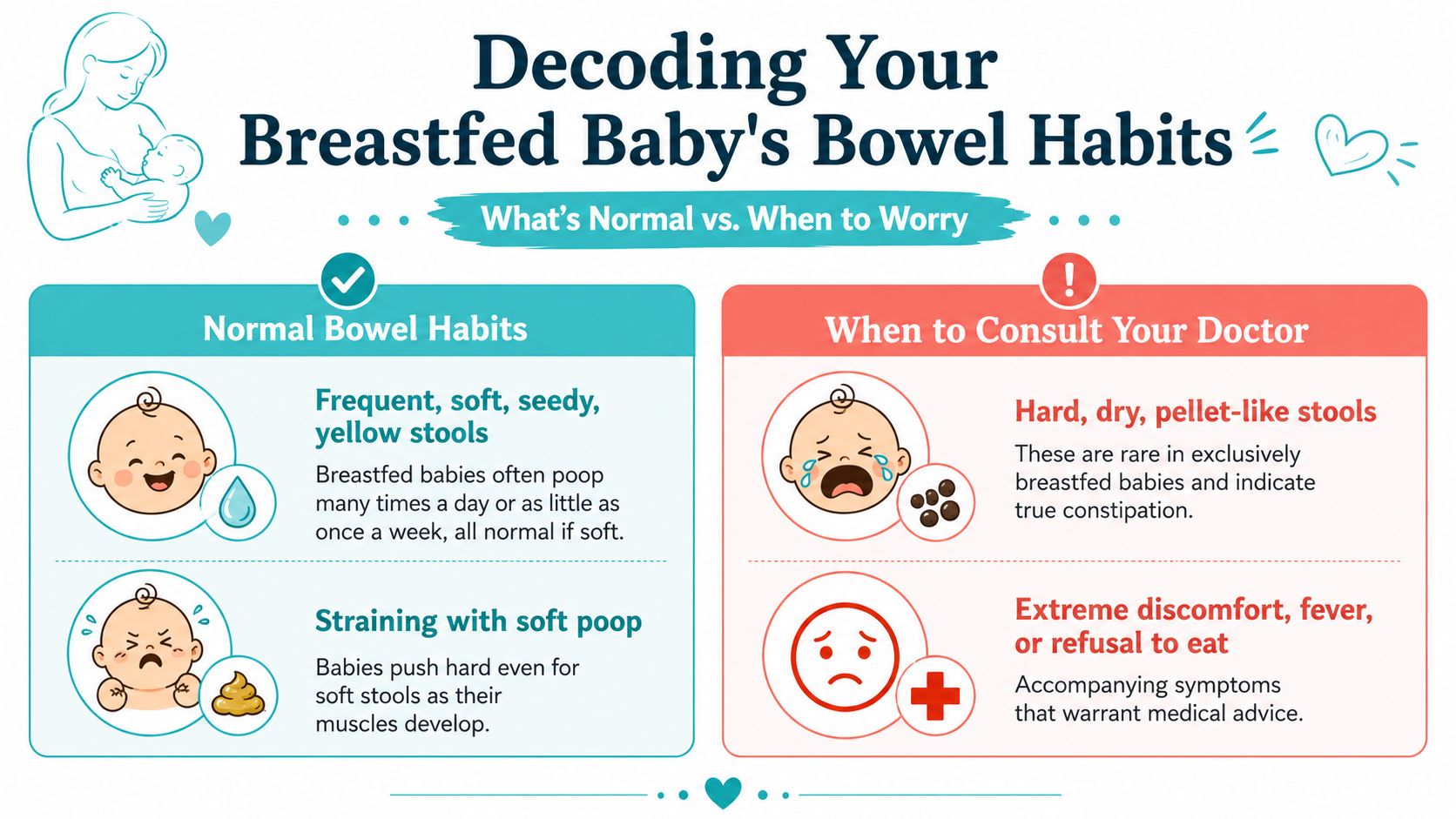
Breastfed babies can have wildly different stool schedules and still be normal. Some poop several times a day. Some go days between bowel movements. That gap alone doesn't mean constipation, especially if the stool stays soft and the baby is feeding well.
The key distinction is frequency versus consistency. True constipation is about hard, difficult-to-pass stools, not merely how long it's been since the last diaper change. In early days, infrequent stools can also signal that a baby isn't getting enough milk, so the feeding picture matters too, not just the diaper timeline.
What normal often looks like
Normal breastfed stool is usually soft and easy to pass. Parents often describe it as loose, seedy, or similar to mustard or peanut butter. Straining can still happen even when the stool is soft, because babies are learning how to coordinate their abdominal and pelvic muscles.
Practical rule: if the stool is soft, the baby is feeding normally, and there's no distress, the pattern is often within the range of normal.
The gut of a breastfed infant is still developing, and breast milk is generally easier to digest than formula. That's one reason constipation is described as uncommon in exclusively breastfed babies. When stool patterns shift, it's worth asking whether feeding has changed recently, especially if formula or solids have entered the picture.
What needs medical attention
Hard, dry, pellet-like stools are not a normal breastfed pattern. Neither are signs of significant distress, fever, or refusal to eat. If your baby seems uncomfortable every time they try to pass stool, or if they're suddenly going much longer without output and also acting unwell, it's time to call the pediatrician.
A useful rule is simple. Watch the stool texture, the baby's feeding, and the overall mood. If you're seeing soft stool and a generally content baby, you're usually looking at normal variation. If you're seeing hard stool or a baby who seems sick, that's different.
Why Postpartum Constipation Affects Breastfeeding Moms
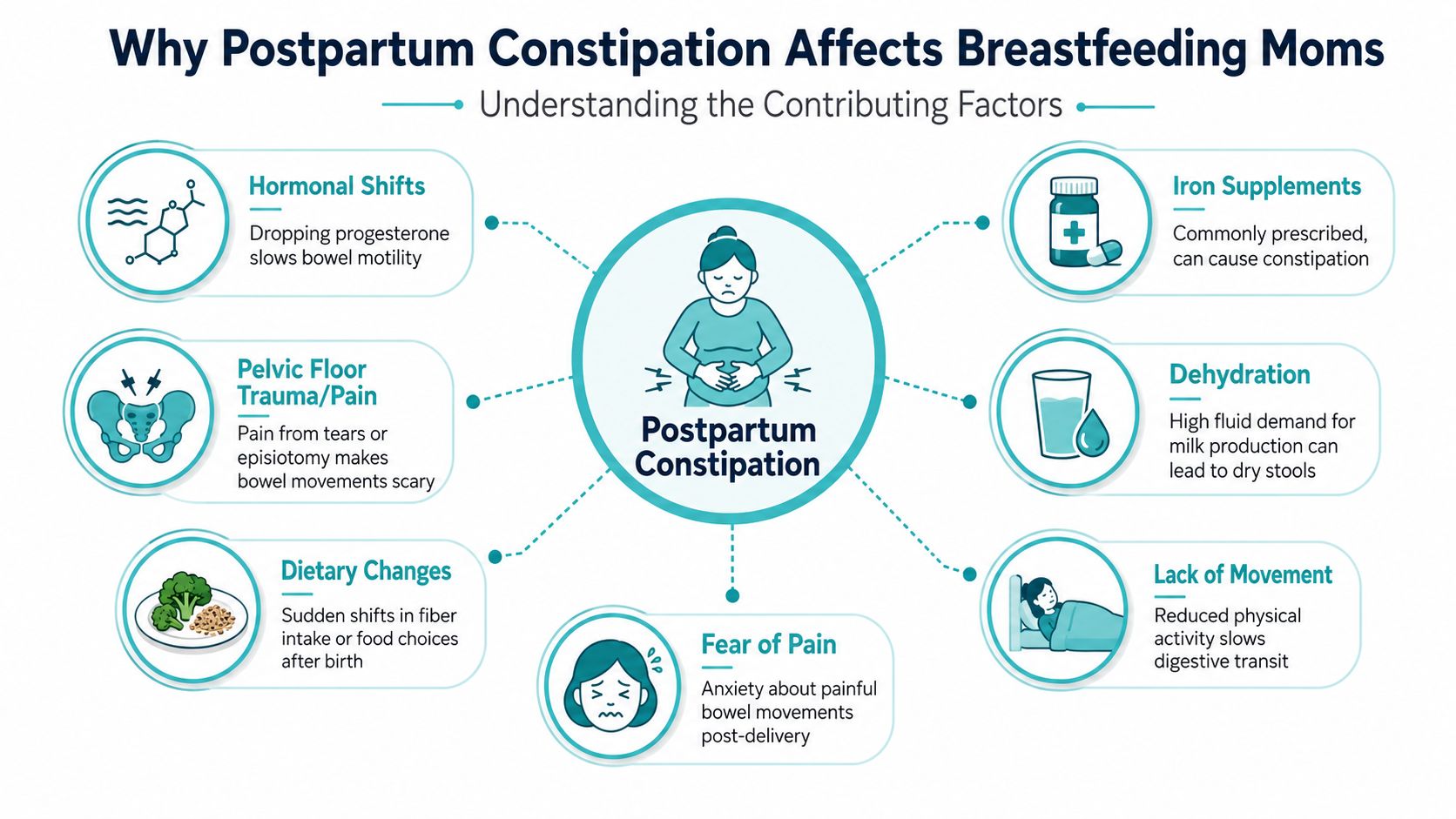
The mother's side of constipation breast feeding is often the harder part to see, and often the harder part to live with. Birth recovery can change bowel function in several ways at once, and those changes usually do not improve with “just drink more water.”
The body reasons it happens
Pressure and healing are the first factors. After a vaginal birth, soreness, stitches, swelling, or a torn perineum can make the first bowel movement feel scary. After a C-section, abdominal pain and guarding can make it hard to relax enough to pass stool comfortably.
Hormonal shifts can also slow bowel movement, and breastfeeding adds more fluid demand on top of that. Many new mothers also leave the hospital with iron supplements, and some need opioid pain medication after delivery. Both can make constipation worse.
Fear changes the pattern too. When a bowel movement hurts, many women start holding it in. That withholding can set up a cycle of harder stool, more pain, and more tension in the pelvic floor.
If you want a practical look at how rehab is approached, Lake City Physical Therapy's postpartum pelvic floor care shows why bowel symptoms are often tied to muscle function, not just food choices.
Why your baby and your body can move in opposite directions
Breast milk can support a baby's gut while the mother's body is struggling. A large cohort study of over 77,000 children found that longer and more exclusive breastfeeding was linked with lower risk of functional constipation by age 3. That highlights how breast milk protects the baby even while the mother may be dealing with constipation herself.
Your baby's digestion can be going well while your own pelvic floor, hydration, and bowel timing are off. That mismatch is common after birth.
If constipation started after delivery, especially after a painful first bowel movement, do not assume it is just a food problem. The mechanics of recovery matter.
A note on practical postpartum support
When you are sorting through postpartum supplies and recovery advice, Hiccapop's guide to new mom recovery can help you think more broadly about comfort, positioning, and healing. The same caution applies to generic wellness advice about addressing digestive discomfort. Postpartum constipation needs a more targeted plan than broad tips, because the pelvic floor, pain level, and bathroom habits all affect how easily stool can move.
Safe and Effective Relief Strategies While Breastfeeding
Postpartum constipation is often a systems problem. Stool may be dry, the pelvic floor may be guarding, pain may make you avoid the toilet, and the new rhythm of feeding and sleep can make bathroom timing harder to notice. The goal is to soften stool, reduce strain, and make bowel movements feel less threatening.
Start with the postpartum triad
Three common factors worsen constipation after birth, low fluid intake, low fiber intake, and reduced mobility. Breastfeeding can increase hydration needs, yet many mothers still fall short because they are busy, sore, or tied to a baby for long stretches.
Practical habits usually work better than aiming for perfect routines. Keep water where you feed. Add fiber in forms you can tolerate, like oatmeal, pears, prunes, beans, chia, or cooked vegetables. Walk around the house or take a gentle stroll when you are able.
Practical rule: if your stool is hard enough that you are bracing before you even sit down, diet alone usually is not enough.
For many breastfeeding mothers, that means laxatives may be part of the plan. Guidance recognizes that diet and hydration alone are often insufficient, especially when pelvic pain or fear of defecation is present, as noted in the NHS breastfeeding constipation guidance.
Safe constipation aids for breastfeeding mothers
| Medication Type | Examples | Breastfeeding Safety | How It Works |
|---|---|---|---|
| Osmotic laxative | Polyethylene glycol (PEG 17 g once or twice daily) | Considered a first-line choice because it has minimal systemic absorption and is unlikely to transfer into breast milk, according to lactation-oriented guidance | Draws water into the bowel to soften stool |
| Stimulant laxative | Bisacodyl | Often reserved for second-line use when needed, based on the same lactation guidance | Stimulates bowel movement |
| Stool-softening support | Docusate | Commonly used postpartum, though results can be modest | Helps stool absorb more water and pass more easily |
If you want a calmer way to sort through options, a clinician who understands postpartum bowel patterns can help you avoid trial-and-error. A brief check with Lake City Physical Therapy can also be useful when the problem feels more muscular than digestive.
What to skip or use carefully
Do not assume that more prunes and more water will solve everything. They can help, but they are not always enough when pain, immobility, or muscle guarding is driving the problem. If an over-the-counter product makes cramping worse, or if you still cannot pass stool despite softening efforts, the plan needs to change.
Addressing digestive discomfort may sound simple online, but postpartum constipation often needs a more targeted approach. The right next step depends on whether the main issue is stool consistency, pelvic floor tension, or both.
The Pelvic Floor Connection to Postpartum Constipation
The pelvic floor is not just a support structure. It also has to relax at the right time for a bowel movement to happen. After pregnancy and birth, that timing can get disrupted.

When those muscles stay tight, sore, or uncoordinated, stool may sit at the outlet and feel like it won't move even when the bowel itself is trying to do its job. That's one reason postpartum constipation can feel different from ordinary “backed up” constipation. The problem may be at the exit, not just in the gut.
When the muscles are part of the problem
Some women start with protective tension after birth. That can happen after tearing, stitches, hemorrhoids, a C-section, or a painful first bowel movement. The body learns that pooping hurts, then tightens in anticipation, which makes the next attempt harder.
A pelvic floor physical therapist looks at how you breathe, bear down, brace, and relax. That matters because a bowel movement is supposed to involve coordinated pressure, not a forceful all-around squeeze. If the pelvic floor contracts instead of releasing, stool passage gets blocked.
This pattern is often called dyssynergic defecation. In plain language, the body is trying to go, but the muscles are sending the wrong message.
Why therapy can change the equation
Pelvic floor PT is useful when constipation is tangled up with pain, guarding, or a sense of blockage. Treatment may include breathing strategies, bowel mechanics, posture changes, pelvic floor down-training, and graded return to normal toileting without panic. A skilled clinician can also help if you're clenching because you're scared of pain.
For a focused explanation of that approach, pelvic floor therapy for constipation is worth reviewing. The point isn't to strain harder. It's to restore the coordination that lets the bowel and pelvic floor work together.
If your symptoms feel mechanical, not just dietary, that's a clue. Hard stools are one issue. A pelvic floor that won't let go is another. Many postpartum mothers have both.
When to Seek Professional Help for You or Your Baby
For your baby, call the pediatrician if constipation signs come with hard pellet-like stool, clear distress, fever, refusal to feed, or a pattern that feels off even after you've checked feeding. If the stool is soft and the baby is otherwise well, that often points to normal variation instead of true constipation.
For you, call your OB-GYN or primary care clinician if constipation is persistent, painful, or associated with bleeding, severe abdominal pain, or worsening symptoms despite basic self-care and a compatible laxative plan. If the problem started after a tear, C-section, or a painful first bowel movement and you feel a blockage, pelvic floor assessment makes sense.
Good threshold: if bathroom trips are making you anxious, bracing, or avoiding the urge to go, don't wait for it to become your new normal.
The broader takeaway is simple. Postpartum guidance is increasingly acknowledging that diet and hydration alone are often insufficient, and compatible laxatives are a real part of care, especially when pain or fear of defecation is involved, as reflected in the NHS breastfeeding constipation guidance. If your symptoms point to pelvic floor dysfunction, schedule an evaluation with Lake City Physical Therapy and ask for postpartum pelvic floor support so you can get a plan that matches what your body is doing.