How to Reduce Scar Tissue After Surgery Safely
You're home from surgery, the dressing is off, and the incision looks nothing like the smooth skin you had before. It may feel numb in one spot, tight when you stand, itchy at the edges, or strangely stuck when you reach, walk, roll in bed, or lift your arm. The natural question is, how do you reduce scar tissue after surgery without irritating the repair?
The answer isn't to rub harder or start as soon as possible. Effective scar care follows a sequence: protect the wound, confirm that healing is complete, begin gentle skin mobility, add silicone or taping when appropriate, restore movement around the area, and involve a clinician when the scar is painful, raised, tethered, or interfering with function. Massage can help, but it isn't a guaranteed way to prevent deep abdominal adhesions or correct every type of abnormal scar.
Why Scar Tissue Forms and Why Active Management Matters
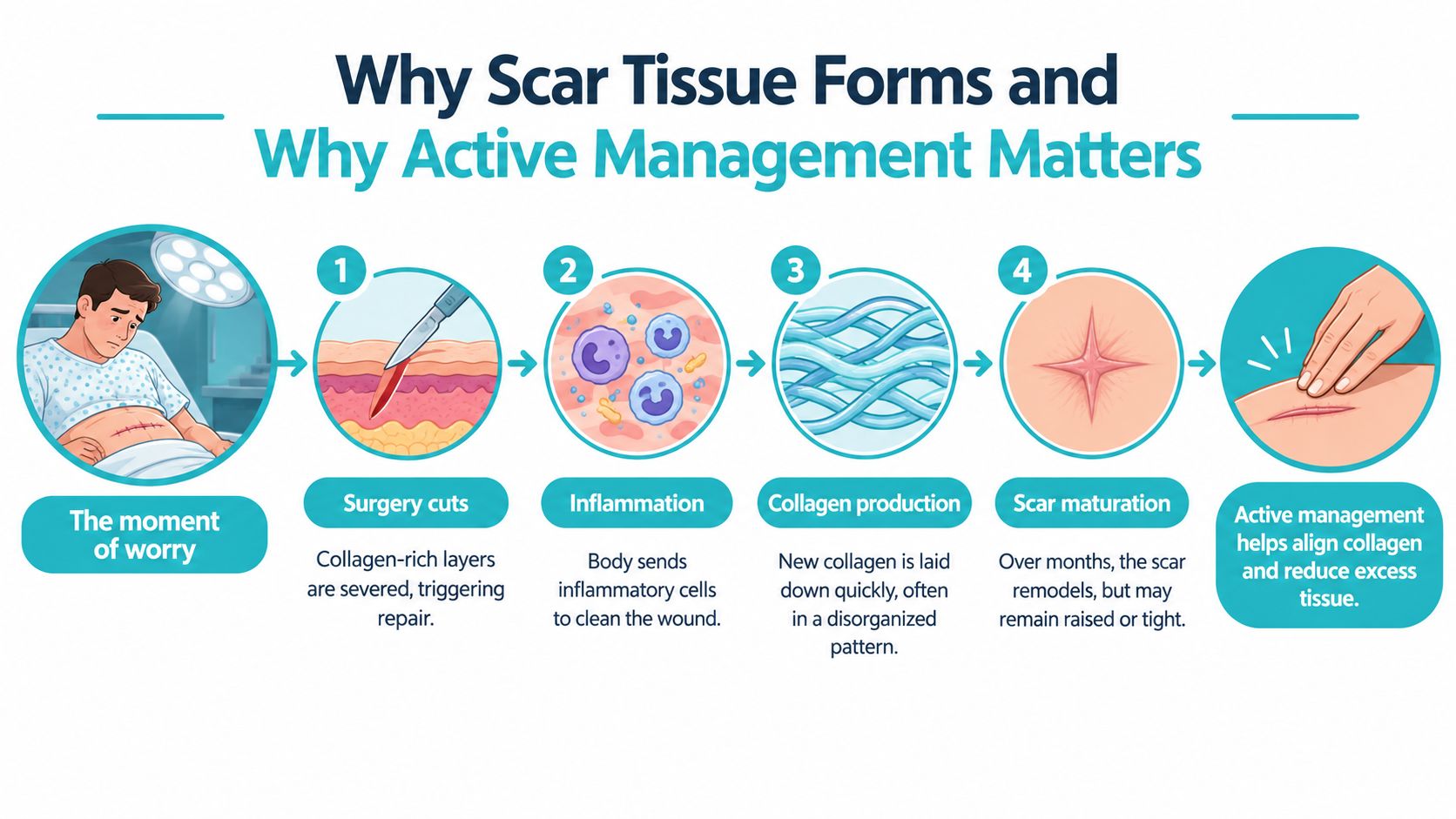
Under the hospital lights, many patients look at a fresh incision and wonder whether it will ever feel like their body again. The visible line is only the surface. Surgery also disrupts collagen-rich skin, fascia, muscle, and connective-tissue layers, so the body quickly builds a temporary repair scaffold.
Healing unfolds through hemostasis, inflammation, proliferation, and remodeling. Early clotting protects the wound, inflammatory cells clear damaged material, and proliferating cells produce new collagen. During remodeling, collagen fibers reorganize and strengthen. If the layers don't glide well, the resulting tissue may feel firm, raised, tight, numb, itchy, or attached to deeper structures.
Practical rule: Waiting is appropriate while the incision is open. Once the wound is fully closed and your surgical team has cleared you, controlled movement becomes more useful than passive waiting.
The reason this matter extends beyond appearance. A review reports that pathologic adhesions develop after 95% of all operations, and that 35% of patients are readmitted within 10 years after pelvic or abdominal surgery for a disorder directly or potentially related to adhesions. The same review estimates more than USD 2.5 billion in annual U.S. healthcare spending for adhesion-related problems, along with nearly 1 million additional inpatient days each year. The review of postsurgical adhesions explains why pelvic, abdominal, gynecologic, and cesarean recovery deserves more than cosmetic scar advice.
The practical window for influencing surface mobility is the remodeling period, particularly once the incision has closed and symptoms are stable. For procedure-specific guidance, 3D Aesthetics Leamington Spa scar advice offers another perspective on scar prevention and care. Women recovering from cesarean birth can also review cesarean scar treatment guidance before building a self-care routine.
Safety First, When It Is Safe to Start Scar Work
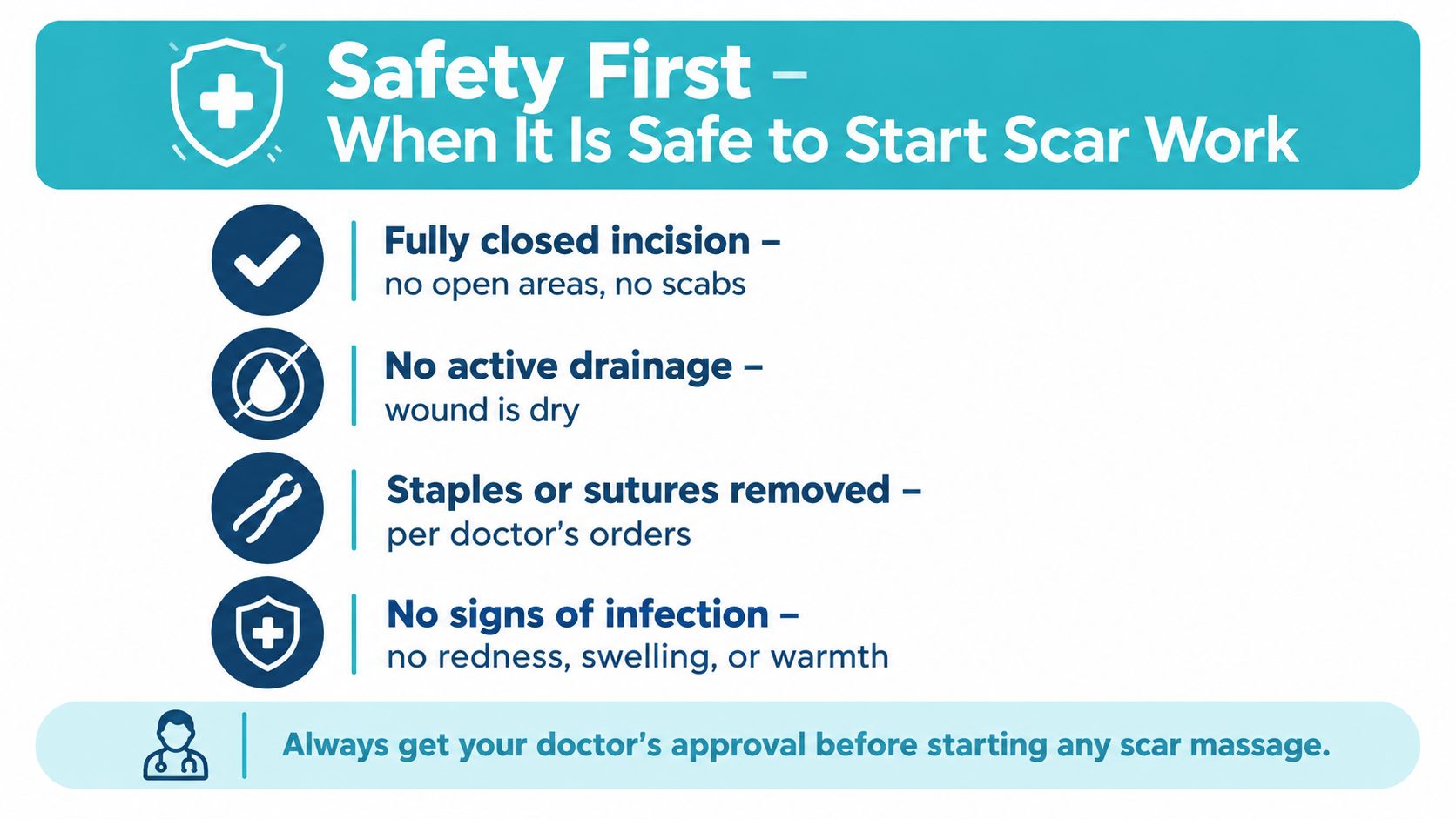
Direct scar manipulation begins only when the incision has passed several clinical checkpoints. A typical uncomplicated closure may be ready for gentle contact after two to three weeks, but abdominal, joint, oncologic, or complicated procedures may need longer. Your surgeon's instructions take priority over any general timeline.
Before touching the scar, confirm all of the following:
- The incision is fully closed: There are no open areas, raw edges, or scabs that could be disturbed.
- The skin is dry: There's no active drainage, bleeding, or fluid leaking from the incision.
- Closure material has been managed: Staples or sutures have been removed according to your surgeon's plan.
- The area looks settled: There's no spreading redness, unusual warmth, increasing swelling, foul odor, or worsening tenderness.
- Your medical team agrees: Clearance matters most after infection, wound separation, delayed healing, reconstruction, or cancer surgery.
Mild itching, mild tightness, and altered sensation can occur during ordinary healing. Burning, throbbing, escalating pain, or pain caused by very light touch deserves more caution. Scar work should create a tolerable stretch or pressure, never sharp, electric, or radiating pain.
Stop and contact your surgeon or wound-care provider if the wound edges separate, redness expands, drainage changes, swelling appears suddenly, or you develop a fever. Don't apply creams, silicone, tape, or deep pressure to an open wound. The 2022 systematic review of postoperative scar massage found that research on massage remains limited and inconsistent, so timing and patient selection matter as much as technique.
Scar Massage Techniques You Can Start at Home
Once your incision is completely healed and you've been cleared, start with the skin around the scar rather than pressing directly into the line. Clean your hands, choose a comfortable position, and use a small amount of plain moisturizer or silicone-based gel to reduce drag. Vitamin E oil is sometimes used, but it isn't a scar-removal treatment, and any product that causes redness or itching should be stopped.
Start with superficial movement
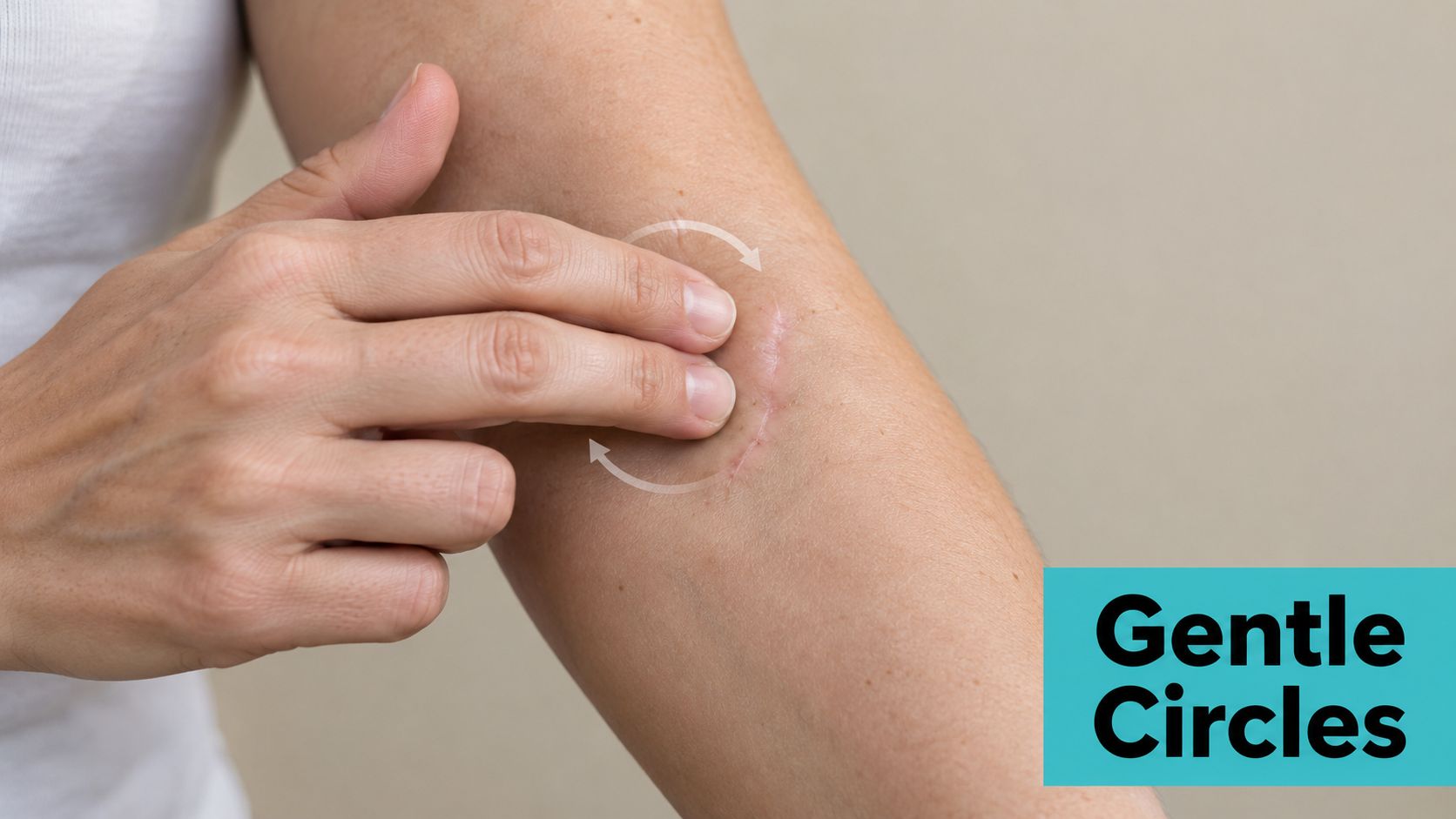
Use the pads of two or three fingers to make small, stationary circles beside the incision. Keep the movement slow and let the skin shift under your fingers. After that feels comfortable, place your fingers over the healed line and repeat the circles with light pressure.
A useful pressure guide is blanching. Press firmly enough that the skin or nail bed becomes slightly lighter, but not enough to bruise, swell, or remain sore afterward. Begin with five minutes twice daily, then work toward 10 minutes if the skin responds calmly.
Add directional strokes
Stroke along the length of the scar, then move across it from one side to the other. Linear strokes encourage you to notice whether one segment feels more restricted, while perpendicular strokes challenge the tissue in a different direction. Don't scrape over the skin. Your fingers should move the tissue, not irritate it.
When the scar becomes less sensitive, gently lift and roll a small fold of skin between your thumb and forefinger. If the tissue won't lift or feels anchored, that's useful information, not a reason to force it. Add a nearby joint movement, such as bending the knee, extending the hip, reaching the arm, or rotating the trunk, while maintaining light contact.
Keep a brief journal after each session. Record tenderness, pulling, skin color, swelling, and the movement that feels limited. The aim is gradual improvement from week to week, not a dramatic change after one massage.
For cesarean recovery, this guide to C-section scar massage can help you understand how healed abdominal tissue may be assessed and mobilized.
Silicone Sheets, Gels, and Tapes Compared
Silicone products work through hydration and occlusion, and they're more appropriate for a healed incision than for an open wound. The format you choose should match the scar's shape, location, skin sensitivity, and how consistently you can use it.
Sheets suit a flat scar that doesn't move much. They provide a continuous barrier and can stay in place for extended wear, but they need clean, dry skin and regular washing. Hair, sweat, joint movement, and friction from clothing can make adherence frustrating.
Gels are easier on curved or visible areas, including the face, around joints, or along irregular contours. They dry as a thin film and don't require the same physical attachment as a sheet, but they need repeated application and may rub off with clothing or exercise.
Medical tape can provide light tension offloading when the scar sits under pull, such as over the knee, shoulder, sternum, or abdomen. It's not a substitute for wound closure or professional assessment. Some people develop adhesive irritation, so test a small area and remove the tape if the skin becomes persistently red or itchy.
| Format | Best For | Wear Time | Key Trade-off |
|---|---|---|---|
| Silicone sheets | Flat, low-mobility scars | Guidance commonly supports at least 4 hours daily, with ideal use extending to 12 to 24 hours | Consistent coverage, but adherence and washing can be inconvenient |
| Silicone gel | Curved, visible, or mobile areas | Reapply according to product instructions | Discreet and flexible, but less convenient during sweating or frequent washing |
| Medical tape | Scars under tension or with mild pulling | Replace according to skin tolerance and product instructions | Adds mechanical offloading, but may irritate sensitive skin |
Wound-care and NHS-linked guidance commonly recommends silicone for at least two to three months, and some guidance notes meaningful improvement when worn for at least four hours per day, with ideal use reaching 12 to 24 hours daily. Another NHS leaflet says silicone gel sheets can last about five to 10 days when cared for properly and used only on completely healed skin. The systematic review of physical scar treatments supports treating scar care as a weeks-to-months process, not a quick fix.
Stretching and Mobility Work Around the Scar
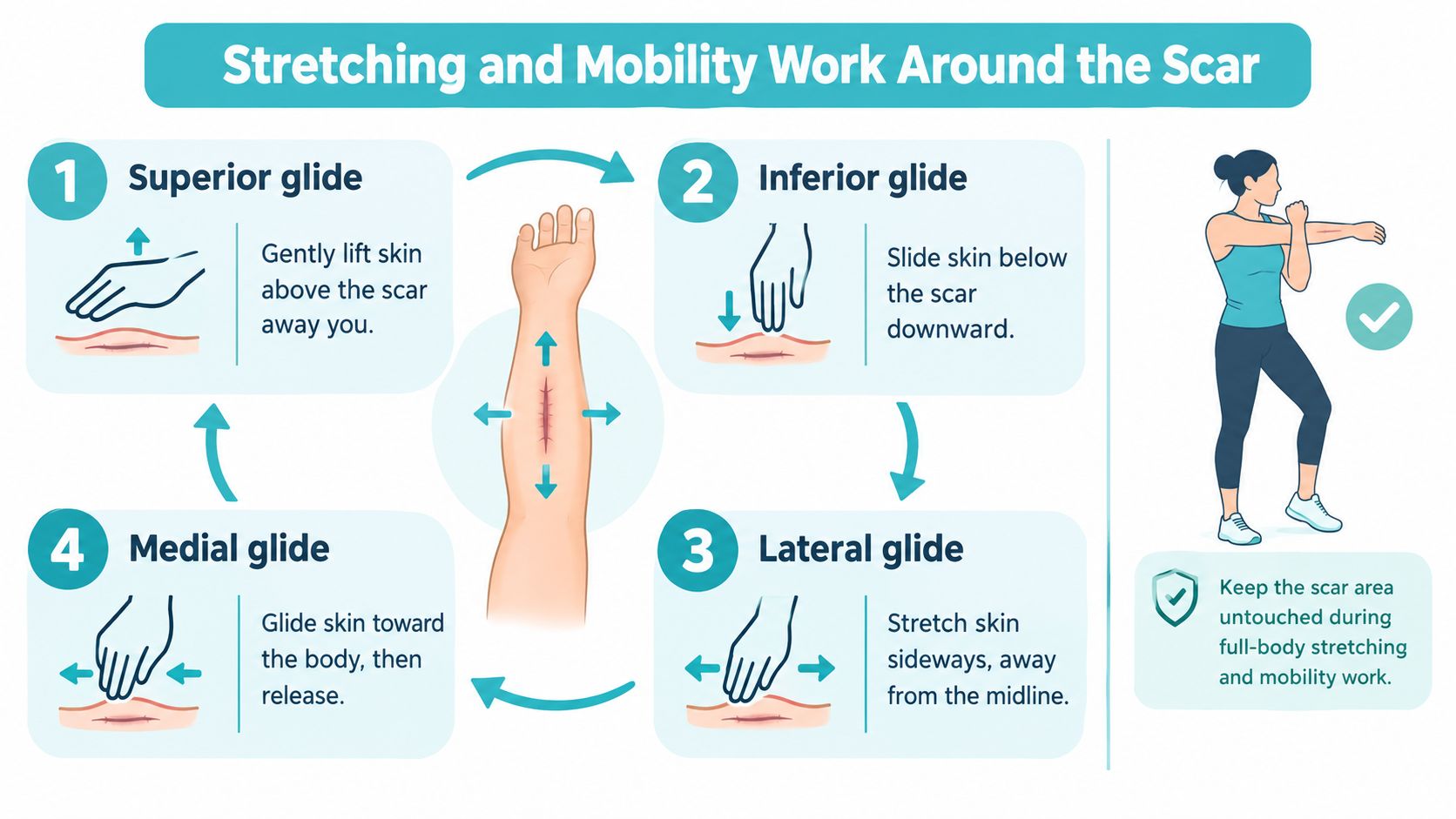
Massage changes how the skin moves. Mobility work teaches that skin and the deeper tissues to move with the rest of your body. Work around the scar first, especially after abdominal, breast, pelvic, orthopedic, or neck surgery, and follow procedure-specific restrictions before stretching.
Start with clean hands and a comfortable position. Place your fingers above the scar and gently glide the skin upward, then repeat below the scar with a downward glide. Add side-to-side and diagonal directions. The motion should be small and controlled, with the skin moving under your fingers while the scar itself remains comfortable.
Build three-dimensional motion gradually
Once the skin slides in several directions, try small circular lifts. Pick up a fold of tissue, lift it slightly, and release. This isn't a forceful pinch. You're checking whether the superficial layers can separate and glide.
Use breathing to reduce guarding. Inhale gently through the nose, then make the glide during a slow exhale. Hold a comfortable stretch for 30 to 60 seconds, without bouncing or holding your breath.
The muscle group you address depends on the operation:
- After breast or cardiac surgery: A gentle pectoral stretch may help restore chest and shoulder movement, but protect the sternum and follow surgical restrictions.
- After abdominal or lower-body surgery: Gradual quadriceps, hip, or hamstring lengthening can reduce the tendency to brace around the incision.
- After thyroid or shoulder procedures: Comfortable cervical rotation and shoulder motion can help the neck and upper shoulder region move without substituting by hiking the shoulder.
Notice the quality of movement: The scar should travel with the skin. If the skin moves while the scar stays tethered, reduce the range and seek an assessment if that pattern persists.
A flexible 10-minute routine can look like this: two minutes of relaxed breathing and body scanning, three minutes of gentle scar massage, two minutes of directional skin glides, two minutes of procedure-approved stretching, and one minute of an easy functional movement such as walking, reaching, or turning. Massage comes first, stretching second, and functional movement last.
When to Bring in a Physical Therapist for Manual Therapy
Home care has a ceiling. You can improve superficial glide and sensitivity, but you can't reliably determine whether a restriction sits in the skin, fascia, muscle, nerve pathway, or deeper abdominal tissue by looking at the scar alone.
A physical therapist evaluates the scar while you move. They may compare skin glide in several directions, assess nearby joints and muscles, check breathing or abdominal pressure strategies, and identify compensations such as shoulder hiking, breath holding, pelvic guarding, or avoiding one side of the body.
What professional treatment can add
A clinician may use carefully graded manual mobilization, cross-fiber work, desensitization, or myofascial techniques. Instrument-assisted soft-tissue methods, cupping, or myofascial decompression may be considered when the therapist believes they fit the tissue response. Modalities such as low-level laser therapy, ultrasound, or shockwave aren't automatic choices. Their usefulness depends on the scar type, healing status, symptoms, and the clinician's assessment.
Book an evaluation when a healed scar remains tethered, painful, hypersensitive, puckered, or connected to a movement restriction. For uncomplicated healing, an assessment during the early remodeling period can prevent you from spending months repeating a routine that isn't addressing the actual limitation. After orthopedic, reconstructive, or oncologic surgery, earlier coordination may be appropriate because the surgical repair may have specific loading rules.
A first visit usually includes your surgical history, wound-healing timeline, symptom review, scar and movement assessment, hands-on treatment if appropriate, and a home program. The therapist may track range of motion, tenderness, sensitivity, functional tasks, or the distance a scar can glide. Those measures turn “it feels stuck” into something you can monitor.
Patients after breast surgery often need more than scar pressure. Post-mastectomy scar tissue treatment may include scar mobility, desensitization, shoulder movement, chest-wall mobility, and lymphedema-related assessment when clinically indicated. Choose a therapist who routinely treats post-surgical scars and understands your procedure, rather than assuming every massage provider has the same training.
Warning Signs, Specialist Referrals, and Your 90-Day Plan
Scar care should make the area more comfortable and functional over time. It shouldn't create a cycle of irritation, swelling, and increasingly aggressive treatment. Use two separate decisions: Is the wound safe? and Is progress occurring?
Stop self-care and contact your medical team
Pause massage, silicone, tape, and stretching if you notice:
- Spreading redness: Redness that extends beyond the incision or continues to expand needs medical review.
- Increasing warmth or swelling: New heat, swelling, or a sudden change is different from stable postoperative tightness.
- Drainage or odor: Foul-smelling drainage, pus-like fluid, or renewed bleeding requires prompt contact.
- Fever or systemic illness: Call your surgeon or urgent medical service according to the severity of your symptoms.
- Wound separation: Don't try to tape or massage separated edges closed.
- Escalating pain: Pain that increases instead of gradually settling deserves assessment.
- New numbness or color change: A pale, blue, cold, or newly numb limb is not a routine scar symptom and may require urgent care.
Deep abdominal adhesions deserve particular caution. Manual work may improve surface mobility or symptoms, but it can't guarantee prevention or removal of internal adhesions. A 2024 systematic review found that intraoperative adhesion-prevention agents, including bioresorbable membranes and barrier solutions, can reduce the incidence and severity of postoperative adhesions. The review of adhesion-prevention agents supports discussing internal adhesion risk with the surgical team rather than relying on self-massage alone.
Recognize stalled progress
A physical therapist is the more appropriate next step when the wound is healed but:
- the scar remains raised, puckered, or increasingly firm beyond eight weeks,
- the skin feels tethered to deeper tissue,
- range of motion remains restricted after two weeks of consistent, gentle home work,
- light touch causes marked hypersensitivity,
- the scar catches, pulls, or causes a repeated movement compensation,
- pain persists around the scar without a clear improvement trend.
A raised scar that grows beyond the original incision, or one that becomes intensely itchy and firm, may need dermatology or surgical review rather than more friction. People prone to abnormal scarring may need silicone, pressure, injections, laser treatment, or another targeted approach selected by a qualified clinician.
Use this 90-day framework
Early healing, before direct scar work: Follow the surgeon's wound instructions, protect the incision, manage swelling as directed, and perform only the movement your procedure allows. Success means a closed, dry wound without worsening redness, drainage, or pain.
After clearance and complete closure: Begin superficial contact around the scar, then gentle direct massage if the skin remains calm. Use short sessions, observe the next-day response, and add silicone when appropriate. Success means less sensitivity, easier skin glide, or improved comfort during a specific daily movement.
The following remodeling period: Add directional glides, comfortable stretching, and functional movement. Consider a physical therapy assessment if the scar still feels anchored or your movement has plateaued. Success means the scar moves with the surrounding skin and the related joint, trunk, chest, or pelvic region functions more normally.
By the final checkpoint: Don't judge progress only by color or appearance. A scar can remain visible while becoming softer, less painful, less sensitive, and less restrictive. If those changes aren't happening, escalate rather than increasing pressure.
The right provider depends on the problem. Contact the surgeon for wound separation, infection concerns, new drainage, or unexpected swelling. A dermatologist can assess abnormal raised scarring and recommend medical scar treatments. An occupational or physical therapist can address mobility, tethering, desensitization, and functional restrictions. A pain specialist may help when burning, electric, or persistent nerve symptoms continue after the wound has healed.
Lake City Physical Therapy provides individualized post-surgical rehabilitation that can include scar mobilization, desensitization, breathing retraining, pelvic and abdominal recovery, and oncology-focused mobility care. Visit Lake City Physical Therapy to explore care options and schedule an evaluation for a scar that remains painful, restricted, or difficult to manage on your own.