Recovery from Endometriosis Excision Surgery Plan
Recovery from endometriosis excision surgery happens in stages over weeks to months, usually faster after laparoscopy than open abdominal surgery, and isn't a single return-to-normal date. A closed incision doesn't mean your pelvic tissues, bladder, bowel, and exercise tolerance have all recovered together.
The popular advice to rest until the wounds heal, then resume normal life, misses the hardest part: rebuilding function without repeatedly provoking symptoms. A useful plan tracks what you can do comfortably, how you feel afterward, and which symptoms need medical review rather than more exercise.
Week by Week Recovery Timeline After Excision
Recovery depends on both the surgical approach and what the operation involved. Laparoscopic excision uses small abdominal incisions; open surgery uses a larger incision and often calls for a slower progression. The European Society of Human Reproduction and Embryology patient guideline on endometriosis describes keyhole surgery as the preferred approach when appropriate, citing less postoperative pain, a shorter hospital stay, faster recovery, and smaller scars.
Recovery phases after endometriosis excision
| Phase | Time window | What usually changes | Activity to stay within |
|---|---|---|---|
| Immediate | Surgery and initial discharge period | Gas discomfort, incision soreness, anesthesia-related drowsiness | Short supervised walks; no driving while impaired or taking opioids |
| Early home | Initial home recovery | Bowel sluggishness, fatigue, gradually easing incision pain | Brief walks separated by rest; follow the written lifting restriction |
| Tissue settling | Early weeks | Energy returns unevenly while internal healing continues | Light desk tasks if comfortable; avoid abdominal loading, running, and penetration until cleared |
| Scar and walk build | After wound closure and surgical review | Skin healing becomes less limiting; deeper tissues remain sensitive | Longer comfortable walks; scar work only after clearance |
| Rehab phase | After permission for targeted rehabilitation | Guarding, endurance, and coordination may limit progress | Individualized pelvic-floor, hip, and core work |
| Function phase | Subsequent months | Bowel, bladder, sex, and sport symptoms may continue changing | Increase load only when symptoms remain stable afterward |
Treat these as decision stages, not automatic clearance dates. Excision involving the bowel, bladder, or ovary may require restrictions that the skin incisions alone do not reveal.
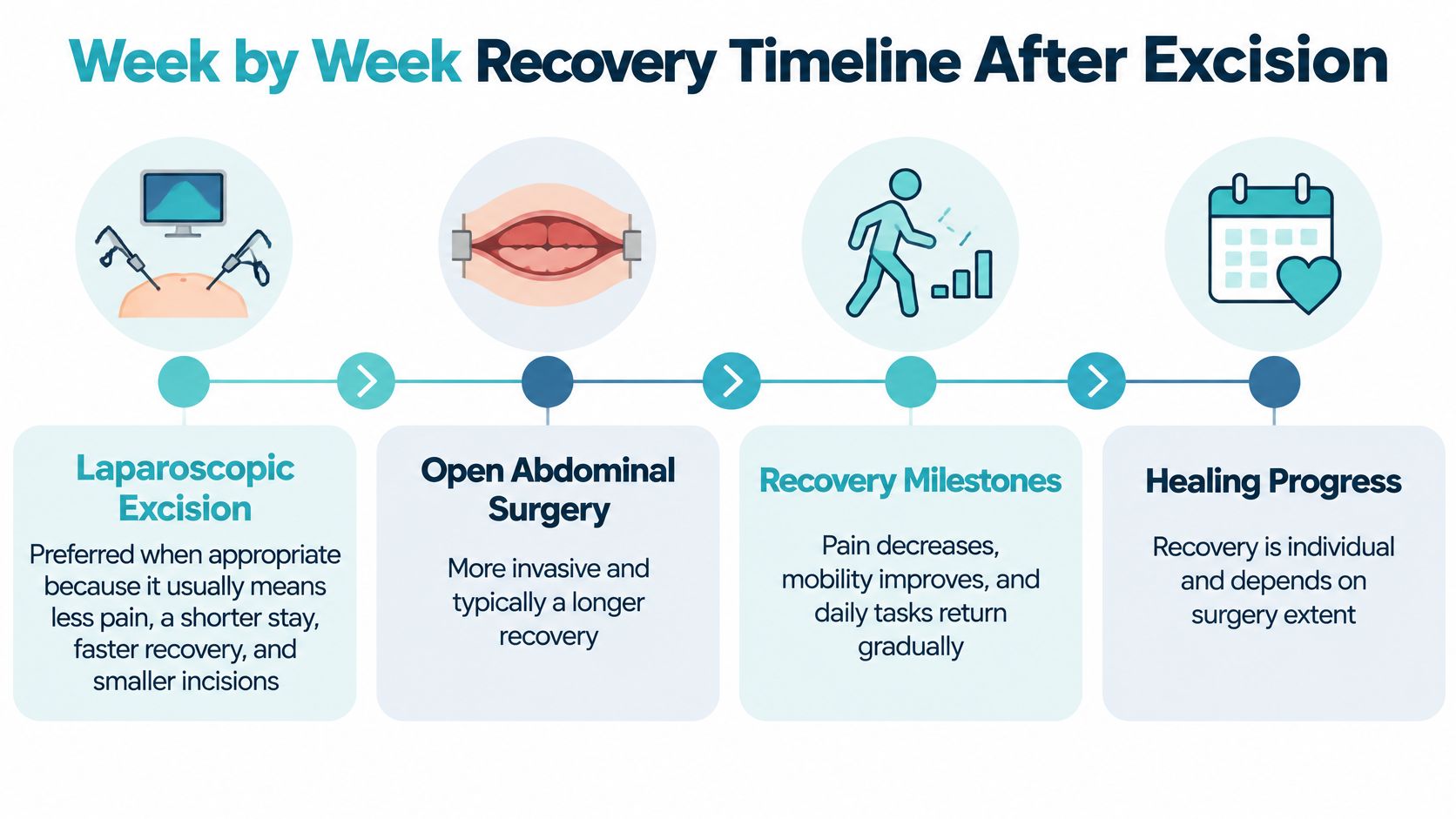
Match progress to the operation
Before discharge, ask what was removed, whether an organ was repaired, and which restrictions protect that repair. Laparoscopic describes how surgeons reached the abdomen, not the extent of the work inside it.
A prospective case series indexed on PubMed reported that all 15 women resumed daily activities within 3 days after laparoscopic excision using ultrasonic surgical aspiration. That result came from a small study of a specific technique, so it is not a target for recovery after deep bowel, bladder, or ovarian excision.
Track function rather than appearance
Pay attention to practical changes: getting out of bed without marked bracing, eating comfortably, passing urine without difficulty, and walking without a prolonged symptom flare. Incisions can look tidy while fatigue still limits activity.
For further context on endometriosis-focused rehabilitation, see Lake City Physical Therapy's endometriosis physical therapy information. General practical recovery guidance for active adults can help with everyday routines, but your surgical team's restrictions take priority.
Choose the stage that reflects the operation and your current function, not the fastest published recovery.
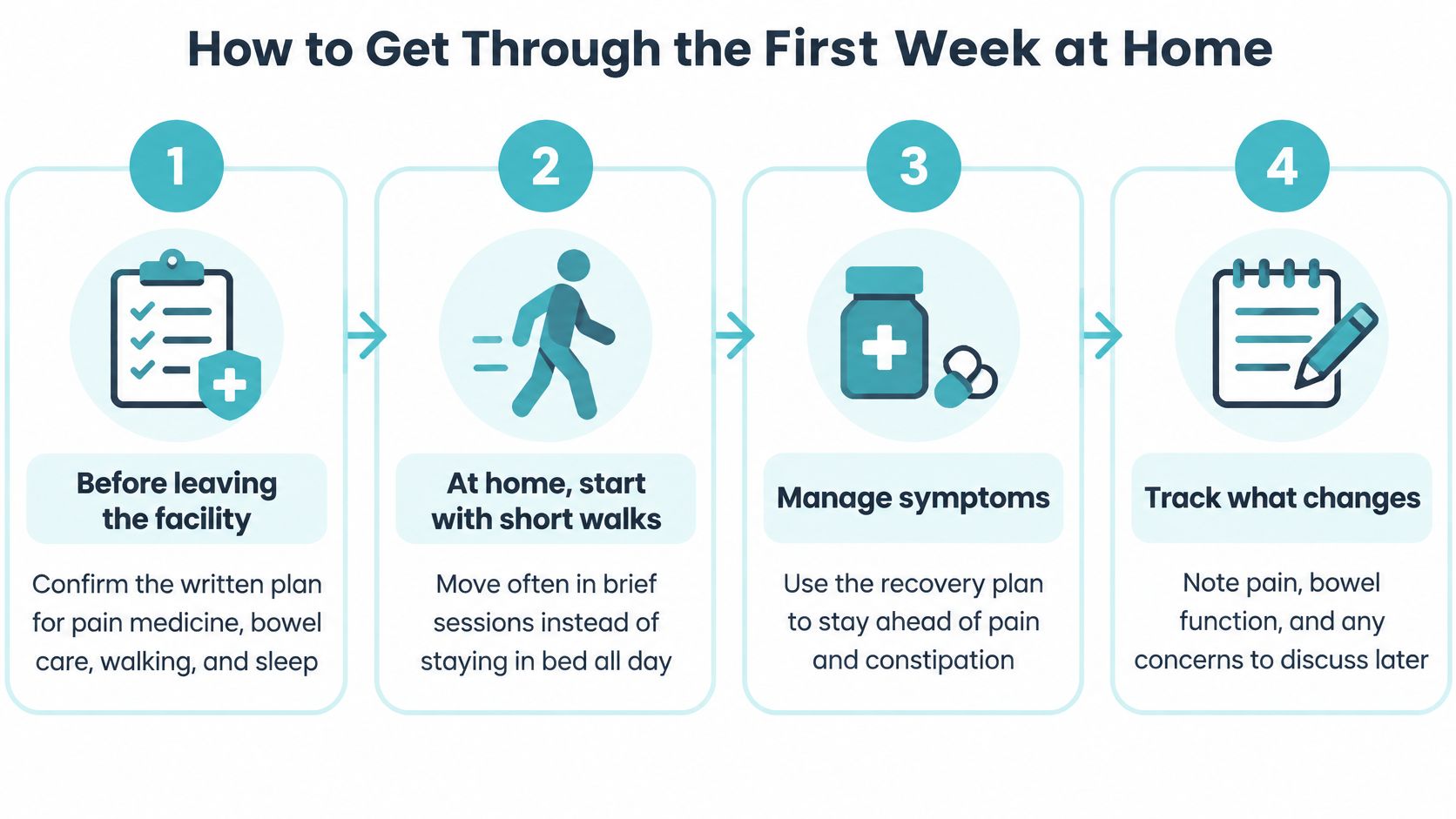
How to Get Through the First Week at Home
The first week is a sequence of eating, moving, managing symptoms, and resting. It isn't a bed-rest prescription or a test of how quickly you can stop needing help.
An enhanced-recovery review available through the National Library of Medicine supports individualized planning, multimodal opioid-sparing pain relief, early oral intake, mobilization, and graded activity. Bowel or bladder procedures may change the details, so your discharge instructions take priority.
Follow the home sequence
-
Confirm the written plan before leaving. Check pain medicine, bowel medicine, lifting restrictions, showering instructions, and the surgical team's contact number. Ask whom to call outside office hours.
-
Take prescribed medicines as directed. Use enough pain control to sleep and move, rather than waiting until discomfort becomes overwhelming. Ask the prescriber how to reduce short-term opioids; don't abruptly stop medication you've used regularly without a plan.
-
Restart drinks and food as permitted. Begin with what you tolerate and progress toward ordinary meals unless your team has prescribed a modified diet. Don't start a bowel cleanse at home because you feel bloated.
-
Move briefly and regularly while awake. Start with the bathroom or a short indoor route. Walking supports circulation and helps avoid spending the entire day in a guarded, curled position.
-
Support coughing and protect the wounds. Hold a pillow lightly against your abdomen when coughing or changing position. Follow the discharge sheet for dressings, washing, and drying rather than adding antiseptics or creams yourself.
-
Use the prescribed bowel regimen. Drink regularly unless you've been given fluid restrictions, and take the recommended stool softener or laxative. Straining through pain isn't a useful recovery exercise.
-
Set up supported rest. Try lying on your back with your knees supported or on your side with a pillow between your knees. Don't drive while taking opioids or until you can turn, concentrate, and brake safely.
-
Keep a brief symptom log. Note pain location, temperature, urine, bowel movements, and medication use. A clear trend is more useful at follow-up than trying to remember whether yesterday felt better.
The infographic offers a compact reminder of those priorities.
Make rest easier without becoming immobile
If you already use a powered recliner, DME Superstore explains how to adjust your lift chair settings. Choose a position that lets you breathe comfortably and stand safely, rather than staying reclined all day.
A cohort study in the National Library of Medicine found that 16 of 19 patients who regularly used pain medication before surgery, or 84.2%, stopped afterward. That supports reviewing medication needs as recovery progresses, not promising an immediate taper.
A manageable home day includes brief walks, tolerable meals, softer pain, and bowel function moving forward without vomiting. If that pattern is deteriorating, contact the surgical team.
Pain Medicine Incisions and Scar Mobility
Pain after surgery has different sources, and treating every sensation with the same response rarely works well. Identify the location and trigger before deciding whether you need medicine, movement, rest, or medical advice.
This image illustrates abdominal discomfort, but the location alone doesn't establish its cause.

Separate the pain sources
- Incision pain is usually local and may feel sharp when clothing rubs, you cough, or you change position. Loose clothing and supported transfers reduce unnecessary irritation.
- Laparoscopic gas discomfort can sit beneath the ribs or refer into the shoulder because the gas used during surgery irritates the diaphragm. Gentle walking and comfortable positioning may help.
- Deep pelvic aching can follow extensive tissue treatment. Record whether it follows activity, urination, bowel movements, or prolonged sitting so the team can assess the pattern.
Use acetaminophen or an anti-inflammatory only if your surgical team has approved it. Check combination products carefully because an opioid prescription may already contain acetaminophen.
Keep a written medication schedule and ask which medicine to reduce first. If pain is preventing basic walking or sleep despite the prescribed plan, contact the prescriber rather than adding doses yourself.
Protect skin before treating scars
Laparoscopic ports may be small, but don't judge internal healing by their appearance. Shower only when permitted, pat the area dry, and leave surgical glue or strips alone unless instructed otherwise.
Avoid soaking, swimming, and scrubbing until the team confirms the wounds are ready. Spreading redness, drainage, wound opening, or fever belong in a medical assessment, not a scar-massage session.
Once the skin is fully intact and your surgeon agrees, begin with gentle contact. Place your fingertips beside the scar and glide the skin up, down, and sideways without dragging across a scab.
If a healed scar feels tethered, a therapist may teach a light pinch-and-lift. Stop for sharpness, increasing tenderness, or symptoms that linger afterward; aggressive scraping isn't necessary.
The following video can supplement discussion with your therapist, but it doesn't override postoperative restrictions.
Guidance on scar tissue pain can help you distinguish local sensitivity from movement restriction. Neither requires forcing the tissue until it hurts.
After ovarian endometrioma excision, also discuss ovarian reserve and reproductive planning with the surgical team. Scar treatment addresses comfort and mobility, not ovarian function.
At follow-up, check for intact skin, an improving pain trend, and no new fever. Those findings matter more than how flat or pale the scar looks.
Pelvic Floor Rehab When Pain Is Still There
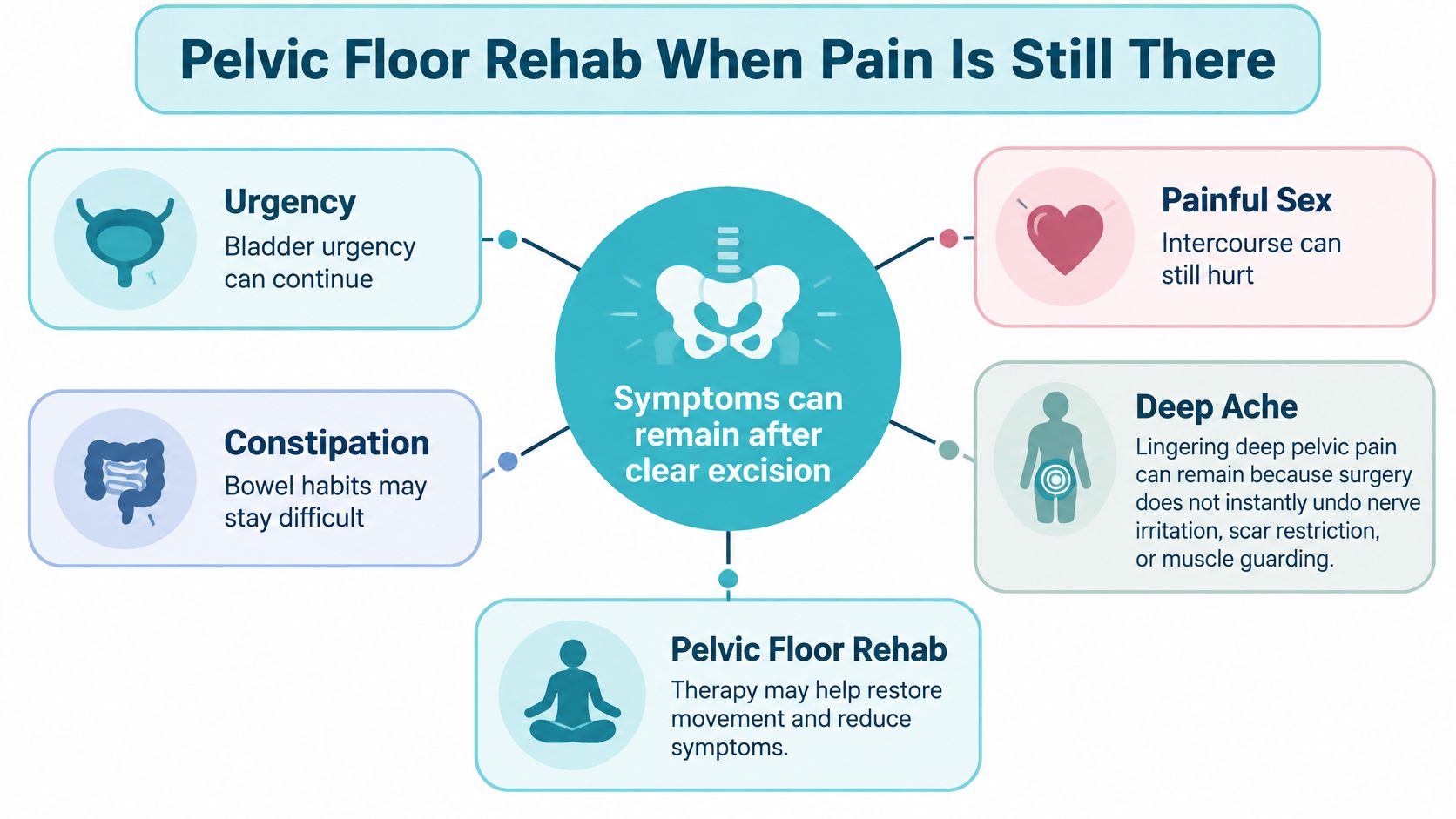
Why can urgency, constipation, painful sex, or a deep ache remain after visible lesions have been removed? Surgery doesn't instantly reverse nerve irritation, restricted tissue movement, or protective muscle guarding.
Don't start repeated Kegels because your pelvis feels different. A muscle that's already holding tension may need help releasing before it needs strengthening.
A report on urinary-tract endometriosis surgery indexed on PubMed found that storage symptoms improved, yet up to 50% of patients continued to experience voiding dysfunction; the authors identified possible contributions from neural injury, fibrosis, and pelvic-floor hypertonicity. That finding concerns urinary-tract surgery specifically, but it illustrates why persistent symptoms don't automatically mean failed excision.
Overactivity and weakness need different treatment
An overactive pelvic floor may have difficulty lengthening during urination, bowel movements, an examination, or penetration. You might notice hesitancy, incomplete emptying, painful sex, or a sense that you can't unclench.
Weakness may contribute to leakage or heaviness, but symptoms alone don't establish muscle strength. A person can have a tense pelvic floor that also produces a poorly coordinated contraction.
| Pattern | Useful assessment question | Initial treatment direction |
|---|---|---|
| Guarding or overactivity | Can the muscles release without pain or bearing down? | Breathing, supported positions, down-training |
| Reduced strength or endurance | Can the muscles contract and then fully relax? | Graded strengthening when appropriate |
| Mixed symptoms | Does loading provoke pain, leakage, or pressure? | Coordination before heavier exercise |
Repeated squeezing can aggravate guarding, particularly when you hold your breath or brace your abdomen with every contraction. An assessment should determine what the muscles can do.
The symptom map below shows why rehabilitation needs to consider more than incision healing.
Begin with release and coordination
After surgeon clearance, use a gentle starting sequence:
- Breathe without pushing. Lie comfortably with your knees supported. Let your lower ribs and abdomen expand on the inhale, allowing the pelvic floor to soften rather than deliberately bear down.
- Support your feet on the toilet. Use a stable footstool if comfortable, lean slightly forward, and exhale instead of straining. Don't hover above the seat.
- Restore easy movement. Add comfortable hip and trunk motion within your restrictions. Reduce the range if you feel pulling through the wounds or a deep symptom spike.
- Delay strengthening until assessed. A pelvic-floor PT should check relaxation, coordination, and the response to loading before prescribing contractions.
A pelvic floor that can't let go doesn't need a harder squeeze as its default treatment.
Penetration requires medical clearance and a comfortable, graded return. Pain isn't something to push through to regain flexibility, and nonpenetrative intimacy remains an option while tissues and muscle responses settle.
Learn how endometriosis and physical therapy fit together, then arrange an assessment if symptoms persist beyond early healing. The next step is identifying the mechanism, not selecting a generic pelvic workout.
Red Flags and Pain That Is Not a Relapse
Complications are real, though they aren't the expected outcome: the ESHRE patient guideline evidence summary reported complications in 6.8% of 4,721 procedures, including gastrointestinal complications in 1.1%. Surgical complexity and the way complications are counted affect those rates, so they aren't a personal risk estimate.
Symptoms that need urgent review
| Symptom | Possible concern | Action |
|---|---|---|
| Fever or spreading redness and pus | Wound or pelvic infection | Same-day surgical contact or emergency care |
| Pain that's worsening instead of easing | Bleeding or organ injury | Urgent assessment; don't wait for the next clinic day |
| Heavy vaginal bleeding or soaking pads | Hemorrhage | Emergency care |
| Cannot pass urine | Retention or urinary-tract injury | Same-day urgent assessment |
| Persistent vomiting or a swelling, silent abdomen | Bowel injury or obstruction | Emergency care |
| Shortness of breath, chest pain, or one-sided calf swelling | Clot or pulmonary embolism | Emergency care |
| New fecal leakage or urine from the vagina | Fistula after complex surgery | Urgent surgical review |
If you have severe symptoms, feel faint, or can't safely travel, call emergency services. Don't wait for a routine message response from the clinic.
Expected discomfort should trend toward easier function
Fading shoulder discomfort, mild incision soreness, and fatigue can accompany uncomplicated recovery. The important distinction is whether you're gradually tolerating more, not whether every sensation has disappeared.
A sudden change deserves attention even if you felt well earlier. Bowel and urinary complications don't always declare themselves before discharge.
Stable symptoms can still need prompt outpatient review. Ongoing hesitancy, difficult bowel movements, or pain that limits ordinary activity should be reported rather than normalized indefinitely.
Persistent pain needs assessment, not a relapse label
Pain that remains present but isn't escalating doesn't, by itself, establish recurrent endometriosis. The clinician needs the symptom trajectory, examination findings, and imaging when indicated to decide what warrants treatment.
Keep a concise record of when the symptom began, where you feel it, and whether walking, eating, urination, or bowel movements change it. Include whether you're passing gas and whether you feel your bladder empties.
Safety rule: Don't use breathing exercises, laxatives, or another pain tablet to postpone assessment of a new postoperative warning sign.
Once urgent causes have been excluded, the surgical and rehabilitation teams can address limiting symptoms without assuming another operation is the answer.
Returning to Work Walking and Sport
After excision surgery, activity returns in stages. Use how you feel later that day and the following morning to judge each increase. If pain, bleeding, or bladder or bowel symptoms rise above your usual baseline and stay there, reduce the load.
Return to activity after excision
| Activity | Earliest typical window | Ready when | Stop if |
|---|---|---|---|
| Desk work | When basic sitting and concentration are comfortable | You can alternate sitting and standing | Pain climbs through the workday or medication impairs concentration |
| Standing or light-lift job | After tolerating comparable walking and standing at home | The shift demands fit your restrictions | Heaviness, bleeding, or pain persists afterward |
| Heavy labor | After explicit surgical clearance | The surgeon clears the actual lifting and carrying demands | Bowel, bladder, or wound symptoms change |
| Continuous walking | Build gradually from brief walks | You finish with comfortable breathing and steady symptoms | You need prolonged bed rest afterward |
| Strength without impact | After clearance for resistance exercise | You can exhale through effort without bearing down | You brace excessively, leak, or develop pelvic pressure |
| Running, CrossFit, jumping | After impact screening and surgical clearance | Walking and basic strength are consistently comfortable | Pelvic aching, bleeding, or urgency follows |
| Sex | After clearance for penetration | Contact feels comfortable and controllable | Pain, bleeding, or muscle spasm occurs |
Increase the demand you can measure
For work, account for the commute as well as the shift. Sitting comfortably at home does not necessarily prepare you for a crowded journey, prolonged sitting, or carrying a laptop bag.
Where possible, ask about shorter shifts, remote work, standing breaks, or temporary lifting modifications. Describe the actual job tasks to your surgeon so the restrictions match the demands.
For exercise, increase duration, resistance, or impact one at a time. If you increase session length and resistance together, it becomes harder to identify what triggered a flare. Swimming requires healed incisions and permission to submerge them. Cycling has less impact than running, but saddle pressure and a flexed position can still provoke pelvic symptoms.
A runner's progression
A runner may first tolerate comfortable walking, then receive clearance to try easy cycling. If cycling feels fine but a first jog triggers deep pelvic aching that lasts into the following morning, reduce the running load. If the pattern continues, arrange reassessment rather than adding harder core work. Comfortable cross-training can help maintain a routine while impact tolerance improves.
Lake City Physical Therapy's return-to-play guidelines offer guidance for planning a staged return to sport. A separate guide to return to running after an ankle sprain concerns ankle recovery, so its criteria do not determine clearance after pelvic surgery.
A good session is one you can repeat after recovery without a symptom spike, not one you merely manage to finish.
Book Pelvic Floor PT After Surgeon Clearance
Book a pelvic-floor evaluation when the surgeon permits the type of assessment and rehabilitation you need. An education-focused appointment may be appropriate earlier, while internal examination, scar treatment, and loaded exercise require their own clearance.
Don't spend months waiting for painful sex, incomplete emptying, or persistent pelvic tension to resolve without assessment. New or worsening urinary and bowel problems still belong with the surgical team first.
Bring the information that changes treatment
- Operative details: Bring the operative note, including any bowel, bladder, or ovarian treatment.
- Current restrictions: Include lifting limits and permission for internal examination, penetration, and exercise.
- Symptom patterns: Bring your medication list and notes about walking, sitting, toileting, and sleep.
- Reproductive plans: Explain whether you're trying to conceive and whether hormonal treatment is planned.
At Lake City Physical Therapy, we offer Endometriosis Physical Therapy. After a new patient's evaluation, we schedule at least 12 visits, 2 times a week; the therapist determines whether down-training, coordination, or later strengthening should come first.
Include long-term medical management
Rehabilitation doesn't replace follow-up for endometriosis itself. A prospective laparoscopic excision study indexed on PubMed estimated a 36% probability of further surgery during 2–5-year follow-up, underscoring why symptom relief and long-term disease control aren't interchangeable.
The Irish national clinical guideline summary supports considering postoperative hormonal suppression when immediate conception isn't planned, with 18–24 months recommended in some guidance for secondary prevention of dysmenorrhea. That isn't a guarantee against every pain type, and suppression isn't appropriate while actively trying to conceive.
Coordinate those decisions with your gynecologic team so your rehabilitation supports, rather than conflicts with, your broader treatment plan.
Lake City Physical Therapy offers pelvic-floor care for endometriosis, incontinence, prolapse, and painful sex, alongside women's sports rehabilitation. If guarding, toileting symptoms, or difficulty returning to activity are limiting your recovery, visit Lake City Physical Therapy to request an evaluation after surgeon clearance.

